



Microwave Tube Technology: From Klystrons to Magnetrons
When radio‑frequency (RF) signals push beyond 1 GHz, conventional electron‑tube designs face steep penalties from inter‑electrode capacitance and transit‑time delays. Yet engineers have continually re‑imagined tube architecture to meet these challenges, producing a family of high‑frequency devices that remain indispensable in modern radar, communications, and industrial heating.
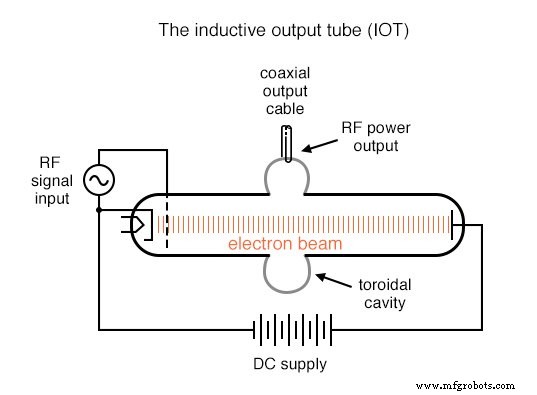
In 1939, a breakthrough came with the cavity resonator—a conductive toroid that surrounds an oscillating electron beam. The resonator’s electric and magnetic fields “echo” the beam’s intensity variations, enabling the tube to extract power without intercepting the electrons. The resulting device, the inductive output tube (IOT), transferred RF energy to a waveguide or coaxial line via a coupling loop, preserving beam integrity while delivering high output power.
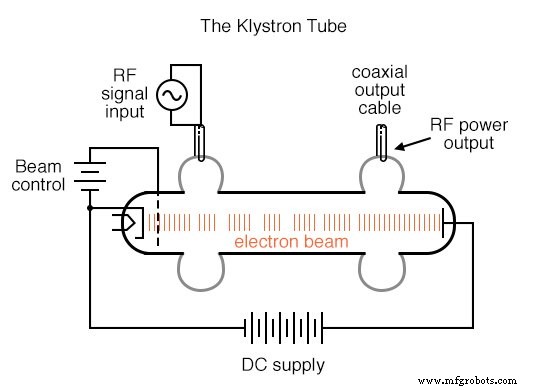
Two pioneers, Sigurd and Russell Varian, expanded on this concept by adding a second cavity resonator that served as inductive grids. These grids alternately bunched and released packets of electrons, creating a velocity‑modulated beam. The same modulation produced amplitude variations in the output resonator, allowing efficient energy extraction. The Varian brothers dubbed this innovation the klystron, a device that would become a cornerstone of high‑power, high‑frequency transmitters.
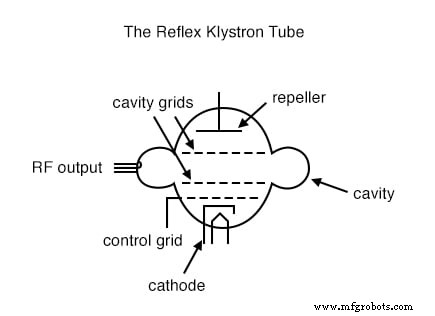
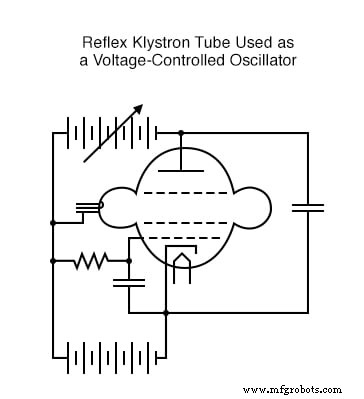
Later, the Varian team introduced the reflex klystron, a single‑cavity tube in which electrons bounce back and forth under the influence of a repeller plate. The resulting self‑sustaining oscillations form a voltage‑controlled oscillator (VCO), whose frequency is tuned by the repeller voltage. Reflex klystrons quickly found use as local oscillators in radar and microwave receivers, offering compactness and precise tuning. While semiconductor VCOs have largely replaced them for low‑power applications, reflex klystrons remain valuable in specialized research and high‑power transmitter chains.
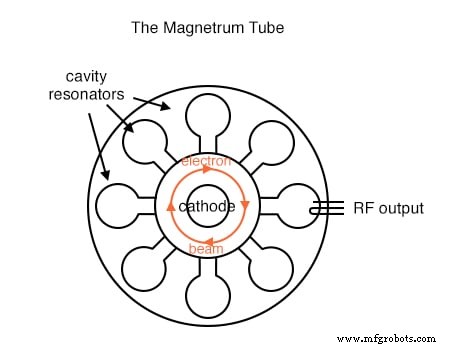
Beyond linear‑beam tubes, the magnetron represents a different class of microwave technology. By steering the electron beam in a circular path with a strong magnetic field, the magnetron utilizes cavity resonators as tank circuits that inductively couple RF power out through a waveguide. This arrangement is the workhorse behind consumer microwave ovens, delivering several hundred watts of RF energy reliably even under frequent on/off cycles. The magnetic field, perpendicular to the electron trajectory, is typically generated by a permanent magnet or electromagnet not shown in the schematic.
In every application—whether as a high‑gain amplifier in satellite links, a frequency‑tunable oscillator in radar, or the humble cooking appliance—microwave tubes demonstrate a unique blend of robustness, high power density, and precise control that continues to complement semiconductor devices.
Industrial Technology
- Titanium Tubes Explained: 9 Types & Their Industrial Applications
- Variable Inductor Lab: Exploring Magnetic Permeability and Inductive Reactance
- Understanding Electron Tubes: Components and Functionality
- A Primer on Vacuum (Electron) Tubes: Foundations of Modern Electronics
- The Triode: A Cornerstone of Vacuum Tube Technology
- Beam Power Tubes: Enhancing Efficiency with Electron Beam Focus
- Pentodes: The Fifth Element for Enhanced Tube Performance
- Combination Tubes: Merging Multiple Functions into a Single Glass Envelope
- Key Performance Parameters of Electron Tubes
- Display Tubes: From CRTs to Cat‑Eye Indicators