



Tubes versus Semiconductors: When Vacuum Tubes Still Outshine Solid‑State Devices
Devoting an entire chapter in a modern electronics textbook to electron‑tube design and function may appear odd, given semiconductor dominance. Yet, beyond historical interest, tubes remain indispensable in niche domains where they outperform any solid‑state device yet invented.
In certain high‑power, high‑speed switching scenarios, specialized tubes—such as hydrogen thyratrons and krytrons—handle far greater currents at faster rates than any contemporary semiconductor. The thermal and temporal limits that constrain semiconductor physics simply do not apply to vacuum tubes, giving them a decisive edge.
High‑power microwave transmitters likewise favor tubes. Vacuum conduction is temperature‑independent, whereas semiconductor carriers suffer severe mobility loss as temperature rises. This allows tubes to operate at temperatures far beyond what a comparable semiconductor device can tolerate, enabling smaller, lighter continuous‑power systems.
Repairability is another advantage. A large tube that fails can often be disassembled and rebuilt for a fraction of the cost of a new unit, whereas a failed semiconductor component is usually irreparable. For example, a 1960s 5 kW AM radio transmitter housed an Eimac power tube that could be rebuilt for only $800—well below the price of a comparable modern solid‑state equivalent.
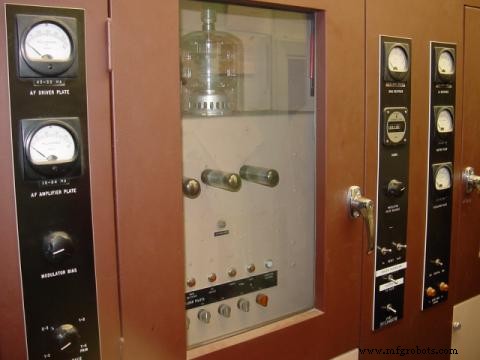
Because tubes are simpler to manufacture—essentially glass, metal, and a vacuum seal—they can be hand‑assembled without the ultra‑clean facilities required for semiconductor fabrication. While mass production of semiconductors drives costs down, the theoretical simplicity of tubes still offers potential savings in low‑volume or specialty applications.
In the professional and high‑end audio amplifier market, tubes enjoy a cultural and technical niche. Guitarists, for instance, prefer tube amps for the warm, musically pleasing distortion they introduce—an effect prized in rock music and other genres. An electric guitar amplifier is intentionally designed to generate distortion, unlike pure‑tone audio‑reproduction gear where minimal distortion is paramount.
Solid State: A component that has been specifically designed to make a guitar amplifier sound bad. Compared to tubes, these devices can have a very long lifespan, which guarantees that your amplifier will retain its thin, lifeless, and buzzy sound for a long time to come.
High‑end audio consumers, however, continue to seek tube amplifiers for their perceived sonic quality. While objective measurements show that both tube and transistor amplifiers introduce distortion when overloaded, audiophiles often find the distortion curves of tube circuits more musically acceptable. The human ear is highly nonlinear, so what is “better” in practice can differ from laboratory metrics.
Tubes also exhibit remarkably stable characteristics across wide temperature ranges. Their behavior depends on physical dimensions—cathode, grid, plate—rather than semiconductor junctions, making them less susceptible to temperature‑induced drift. This stability allows designers to build true class A audio amplifiers that deliver low distortion without the efficiency trade‑offs that plague solid‑state designs.
On the flip side, tubes do age. Vacuum leaks can permanently alter a tube’s performance, limiting its lifespan compared to semiconductors. Yet, with careful maintenance, tubes can achieve extraordinary longevity—consider the klystron that operated for 240,000 hours, as reported by Robert S. Symons in IEEE Spectrum (April 1998).
The ongoing debate between tube and solid‑state enthusiasts has spurred valuable research and innovation in amplifier theory. The versatility of tube configurations—multiple control grids, varied geometries—offers design flexibility that semiconductors can’t match. For these reasons, vacuum tubes will never truly become obsolete; they will continue to serve specialized roles and inspire engineers and hobbyists alike.
Industrial Technology
- Discrete Semiconductor Circuits: Foundations and Practical Applications
- Understanding Electron Tubes: Components and Functionality
- Decimal vs. Binary Numeration: Place‑Weight, Efficiency, and Conversion
- Numbers vs Numeration: Understanding the Distinction and Its Practical Impact
- Active vs. Passive Electronic Components: Understanding Their Roles
- Understanding Electrons, Holes, and Doping in Semiconductors
- Comprehensive Op-Amp Data: National Semiconductor & CA3130 Datasheets
- A Primer on Vacuum (Electron) Tubes: Foundations of Modern Electronics
- Combination Tubes: Merging Multiple Functions into a Single Glass Envelope
- Display Tubes: From CRTs to Cat‑Eye Indicators