



Decimal vs. Binary Numeration: Place‑Weight, Efficiency, and Conversion
Counting from zero to twenty is straightforward in many numeration systems. Below, we illustrate the same sequence using four different styles: hash marks, Roman numerals, decimal, and binary.
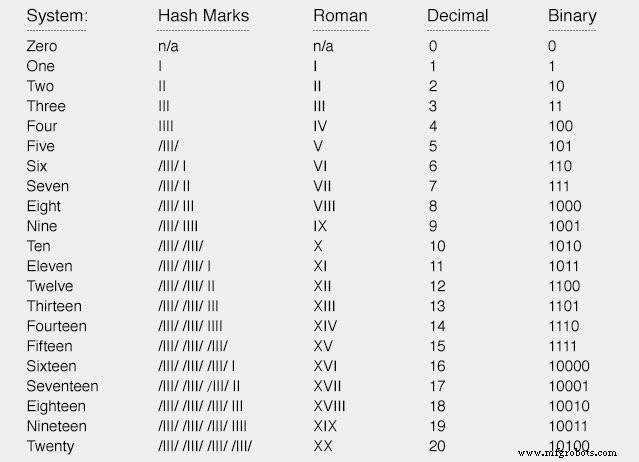
Hash marks and Roman numerals are simple, but they become unwieldy when representing larger values. In contrast, place‑weighted systems—decimal (base‑10) and binary (base‑2)—scale efficiently. Notice that the same quantity requires only two decimal digits, whereas five binary bits are needed.
When evaluating how many distinct numbers a system can express with a fixed number of places, the calculation depends on the base:
- Decimal (base‑10): 5 digits can represent 10⁵ = 100,000 different integers, ranging from 0 to 99,999.
- Binary (base‑2): 8 bits can represent 2⁸ = 256 distinct values, from 0 to 11111111₂ (decimal 255).
Each additional place multiplies the representable range by the system’s base (10 for decimal, 2 for binary). This principle explains why early computers, such as the ENIAC, experimented with decimal ring counters to reduce circuit count. Although innovative, the binary approach proved superior and became the standard for all subsequent digital systems.
Binary to Decimal Conversion
Converting a binary number to decimal involves summing the products of each bit with its place weight:
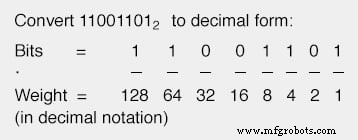
The right‑most bit is the Least Significant Bit (LSB), representing the ones place, while the left‑most bit is the Most Significant Bit (MSB), representing the highest weight (e.g., 128 in an 8‑bit number). A bit value of 1 indicates that its weight is added to the total; 0 means it is omitted.

When a binary number contains a point (.)—a “binary point” analogous to a decimal point—the weights to the right halve with each position (½, ¼, ⅛, …). For example:
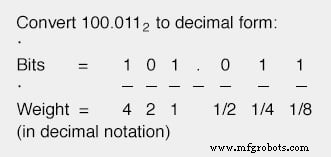

These step‑by‑step illustrations provide a clear method for converting any binary value, integer or fractional, into its decimal counterpart.
RELATED WORKSHEETS:
- Binary Math Worksheet
Industrial Technology
- Understanding Numeration Systems: Roman, Place Value, Binary
- Octal and Hexadecimal Numeration: A Practical Guide for Engineers
- Converting Decimal Numbers to Binary, Octal, and Hexadecimal: A Practical Guide
- Numbers vs Numeration: Understanding the Distinction and Its Practical Impact
- Binary Addition Explained: Rules, Examples, and Its Role in Digital Computers
- Understanding Negative Numbers in Binary: Sign-Magnitude, Complement, and Two’s Complement
- Binary Subtraction Using Two's Complement
- Binary Overflow: How Sign Bits Affect Binary Addition
- Understanding Four‑Bit Binary Counters
- Designing a Binary Half‑Adder: From Logic Gates to Ladder Diagrams