



Understanding Four‑Bit Binary Counters
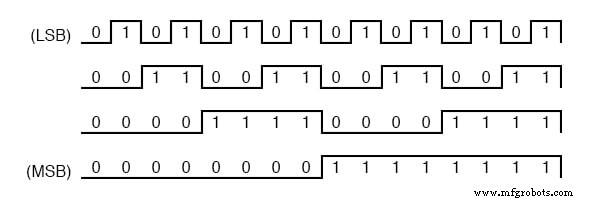
When examining a four‑bit binary count sequence—from 0000 to 1111—a clear pattern emerges in the way each bit oscillates between 0 and 1.
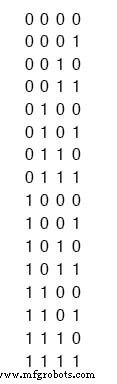
The least significant bit (LSB) toggles every count step, while each higher‑order bit flips at half the frequency of its predecessor. Consequently, the most significant bit (MSB) changes only once, between the transition from 7 (0111) to 8 (1000).
Designing a digital counter that produces this sequence is straightforward: arrange a chain of frequency‑divider circuits, each halving the frequency of the incoming square‑wave pulse. J‑K flip‑flops are ideal for this role, as they can toggle their output when both J and K inputs are high (1) and a clock pulse arrives.
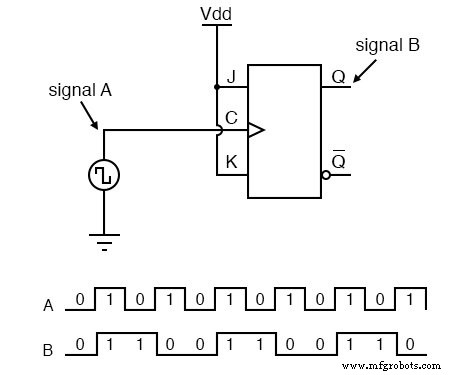
In a typical implementation, signals A and B represent two bits of the binary number, with A as the LSB and B as the MSB. The counter will then produce the sequence 11 → 10 → 01 → 00 → 11—a backward traversal that still satisfies the counting requirement.
Below we delve into several counter designs that leverage the toggle mode of J‑K flip‑flops.
Review
- The oscillation frequency of each bit in a binary counter follows a divide‑by‑two progression from LSB to MSB.
- Binary counters can be implemented with J‑K flip‑flops configured in toggle mode.
Related Worksheets
- Counters Worksheet
Industrial Technology
- Sequences: Understanding Arithmetic and Geometric Progressions
- Decimal vs. Binary Numeration: Place‑Weight, Efficiency, and Conversion
- Binary Addition Explained: Rules, Examples, and Its Role in Digital Computers
- Understanding Negative Numbers in Binary: Sign-Magnitude, Complement, and Two’s Complement
- Binary Subtraction Using Two's Complement
- Binary Overflow: How Sign Bits Affect Binary Addition
- Designing a Binary Half‑Adder: From Logic Gates to Ladder Diagrams
- Practical Applications of Resonance in AC Circuits
- Understanding Filter Circuits: From Audio to Power Conditioning
- Phase Rotation in Three‑Phase Alternators: Mechanics, Detection, and Wire Reversal