



Designing a Binary Half‑Adder: From Logic Gates to Ladder Diagrams
When we need to add two binary digits, the simplest device is a half‑adder. Its logic‑gate implementation is shown below:
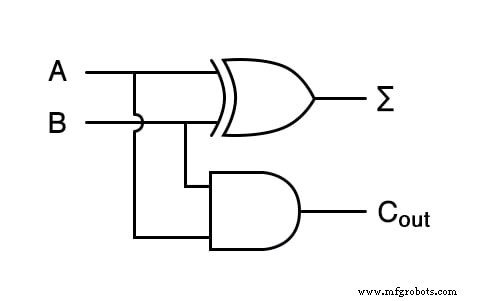
The Σ symbol denotes the “sum” output—the least significant bit (LSB) of the result—while Cout represents the “carry” output, the most significant bit (MSB).
In industrial control systems, the same functionality can be expressed in ladder (relay) logic:
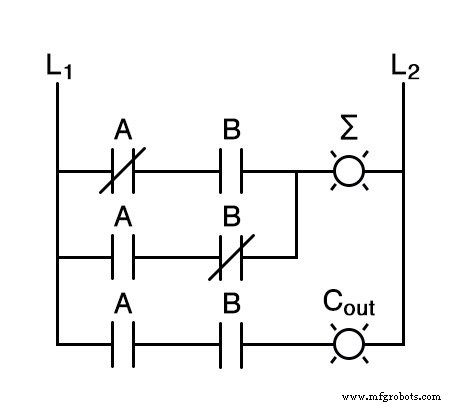
Both diagrams perform the identical binary addition, with the arithmetic rules encoded directly into the circuit’s hard‑wired connections.
Unlike arithmetic operations such as multiplication, which would require a completely different wiring scheme, a half‑adder is dedicated to summing two bits. Re‑configuring it for another function would necessitate rewiring and potentially new components.
Thus, digital arithmetic circuits behave similarly to analog ones: they execute precisely what they are wired for, no more, no less. Yet, this limitation is not inherent to digital design. By storing arithmetic rules as programmable data—using lookup tables or finite‑state machines—we can create devices that perform any calculation on demand, giving rise to the modern programmable computer.
While this article does not cover every possible design, it offers a concise yet insightful look at the core concepts behind programmable devices, starting with often‑overlooked building blocks: lookup‑table memories and finite‑state machines.
RELATED WORKSHEET:
- Binary Math Circuits Worksheet
Industrial Technology
- 3‑Bit Binary Counter with 555 Timer and 4027 Flip‑Flops
- Decimal vs. Binary Numeration: Place‑Weight, Efficiency, and Conversion
- Octal and Hexadecimal Numeration: A Practical Guide for Engineers
- Binary Addition Explained: Rules, Examples, and Its Role in Digital Computers
- Understanding Negative Numbers in Binary: Sign-Magnitude, Complement, and Two’s Complement
- Binary Subtraction Using Two's Complement
- Binary Overflow: How Sign Bits Affect Binary Addition
- Full Adder: Building Efficient Multi‑Bit Binary Adders
- Understanding Four‑Bit Binary Counters
- Binary Switch Game – Arduino UNO Project