



Binary Overflow: How Sign Bits Affect Binary Addition
When working with signed binary numbers, an addition or subtraction can sometimes exceed the magnitude that a fixed number of bits can represent. This phenomenon, known as overflow, occurs because the sign bit’s position is fixed from the start of the calculation.
In the example below we use five bits to encode the magnitude and the left‑most (sixth) bit as the sign bit. With five magnitude bits we can represent 25 = 32 integer values, ranging from 0 up to the maximum magnitude. Consequently, the largest positive number we can represent is +3110 (0111112), and the smallest is –3210 (1000002).
Restrictions of the Six‑Bit Number Field
When we add two binary numbers that both use the same six‑bit field, the result can fall outside the –32 to +31 range. For instance, adding +1710 and +1910 produces a true sum of +3610, which cannot be represented with only five magnitude bits.
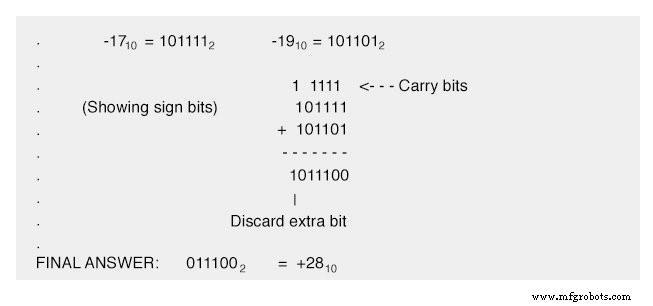
The binary answer, 1001002, is interpreted as –2810 when the sixth bit is treated as –3210. Clearly this is wrong; the overflow error happens because the true sum exceeds the limits of the six‑bit field. Discarding the left‑most “carry” bit yields an incorrect result.
Adding two negative numbers can produce a similar problem. For example, –1710 + –1910 should equal –3610, but with a six‑bit field the binary result is a positive 28, again indicating overflow.
Using the Seventh Bit for a Sign Bit
By expanding the field to seven bits—six for magnitude and one for sign—we can accommodate larger sums. The following diagrams show the same problems resolved when the field is wide enough.
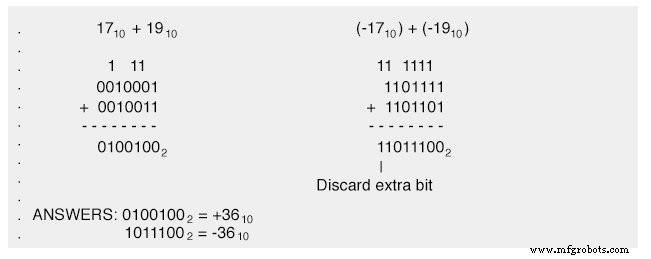
While we can detect overflow by converting the binary result back to decimal, this approach is cumbersome and impractical for electronic circuits. A more efficient method relies on the sign of the sum. If two numbers with the same sign produce a result with the opposite sign, overflow has occurred. Two positive numbers cannot sum to a negative, and two negatives cannot sum to a positive when the field is adequate.
Conversely, adding a positive and a negative number can never overflow. The resulting sum is always closer to zero than either operand, guaranteeing it remains within the representable range.
These overflow detection rules are implemented in digital adders and form a foundational concept in computer arithmetic.
RELATED WORKSHEETS:
- Binary Math Worksheet
Industrial Technology
- 3‑Bit Binary Counter with 555 Timer and 4027 Flip‑Flops
- Decimal vs. Binary Numeration: Place‑Weight, Efficiency, and Conversion
- Octal and Hexadecimal Numeration: A Practical Guide for Engineers
- Binary Addition Explained: Rules, Examples, and Its Role in Digital Computers
- Understanding Negative Numbers in Binary: Sign-Magnitude, Complement, and Two’s Complement
- Binary Subtraction Using Two's Complement
- Understanding Four‑Bit Binary Counters
- Designing a Binary Half‑Adder: From Logic Gates to Ladder Diagrams
- Binary Switch Game – Arduino UNO Project
- Understanding Overflow Pipes: Function, Importance, and Safety Applications