



Mastering Voltmeter Use: Accurate Voltage Measurement Made Simple
PARTS AND MATERIALS
- Multimeter – digital or analog
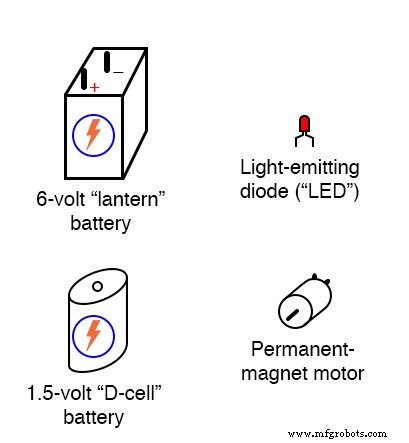
- Assorted batteries
- One LED (Radio Shack catalog #276-026 or equivalent)
- Small hobby motor, permanent‑magnet type (Radio Shack catalog #273-223 or equivalent)
- Two jumper wires with alligator clips (Radio Shack catalog #278‑1156, #278‑1157, or equivalent)
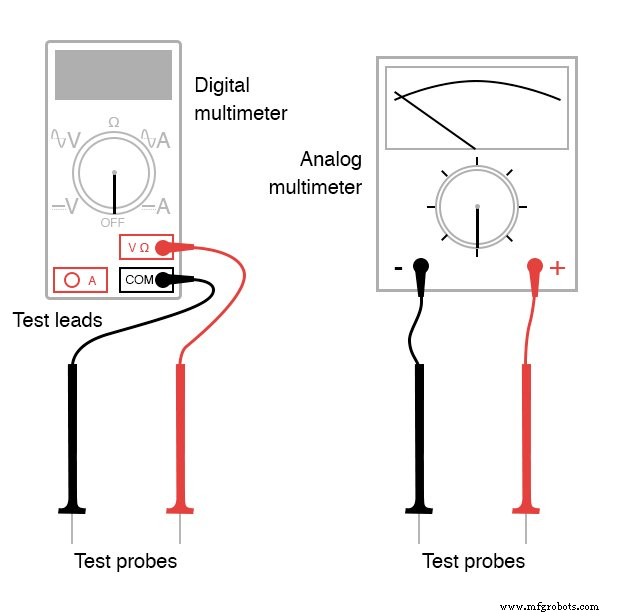
A multimeter is a versatile tool that measures voltage, current, and resistance. Digital models display values numerically, while analog meters use a moving needle over a printed scale. Analog meters are often more affordable and serve as excellent learning instruments for beginners. For a comprehensive toolkit, acquire both analog and digital meters, but start with an analog version.
CROSS-REFERENCES
- Lessons In Electric Circuits, Volume 1, chapter 1: “Basic Concepts of Electricity”
- Lessons In Electric Circuits, Volume 1, chapter 8: “DC Metering Circuits”
LEARNING OBJECTIVES
- Measure voltage accurately
- Understand voltage’s point-to-point nature
- Select the proper meter range
ILLUSTRATION
INSTRUCTIONS
In all experiments, a multimeter is your primary “eye” for detecting and measuring invisible electrical properties. Electricity, especially in low‑current, safe ranges, is imperceptible to the human body, so a reliable meter is essential.
Begin by reading your multimeter’s manual. Digital meters require a small battery; analog models do not. Autoranging meters automatically select the optimal scale, whereas manual‑range meters offer multiple dial positions for each measurement type.
Set the selector switch to the highest available “DC volt” setting (or the sole DC‑volt position on an autoranging unit). Connect the red probe to the battery’s positive terminal and the black probe to the negative terminal. A reading should appear. If the display is negative, reverse the probes.
For manual‑range meters, a high setting may yield a weak indication. Shift the dial to a lower DC‑volt range and reconnect. The reading should strengthen. Select the lowest range that does not cause the meter to “over‑range” (an analog meter’s needle hits the far right; a digital meter may display “OL” or a series of dashes).
Ask yourself: What happens if only one probe touches a battery? How must the meter connect to register voltage? These questions illustrate that voltage exists only between two points and that a voltmeter must bridge a complete circuit to function.
Next, measure multiple battery sizes to practice choosing the correct range for maximum accuracy.
Now set the multimeter to the lowest DC‑volt range and connect the probes to the LED’s leads. An LED emits light when powered by a small electric current and can also generate a small voltage when illuminated, similar to a solar cell. Point the LED toward a bright light source and observe the meter’s reading.
Unlike batteries, which rely on chemical reactions, an LED converts optical energy into electrical energy, producing voltage as long as it receives light.
Finally, test the motor as a simple generator. Connect the meter to the motor’s terminals and spin the shaft by hand. The meter should indicate a voltage that increases with rotational speed. If maintaining contact is difficult, use alligator‑clip jumper wires (see image). Reverse the rotation and note the polarity change: the meter will display a reversed sign or a needle deflection in the opposite direction.
RELATED WORKSHEETS:
- Basic Voltmeter Use
Industrial Technology
- Exploring Voltage Addition with Series Battery Connections
- Voltage Divider Lab: Design, Measurement, and Kirchhoff’s Voltage Law Verification
- Thermoelectricity: Understanding Thermocouples and the Seebeck Effect
- Potentiometric Voltmeter: Precise Voltage Measurement with Minimal Loading
- Binary Signals and Logic Gates: Foundations of Digital Electronics
- Safe Meter Usage: A Professional Guide for Electronics Technicians
- Tachogenerators: Precision Speed Measurement for Industrial Motors and Equipment
- Understanding AC Waveforms: Sine Waves, Frequency, and Oscilloscope Basics
- Accurate Voltage Measurement with Digital and Analog Multimeters – A Step-by-Step Guide
- Voltmeter IC: Precision Voltage Measurement Made Simple