



Understanding Negative Numbers in Binary: Sign-Magnitude, Complement, and Two’s Complement
Subtraction can be transformed into addition by treating the subtrahend as a negative value; for example, 7 − 5 becomes 7 + (−5).
Once positive binary representation is mastered, the next step is to encode negative numbers so that subtraction can be performed using the same addition routine.
In decimal, a minus sign prefixes the most significant digit (e.g., −5). In binary hardware, we have only two states—high or low—so we must encode the sign within the bit pattern itself.
In this context, we don’t have a third symbol such as a “minus” sign. One solution is to reserve a bit that represents the mathematical sign:
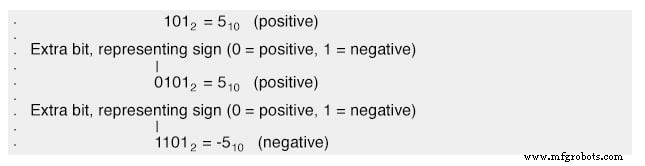
Using bits for purposes beyond their positional weight can lead to confusion; for instance, 1101₂ might be read as thirteen unless the leading bit is treated as a sign.
First, decide the total bit width required to accommodate the largest magnitude, then ensure all operations stay within that width.
In the example below, we constrain the range to −7 (1111₂) through +7 (0111₂) by treating the most significant bit as the sign, thereby preventing misinterpretation.
Encoding −5 as 1101₂ illustrates the sign‑magnitude system, where the leading bit denotes sign rather than value, trading positional purity for practicality.
The most significant bit indicates sign; the remaining bits retain standard positional values (powers of two).
Complementation
While sign‑magnitude is conceptually straightforward, it complicates binary addition. How does one add −5 (1101₂) to another number using ordinary addition?
Creating a custom addition algorithm defeats the purpose; it would be equivalent to longhand subtraction, negating any computational benefit.
An alternative—complementation—allows negative numbers to be added using the standard binary addition method and aligns naturally with positional weights.
In this scheme, the most significant bit still demarcates the range but now carries a negative place weight (e.g., −8). For example, −5 is encoded as follows:

With the three right‑hand bits able to represent magnitudes from 0 to 7, and the leftmost bit representing either 0 or −8, we can represent any integer from −7 (1001₂ = −8 + 1 = −7) to +7 (0111₂ = 0 + 7 = 7).
Positive values remain unchanged, but negative values require the complement operation.
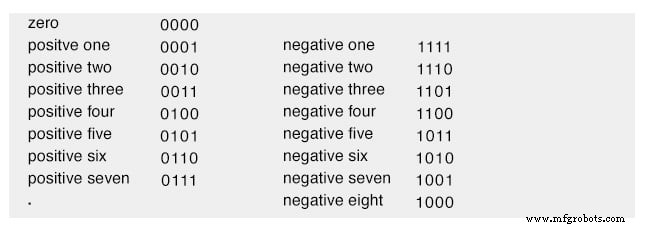
Negative binary numbers in the right column are the sum of the right three bits plus the negative eight of the leftmost bit, so they do not follow the same progression as the positive numbers.
Instead, the right three bits must be set so that, when added to the negative‑eight place value, they yield the desired negative total.
Two’s Complement
The three right‑hand bits are the two’s complement of the positive counterpart. For instance:

With the negative‑weight bit as the fourth bit (−8), the two’s complement for any positive number is the value needed to add to −8 to obtain that number’s negative equivalent.
Calculating a two’s complement is simple: invert all bits (the one’s complement) and add one. For example, to obtain the two’s complement of five (101₂), first invert to 010₂, then add one to get 011₂, which represents −5 in three‑bit two’s complement.
Generating the two’s complement works the same if you manipulate all bits, including the most significant bit, at once. For example, converting 0101₂ (five) to negative five:
Invert all bits → 1010₂; add one → 1011₂, representing −5 in four‑bit two’s complement.
It is crucial that the negative‑weight bit’s position be fixed before performing any two’s complement conversions. If the eighth bit were the negative‑weight bit (10000000₂), the two’s complement of 0000101₂ would be 1111011₂, representing −5 in eight‑bit two’s complement.
Thus, in an eight‑bit system, +5 is 00000101₂ and −5 is 11111011₂.
RELATED WORKSHEETS:
- Binary Math Worksheet
Industrial Technology
- Decoding Numbers and Symbols in Electronics
- Decimal vs. Binary Numeration: Place‑Weight, Efficiency, and Conversion
- Numbers vs Numeration: Understanding the Distinction and Its Practical Impact
- Binary Addition Explained: Rules, Examples, and Its Role in Digital Computers
- Binary Subtraction Using Two's Complement
- Binary Overflow: How Sign Bits Affect Binary Addition
- Understanding Four‑Bit Binary Counters
- Designing a Binary Half‑Adder: From Logic Gates to Ladder Diagrams
- Understanding Negative Feedback in Op‑Amps: Voltage Followers and Stability
- MATLAB – Numbers: Types, Storage, and Conversion