



Sequences: Understanding Arithmetic and Geometric Progressions
Arithmetic Sequences
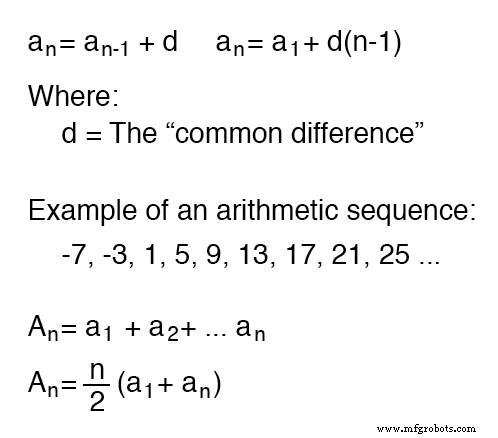
An arithmetic sequence is a list of numbers where each term differs from the previous by a fixed amount, called the common difference. A child’s simple counting (1, 2, 3, 4, …) is a classic example with a common difference of 1. If we restrict ourselves to even numbers (2, 4, 6, 8, …) or odd numbers (1, 3, 5, 7, …), the common difference becomes 2.
In sequence notation, the lowercase letter a denotes an individual term. The index subscript n, as in an, indicates the term’s position in the sequence. For instance, in an even‑number sequence that starts at 2, a3 equals 6, a2 equals 4, and a1 marks the initial term, which is 2.
A capital A represents the cumulative sum of the sequence up to a given term. For example, in the same even‑number sequence, A4 equals 2 + 4 + 6 + 8 = 20.
Geometric Sequences
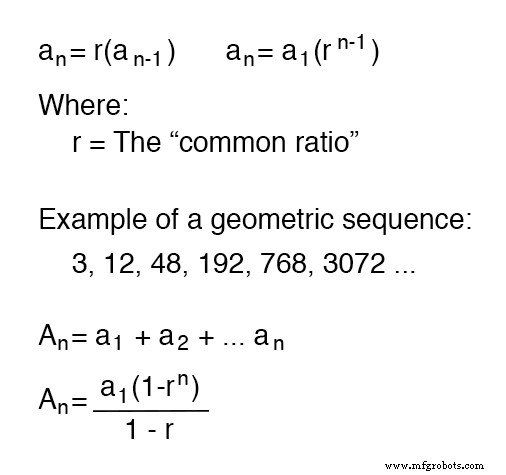
A geometric sequence is built by multiplying (or dividing) each term by a constant, called the common ratio. A binary place‑weight sequence (1, 2, 4, 8, 16, 32, 64, …) illustrates a common ratio of 2.
Industrial Technology
- Sequences: Understanding Arithmetic and Geometric Progressions
- Understanding Normal Positions and Contact Sequences in Process Switches
- Understanding Four‑Bit Binary Counters
- Phase Rotation in Three‑Phase Alternators: Mechanics, Detection, and Wire Reversal
- Understanding Harmonic Phase Sequences in Three-Phase Power Systems
- Verilog Sequence Detector: Build a Reliable FSM for Pattern Recognition
- Create Stunning Light Sequences with Arduino Shift Register
- Smart Equipment Care: Predictive Maintenance Strategies & Timelines
- TT6 Turn-Mill Center: Twin Tool Sequences for Peak Productivity
- Optimizing CNC Machining: Process Division & Sequencing for Precision