



Practical Applications of Resonance in AC Circuits
Resonance is far more than a laboratory curiosity; it is a powerful tool in AC circuit design. While some practitioners once viewed resonance merely as a nuisance—especially when series resonance creates a short‑circuit across an AC voltage source—modern engineers harness its unique properties for real‑world applications.
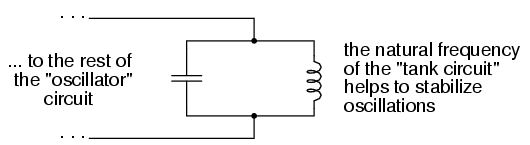
One of the most valuable uses of resonance is establishing a stable frequency in oscillators. A parallel (tank) circuit, consisting of a capacitor and an inductor connected directly together, exchanges energy back and forth. The resonant frequency depends solely on the values of L and C, independent of the signal amplitude. This is analogous to a pendulum keeping a clock’s swings perfectly timed. In electrical terms, the tank circuit locks an oscillator’s output to a precise frequency, ensuring reliable signal generation.
Resonance also plays a critical role in impedance control. By tuning a circuit to a particular frequency, the impedance can rise dramatically—effectively “blocking” that frequency—or fall to near zero, allowing it to pass. These frequency‑selective structures are the foundation of electronic filters. Designing filters is an entire discipline, focused on shaping signal spectra by exploiting resonant impedance peaks and valleys.
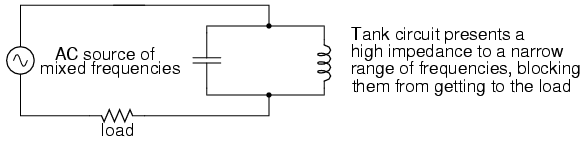
In practice, the principle is employed in analog radio receivers: the tuner circuit isolates a single station’s frequency from a crowded spectrum. By matching the resonant frequency to the desired station, the tuner suppresses all other signals, delivering a clean audio output.
Key Takeaways
- Resonant tank circuits stabilize oscillator frequency, much like a pendulum maintains a clock’s rhythm.
- Resonant circuits can dramatically alter impedance at targeted frequencies, forming the basis of filters that isolate or block specific signal components.
Related Worksheets
- Fundamentals of Radio Communication Worksheet
Industrial Technology
- Mastering AC Circuit Equations: Impedance, Reactance & Resonance
- Parallel Tank Circuit Resonance: Theory, Calculations, and SPICE Verification
- Impact of Resistance on Resonance in Series‑Parallel LC Circuits
- Piezoelectric Sensors: How They Work, Key Specs, and Arduino Integration
- Enhancing Wireless Antenna Design with Long Printed Circuit Boards
- Miniature Circuit Breakers (MCBs): Construction, Operation, Types & Applications
- Mastering the Clapp Oscillator: Design, Frequency Control, and Practical Applications
- CD4049 CMOS Hex Inverter IC: Features, Applications & Circuit Diagram – Your Ultimate Guide
- Beat Frequency Oscillator: Principles, Design, and Applications
- Essential PCB Components & Their Applications: How They Drive Modern Electronics