



Monostable Multivibrators (One‑Shots): Design, Timing, and Industrial Applications
We’ve already encountered a monostable multivibrator in practice: the pulse detector inside a flip‑flop that momentarily powers the latch during a clock edge.
A pulse detector is classified as a monostable multivibrator because it has only one stable output state. In this state the device holds its output indefinitely without external intervention.
By contrast, a bistable device such as a latch or flip‑flop can hold either a “set” or a “reset” state for an arbitrary length of time. Once set or reset, it remains in that state until an external signal forces a change.
A monostable device can only maintain one particular state indefinitely; its other state can be held only briefly when triggered externally.
A common mechanical analogy is a momentary‑contact push‑button that springs back to its normal position once the force is released. A standard wall toggle switch, on the other hand, is bistable because it latches in either an on or off position.
All monostable multivibrators are timed devices. Their unstable output state lasts for a predetermined minimum duration before the circuit automatically returns to the stable state.
In semiconductor monostable circuits, the timing is achieved using resistors and capacitors that exploit the exponential charge and discharge characteristics of RC networks. A comparator typically measures the capacitor voltage against a reference level, and its logic output determines the high or low state.
In ladder logic, time delays are implemented with time‑delay relays. These can be built with RC circuitry as described above or with mechanical delay devices that slow the relay armature’s motion.
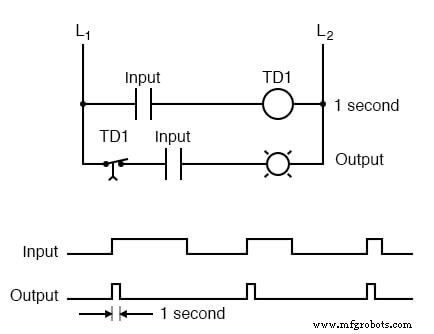
Below is the ladder‑logic representation of a basic pulse detector. Regardless of how long the input remains high, the output stays high for exactly one second before returning to the stable low state.
In many applications, you need a monostable that produces a longer pulse than the triggering input. The following ladder logic circuit demonstrates a 10‑second output that starts when the input contacts close and persists 10 seconds after the input opens.
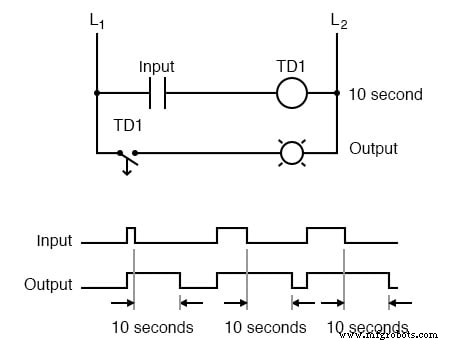
This configuration is known as a one‑shot. When the input pulse ends, the timer begins, and any subsequent pulses within that 10‑second window simply reset the timer, keeping the output high—a characteristic of a retriggerable one‑shot.
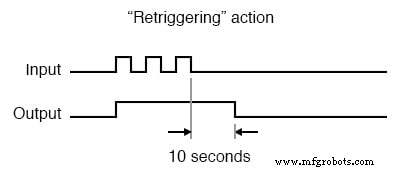
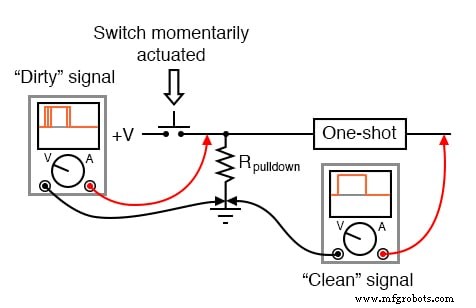
A retriggerable one‑shot is particularly useful for debouncing a single mechanical contact. The output remains high despite the rapid on/off bouncing of the input. In a practical debouncer, the timing would typically be a few milliseconds rather than 10 seconds.
What if you want a 10‑second pulse regardless of how many input pulses occur? In that case, you couple a pulse detector to a non‑retriggerable one‑shot, as illustrated below.
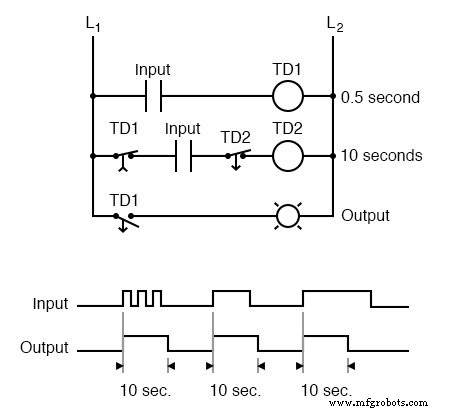
The first time‑delay relay (TD1) energizes the second relay coil (TD2) for at least 0.5 s whenever the input activates. As soon as TD2 energizes, its normally‑closed, timed‑closed contact prevents any further energization of the coil for the full 10‑second period, making the circuit non‑retriggerable.
Both retriggerable and non‑retriggerable one‑shots are widely used in industry—for example, in siren actuation, machine sequencing, and any application where an intermittent input must generate a fixed‑length output pulse.
Review
- A monostable multivibrator has only one stable output state; the alternate state can be held only temporarily.
- One‑shots come in two forms: retriggerable and non‑retriggerable.
- Short‑duration one‑shots are ideal for debouncing mechanical switches.
Related Worksheets
- Timer Circuit – Monostable Multivibrator Worksheet
Industrial Technology
- Non‑Inverting Amplifier: Build, Test, and Master Op‑Amp Gain Control
- Using the 4511 7‑Segment Decoder: A Practical BCD Display Tutorial
- Building a 555 Monostable Multivibrator: Step‑by‑Step Guide
- Mastering Time Constant Calculations for RC and RL Circuits
- Understanding Multiple-Input Logic Gates: Functions, Truth Tables, and Practical Applications
- Mastering the D Latch: A Clean 1‑Bit Memory Circuit
- Understanding the J‑K Flip‑Flop: Design, Logic, and Applications
- Calculating Time to Reach a Target Voltage in RC and RL Circuits
- The Hourglass: History, Craftsmanship, and Modern Appeal
- The Evolution of Timekeeping: From Sundials to Precision Quartz Watches