



Beam Power Tubes: Enhancing Efficiency with Electron Beam Focus
Beam power tubes build upon the classic tetrode architecture by integrating a pair of auxiliary plates and a meticulously arranged grid‑screen system. The result is a focused electron beam—or “sheet”—that travels from cathode to plate with exceptional precision.
Inside the tube, the electrons form a stationary space‑charge cloud between the screen grid and the plate. This cloud repels secondary electrons that the plate emits back onto the plate, effectively raising the overall plate current while keeping the screen current low. Engineers achieve this by aligning each turn of the screen wire directly behind a turn of the grid wire, placing the screen in the grid’s shadow. This alignment preserves the screen’s shielding role with minimal disruption to the electron flow.
To maintain optimal beam focus, a set of beam‑forming plates—each electrically tied to the cathode—is added. These plates help shape the electron trajectory and stabilize the beam, ensuring consistent performance.
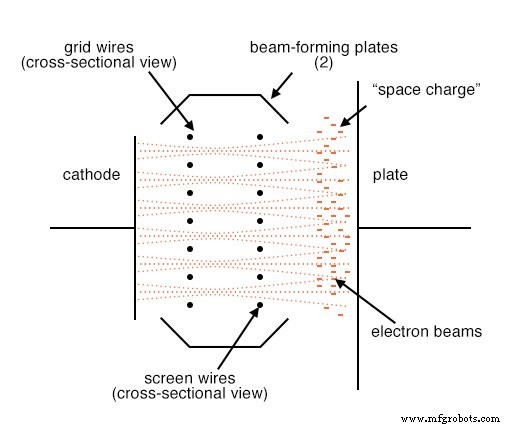
Compared with conventional tetrodes, beam power tubes deliver higher plate current for the same screen current, achieving greater efficiency without significant extra manufacturing cost.
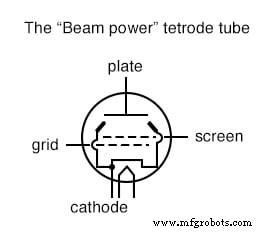
In schematics, beam power tetrodes are often distinguished by a unique symbol that includes the beam‑forming plates, highlighting their specialized construction.
Industrial Technology
- Understanding AC Circuits: A Beginner's Guide
- Power Sources: AC and DC Explained
- Protective Relays: Safeguarding Industrial Power Systems
- Amplifiers: Harnessing Active Devices to Boost Power
- Understanding Bels and Decibels: From Power Gain to Voltage Conversion
- Rectifier Circuits: From Half‑Wave to Polyphase Full‑Wave Designs
- The Tetrode Tube: Design, Function, and Impact on Amplifier Performance
- Key Performance Parameters of Electron Tubes
- Microwave Tube Technology: From Klystrons to Magnetrons
- Calculating Power Dissipation in Resistive Circuits