



Differentiating Exponential Functions of Base e
Example Derivatives of e
Proportionality Constant
When we say that a relationship or phenomenon is “exponential,” we mean that the rate of change of a quantity grows proportionally with the quantity itself. Consequently, the derivative of an exponential function equals the original function multiplied by a constant (k) that represents this proportionality.
$$\frac{\text{d}}{\text{d}x}a^x = k a^x$$
The proportionality constant is simply the natural logarithm of the base:
$$\frac{\text{d}}{\text{d}x}a^x = \ln(a)\times a^x$$
When the base is the natural number e, ln(e) = 1, so the derivative of e^x is e^x itself:
$$\frac{\text{d}}{\text{d}x}e^x = e^x$$
The “Chain” Rule
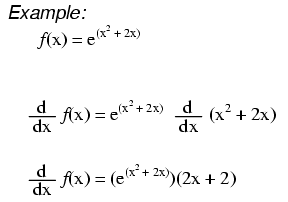
If the exponent is a more complex expression, we apply the chain rule: differentiate the outer exponential and multiply by the derivative of the inner function.
$$\frac{\text{d}}{\text{d}x}e^{x^2+2x} = e^{x^2+2x}\times\frac{\text{d}}{\text{d}x}(x^2+2x) = (2x+2)e^{x^2+2x}$$
This technique is useful for evaluating the sensitivity of diode current to voltage. The Shockley diode equation gives an approximate relation between the voltage across a diode (V_D) and the current through it (I_D):
$$I_D = I_S \times e^{\frac{V_D}{0.026}}$$
(Refer to the “Diodes and Rectifiers” page for a deeper dive; note that I_S is a constant, not a variable.) To find how current changes with voltage, differentiate:
$$\frac{\text{d}I_D}{\text{d}V_D} = \frac{\text{d}}{\text{d}V_D}\bigl(I_S \times e^{\frac{V_D}{0.026}}\bigr) = I_S \times e^{\frac{V_D}{0.026}} \times \frac{1}{0.026}$$
Thus, at a specific V_D, an infinitesimal increase in voltage increases current by (I_S/0.026) e^{V_D/0.026}.
RELATED WORKSHEETS:
- Calculus for Electric Circuits Worksheet
Industrial Technology
- Hands‑On Guide to Current Dividers: Build, Measure, and Simulate with a 6 V Battery
- Essential Derivative Rules: A Quick Reference
- Finding Antiderivatives of Exponential Power Functions
- Power Sources: AC and DC Explained
- Calculating Electrical Power: Voltage, Current, and Resistance Explained
- Practical Considerations in Transformer Design: Power, Losses, and Performance
- Mastering Current, Power, and Torque in Variable Speed Drives
- Advanced Harmonics Management: Part 2 – Effective Strategies & Measurements
- Regenerative Drives Explained: Key Principles & Regulatory Considerations – Part 2
- Understanding Wattmeters: Types, Functions, and How They Measure Electrical Power