



Calculating Electrical Power: Voltage, Current, and Resistance Explained
Learn the Power Formula
In electrical engineering, power (P) is calculated by multiplying voltage (V) by current (I). The result is expressed in watts (W). Let’s apply this to a simple circuit example.
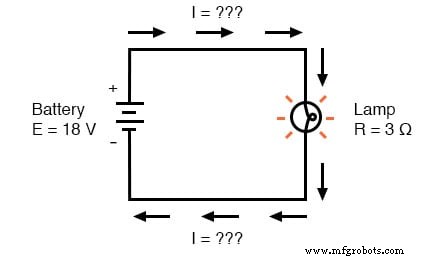
Using Ohm’s Law to Determine Current
For the circuit above, we have an 18‑volt battery and a lamp with a resistance of 3 Ω. Applying Ohm’s Law (I = V / R) gives:
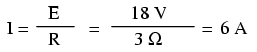
Once the current is known, we multiply it by the voltage to find power:

This calculation shows the lamp dissipates 108 W, primarily as light and heat.
Increasing the Battery’s Voltage
What happens if we double the battery voltage to 36 V while keeping the lamp’s resistance unchanged? Intuitively, the current and power should rise. Here’s the step‑by‑step breakdown:
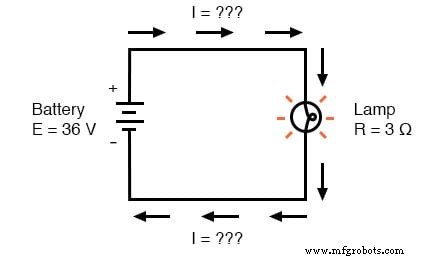
With a 36‑V supply and 3 Ω resistance, the current becomes:

The current indeed doubles from 6 A to 12 A. The resulting power is calculated as follows:

Effect of Voltage on Power
Power increases more than proportionally when voltage rises. Since power equals V × I, doubling both voltage and current multiplies power by 4 (2 × 2). Checking the numbers: 432 W ÷ 108 W = 4, confirming the relationship.
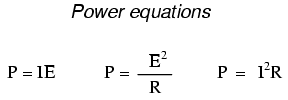
When only voltage and resistance are known, power can be expressed as P = V² / R. Conversely, with current and resistance, P = I² R.
Joule’s Law vs. Ohm’s Law
James Prescott Joule first derived the power‑dissipation relationship in 1841, now known as Joule’s Law (P = I²R). Though often associated with Ohm’s Law equations (E = IR, I = E/R, R = E/I), the power formulas are historically credited to Joule.
Review:
- Power is measured in watts (W).
- Joule’s Law: P = I²R, P = IE, P = V²/R.
Related Worksheets:
- Power Worksheet
Try our Ohm’s Law Calculator in the Tools section.
Industrial Technology
- Differentiating Exponential Functions of Base e
- Understanding Power in Electric Circuits: Measurement & Significance
- Understanding the Physiological Impact of Electrical Shock
- Electric Pendulum: How Capacitors and Inductors Exchange Energy
- Practical Considerations in Transformer Design: Power, Losses, and Performance
- Calculating Power Factor in AC Circuits: Theory, Impact, and Practical Correction
- Mastering Current, Power, and Torque in Variable Speed Drives
- Advanced Harmonics Management: Part 2 – Effective Strategies & Measurements
- Electric Power Transmission: From Plants to Consumers—Efficient Delivery Systems
- Understanding Wattmeters: Types, Functions, and How They Measure Electrical Power