



Insulated‑Gate Bipolar Transistors (IGBTs): Merging FET Precision with BJT Power
Insulated‑gate field‑effect transistors (IGFETs) achieve virtually infinite current gain because their gate is isolated from the channel. No continuous gate current is drawn; only a brief transient is needed to charge the gate‑channel capacitance and shift the depletion region as the device switches between the on and off states.
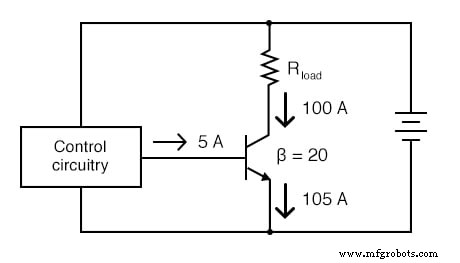
At first glance, this high gain seems to give IGFETs a clear edge over bipolar junction transistors (BJTs) when controlling very large currents. With a BJT, the collector current is tied to the base current by the transistor’s β (current‑gain) factor. For example, a power BJT with a β of 20 must provide at least 5 A of base current to drive a 100 A collector current – a substantial control current for even miniature discrete or integrated circuits.
Transistor with Control Circuitry
Using a Darlington pair can boost the gain, but the required base current remains higher than that needed for an equivalent IGFET. The added complexity and current draw make this solution less attractive for high‑power applications.
Darlington Pair Example
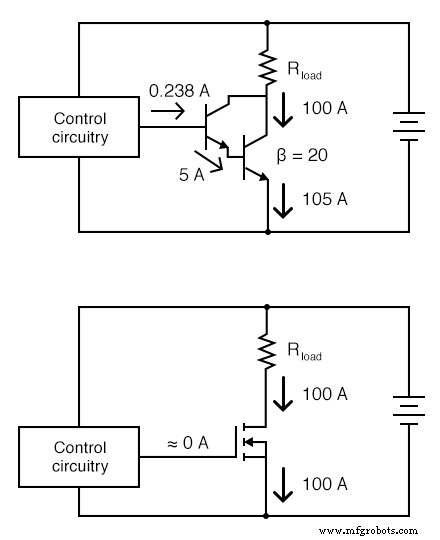
IGFETs also suffer from a larger drain‑to‑source voltage drop when fully saturated compared to the collector‑to‑emitter drop of a BJT. That extra voltage drop translates into higher power dissipation for the same load current, limiting the practicality of IGFETs as high‑power devices. Although specialized structures such as VMOS transistors have been engineered to reduce this disadvantage, BJTs still lead when switching very high currents.
Enter the Insulated‑Gate Bipolar Transistor (IGBT). Also known as a bipolar‑mode MOSFET, a conductivity‑modulated field‑effect transistor (COMFET), or simply an insulated‑gate transistor (IGT), an IGBT essentially combines the high‑gain, gate‑controlled logic of an IGFET with the low‑voltage‑drop, high‑current‑handling ability of a BJT.
Schematic Symbol and Equivalent Circuit
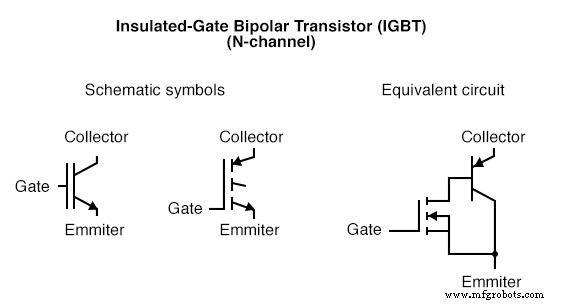
In this architecture, the IGFET drives the base of a BJT. The gate draws virtually no current from the control circuitry, while the BJT delivers the main load current between collector and emitter. The result is an extremely high overall current gain coupled with a collector‑to‑emitter voltage drop that matches that of a conventional BJT.
However, IGBTs are not without trade‑offs. Their turn‑off time is typically slower than that of a standard BJT, which can be critical in fast‑switching applications. Achieving faster turn‑off often comes at the expense of a higher saturated voltage drop between collector and emitter. Nevertheless, for many high‑power control tasks, the IGBT’s blend of low voltage drop and high current gain offers a compelling alternative to both IGFETs and BJTs.
RELATED WORKSHEET:
- Insulated Gate Bipolar Transistors Worksheet
Industrial Technology
- Hands‑On Guide to Current Dividers: Build, Measure, and Simulate with a 6 V Battery
- Using a Transistor as an Electrically Controlled Switch
- Sensitive Static‑Electricity Detector Using a JFET Switch
- Bipolar Junction Transistors (BJT): Core Principles and Practical Applications
- BJT Switching: How Transistors Efficiently Control High‑Current Loads
- Precision Transistor Biasing: Calculating Resistors for Stable Amplifier Performance
- Common-Emitter Amplifier Limitations: Distortion, Temperature, and High‑Frequency Challenges
- Understanding the Shockley Diode: A Comprehensive Guide to PNPN Thyristors
- Understanding Six Primary Leakage Mechanisms in MOS Transistors
- Advanced Method Detects Transistor Defects with Unprecedented Sensitivity