



Resistors: Fundamentals, Types, and Practical Applications
In any electrical circuit, voltage, current, and resistance interact predictably, allowing precise control of one variable by adjusting the others. Among these, resistance is the simplest to manipulate by altering material, size, or shape—think of how a lamp’s thin filament offers more resistance than a thick wire.
What Is a Resistor?
Resistors are dedicated components engineered to provide an exact amount of electrical resistance. Constructed from metal wire, carbon, or other conductive materials, they maintain stable resistance across a wide range of temperatures and humidity levels. While they do not emit light like incandescent bulbs, resistors dissipate energy as heat; however, their primary role is to regulate current flow, not to generate usable heat.
Resistor Symbols and Values
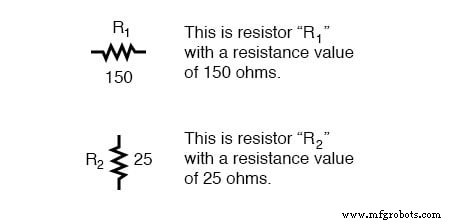
The most common schematic symbol is a zig‑zag line, often accompanied by the resistance value in ohms and a unique identifier (e.g., R1, R2, R3). Symbols can appear horizontally or vertically, and a rectangular box is an alternative representation that more closely resembles the physical component.

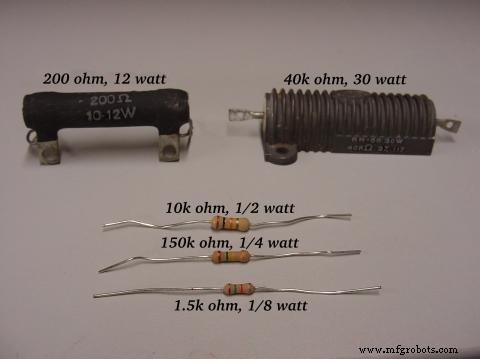
Physical resistors are small tubes or cylinders with two leads for circuit connection. Images of various resistor sizes illustrate the diversity of standard parts.
A rectangular schematic symbol better reflects the component’s shape:

Variable resistors are shown with a diagonal arrow modifier, indicating a changing resistance value. This convention signals that the component can be adjusted, such as in potentiometers or rheostats.
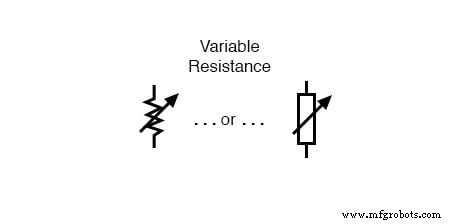
Variable Resistors
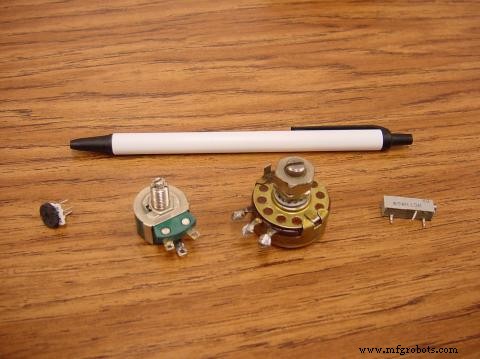
Adjustable resistors incorporate a mechanical element—typically a rotating shaft or lever—to vary resistance. Potentiometers, a common type, serve both as voltage dividers and variable resistors.
Power Rating of Resistors
Resistors dissipate heat proportional to the power they consume. Power ratings, expressed in watts, indicate the maximum safe dissipation before overheating. Small resistors in portable electronics usually carry a 0.25‑W rating or less. The power rating scales roughly with physical size; larger resistors can handle more power, but resistance values themselves are independent of size.
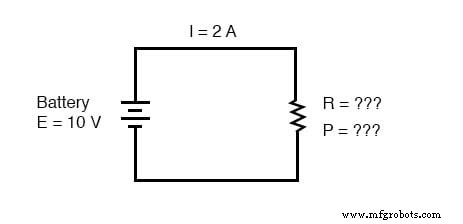
Understanding these ratings is critical when designing circuits: for example, a 5‑Ω resistor operating under 10 V and 2 A must be rated for at least 20 W, otherwise it will fail.
Resistors in Real Circuits
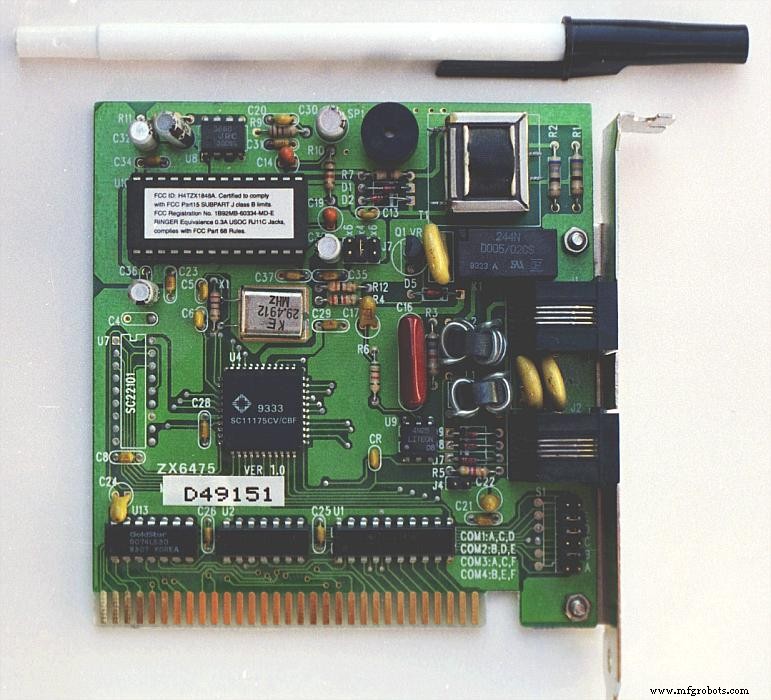
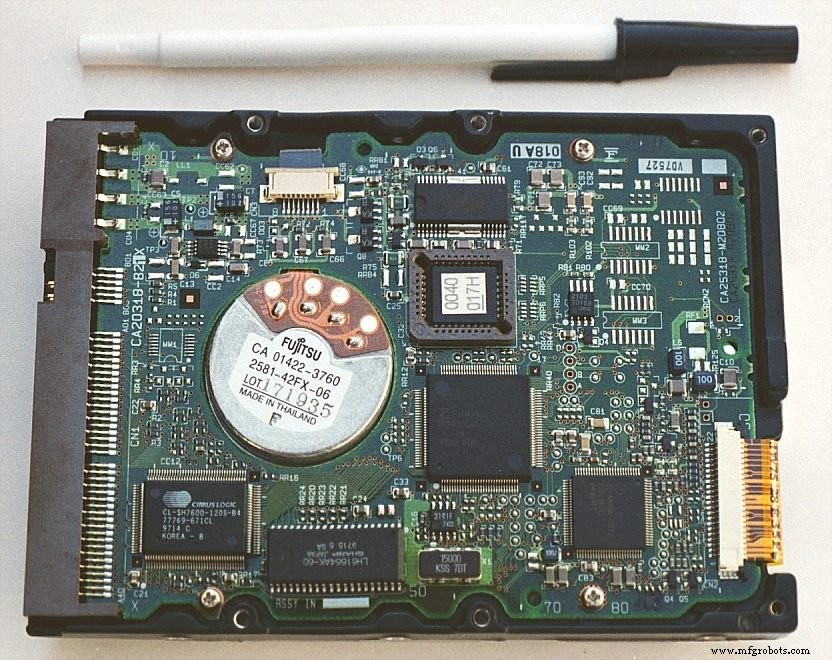
On printed circuit boards (PCBs), resistors are identified by labels beginning with “R.” Below is a modem PCB showing several ¼‑W resistors. Integrated circuits (ICs) contain internal resistor networks, while surface‑mount technology packs hundreds of tiny resistors on a hard‑disk drive board.
Load Symbols in Schematics
In schematic diagrams, a resistor symbol may represent a generic load—a device that consumes electrical energy for a useful purpose. When a schematic uses a resistor symbol labeled “load,” it’s a shorthand for a non‑specific device rather than an actual resistor.
Analyzing a Simple Resistor Circuit
Consider a circuit with a 10‑V supply and 2‑A current. Applying Ohm’s Law: \[ R = \frac{V}{I} \] and \[ P = V \times I \], we find the resistor value is 5 Ω and the power dissipation is 20 W.
Resistor Materials and Types
Different materials offer distinct performance characteristics. Engineers commonly use the following types:
Wirewound Resistors (WW)
Coiled resistance wire around a non‑conductive core, typically ceramic or fiberglass. Ideal for high‑precision, high‑power applications up to 50 kHz. Accuracy ranges from 0.1 % to 20 %.
Metal‑Film Resistors
Made with nickel‑chromium or tantalum nitride films on a ceramic substrate. Offer better high‑frequency performance than carbon film, though slightly less temperature‑stable.
Metal‑Oxide Film Resistors
Utilize metal oxides such as tin oxide, delivering reliable performance at elevated temperatures and high endurance.
Foil Resistors
Feature a thin metal foil on a ceramic substrate, providing exceptionally low temperature coefficients and high precision for demanding applications.
Carbon Composition (CCR) Resistors
Historically common; consist of fine carbon particles mixed with ceramic. Tolerances typically no better than 5 % but can withstand high‑energy pulses.
Carbon‑Film Resistors
Employ a thin carbon film cut into a spiral on an insulating core, offering greater accuracy than CCR and suitable for pulse‑stable applications.
Key Performance Indicators (KPIs)
| Characteristic | Metal Film | Thick Metal Film | Precision Metal Film | Carbon Composition | Carbon Film |
|---|---|---|---|---|---|
| Temperature range (°C) | -55+125 | -55+130 | -55+155 | -40+105 | -55+155 |
| Max. temp. coeff. | 100 | 100 | 15 | 1200 | 250‑1000 |
| Vmax (V) | 200‑350 | 250 | 200 | 350‑500 | 350‑500 |
| Noise (µV per V) | 0.5 | 0.1 | 0.1 | 4 (100 k) | 5 (100 k) |
| Insulation resistance (Ω) | 10 000 | 10 000 | 10 000 | 10 000 | 10 000 |
| Solder (ΔR %) | 0.20 % | 0.15 % | 0.02 % | 2 % | 0.50 % |
| Damp heat (ΔR %) | 0.50 % | 1 % | 0.50 % | 15 % | 3.50 % |
| Shelf life (ΔR %) | 0.10 % | 0.10 % | 0.00 % | 5 % | 2 % |
| Full rating (2000 h at 70 °C) (ΔR %) | 1 % | 1 % | 0.03 % | 10 % | 4 % |
Takeaway
- Resistors provide precise, predictable resistance and are rated by resistance (Ω) and power (W).
- Physical size predicts power rating, not resistance value.
- In schematics, a resistor symbol can denote any generic load; context matters.
Additional Resources
Industrial Technology
- Exploring Nonlinear Resistance in Incandescent Lamps: A Practical Lab Guide
- Resistor Types Explained: From Potentiometers to Thermistors
- Understanding Electrical Resistance and Circuit Safety
- Understanding Conductance: The Inverse of Resistance
- Bridge Circuits: Wheatstone, Kelvin, and Their Role in Precise Electrical Measurements
- Battery Construction Fundamentals: Cells, Internal Resistance, and Connectivity
- Calculating Wire Resistance for Voltage‑Drop‑Critical Circuits
- Temperature Coefficient of Resistance: How Temperature Alters Conductivity
- Enhancing Product Durability: Mastering Polyurethane Impact Resistance
- Polyurethane: The Leading Choice for Superior Abrasion Resistance