



Calculating Wire Resistance for Voltage‑Drop‑Critical Circuits
When designing electrical circuits, ampacity ratings only address fire safety, not voltage drop. In many applications—especially power‑supply designs—the voltage that reaches a load must not fall below a specified threshold. A conductor’s resistance can introduce a voltage drop that, while far below fire‑hazard limits, still compromises performance.
Designing Wire Resistance
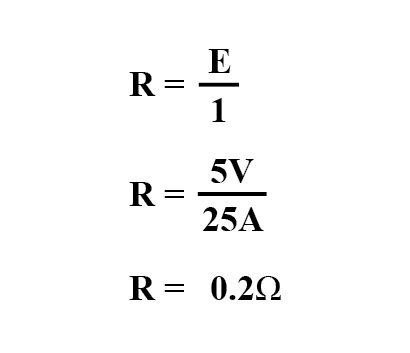
Consider a circuit that must maintain at least 220 V across a load while the source is 230 V. The wiring can therefore drop no more than 10 V in total. With two conductors (supply and return), each must drop no more than 5 V. Using Ohm’s Law (R = V/I), the maximum allowable resistance per conductor is 0.2 Ω for a 25‑A load:
To determine the resistance of a specific wire size, we use the relationship
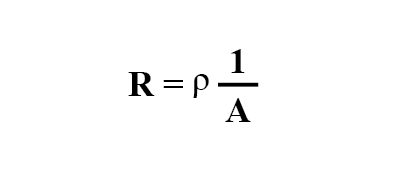
where ρ is the material’s specific resistivity, l the length, and A the cross‑sectional area. A longer conductor increases resistance, while a larger cross‑section decreases it.
The table below lists common conductors’ specific resistances at 20 °C. Copper is highlighted as one of the most conductive materials, second only to silver.
Specific Resistance at 20 °C
| Material | Element/Alloy | (Ω‑cmil/ft) | (µΩ‑cm) |
|---|---|---|---|
| Nichrome | Alloy | 675 | 112.2 |
| Nichrome V | Alloy | 650 | 108.1 |
| Manganin | Alloy | 290 | 48.21 |
| Constantan | Alloy | 272.97 | 45.38 |
| Steel* | Alloy | 100 | 16.62 |
| Platinum | Element | 63.16 | 10.5 |
| Iron | Element | 57.81 | 9.61 |
| Nickel | Element | 41.69 | 6.93 |
| Zinc | Element | 35.49 | 5.90 |
| Molybdenum | Element | 32.12 | 5.34 |
| Tungsten | Element | 31.76 | 5.28 |
| Aluminum | Element | 15.94 | 2.650 |
| Gold | Element | 13.32 | 2.214 |
| Copper | Element | 10.09 | 1.678 |
| Silver | Element | 9.546 | 1.587 |
* Steel alloy: 99.5 % iron, 0.5 % carbon.
Values are presented in Ω‑cmil/ft, a unit convenient when the wire’s length is measured in feet and cross‑sectional area in circular mils. For metric work, ρ can also be expressed in Ω‑m or Ω‑cm, with a conversion factor of 1.66243 × 10⁻⁹ Ω‑m per Ω‑cmil/ft.
Example Calculation
Using the earlier example, we need a conductor that delivers 0.2 Ω or less over 2 300 ft. Assuming copper, the formula becomes:
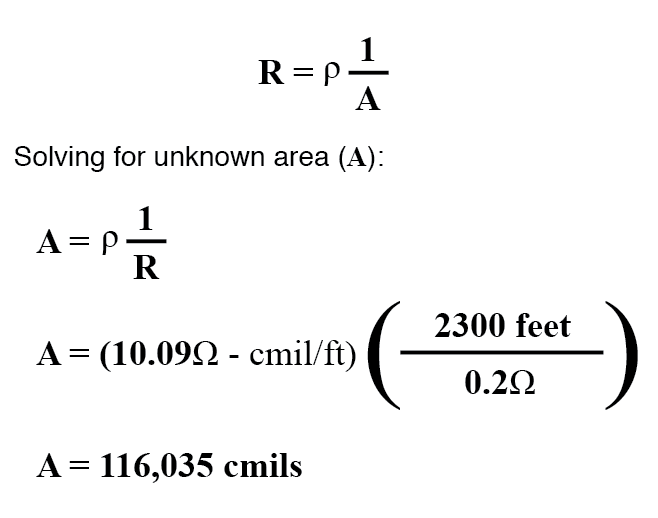
Solving for the cross‑sectional area gives 116 035 cmil. Referring to the standard wire size table, a 2/0 (133 100 cmil) wire meets the requirement, whereas 1/0 (105 500 cmil) does not. Although a 14‑AWG wire would satisfy ampacity for a 25‑A load, its resistance of 5.651 Ω over 2 300 ft (11.301 Ω round‑trip) would drop the voltage below the permissible limit.
To illustrate, 14‑AWG copper has an area of 4 107 cmil. With ρ = 10.09 Ω‑cmil/ft, the resistance per conductor is
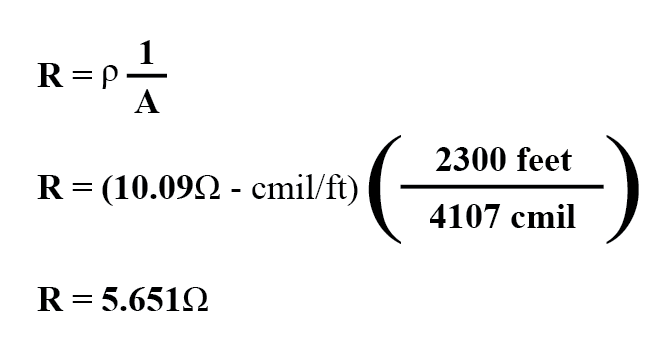
Resulting in a total circuit resistance of 11.301 Ω, which would reduce the 25‑A current to only 20.35 A under 230 V supply.
Busbar Resistance Example
For a custom solid aluminum bar (4 cm × 3 cm cross‑section, 125 cm length), the cross‑sectional area is:
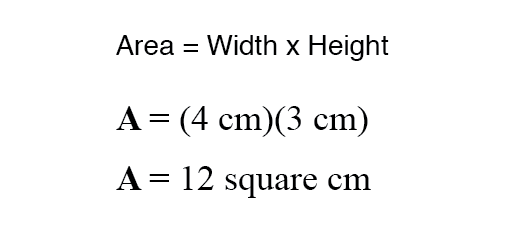
Using ρ = 2.65 × 10⁻⁶ Ω‑cm, the end‑to‑end resistance is:
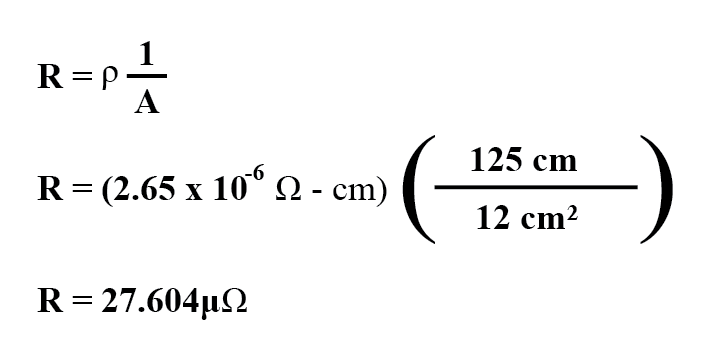
The substantial cross‑section makes busbars highly efficient, yielding resistances far lower than comparable wire gauges.
Key Takeaways
- Resistance rises with length and falls with larger cross‑section.
- Specific resistivity (ρ) is an intrinsic material property used in R = ρ·l/A.
- Ω‑cmil/ft and Ω‑m/Ω‑cm are interchangeable with the conversion factor 1.66243 × 10⁻⁹.
- When voltage drop is critical, perform exact resistance calculations before selecting wire size.
Related Worksheets
- Specific Resistance of Conductors Worksheet
Industrial Technology
- Exploring Nonlinear Resistance in Incandescent Lamps: A Practical Lab Guide
- Specific Resistance Coefficients at 20°C – Comprehensive Material Reference
- Understanding Electrical Resistance and Circuit Safety
- Resistors: Fundamentals, Types, and Practical Applications
- Understanding Conductance: The Inverse of Resistance
- Bridge Circuits: Wheatstone, Kelvin, and Their Role in Precise Electrical Measurements
- Battery Construction Fundamentals: Cells, Internal Resistance, and Connectivity
- Temperature Coefficient of Resistance: How Temperature Alters Conductivity
- Enhancing Product Durability: Mastering Polyurethane Impact Resistance
- Polyurethane: The Leading Choice for Superior Abrasion Resistance