



Understanding Fuses: Types, Ratings, and Safe Installation
While the ampacity rating of a conductor is typically a design limit that should never be exceeded, fuses are an exception. In these devices the very design is to surpass the rated current and then safely interrupt the circuit.
What Is a Fuse?
A fuse is an electrical safety device that contains a conductive strip engineered to melt and open when the current exceeds its rated value. Because a fuse is wired in series with the equipment it protects, the moment it blows the entire circuit is opened and current stops flowing to the protected components. In a parallel circuit a fuse in one branch will not affect the other branches.
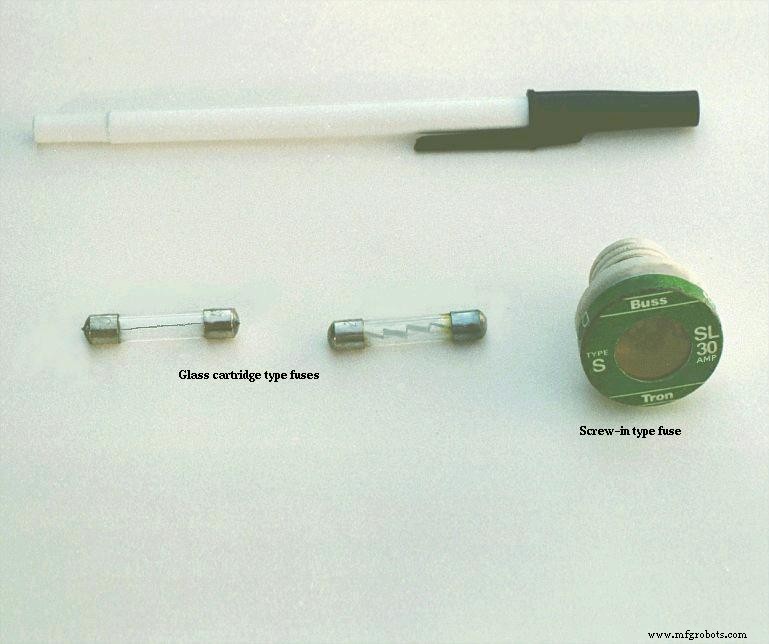
To prevent hazardous arcing when the fuse element burns, the strip is normally encased in a protective sheath. In automotive fuses the sheath is transparent so the element can be inspected visually. Residential wiring often used screw‑in glass fuses with a thin metal foil core. The following photograph shows both types:
Cartridge‑style fuses are common in automotive and industrial settings when a non‑glass sheath is required. Because fuses are designed to fail open, they are normally installed in a holder rather than soldered or bolted directly to the conductors. The next image displays glass cartridge fuses in a multi‑fuse holder:
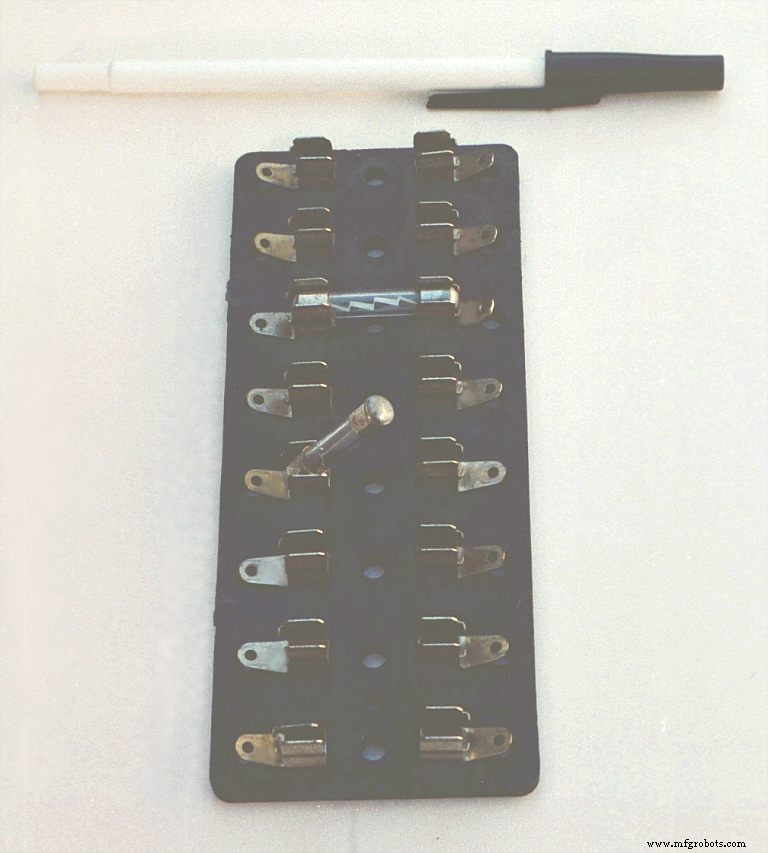
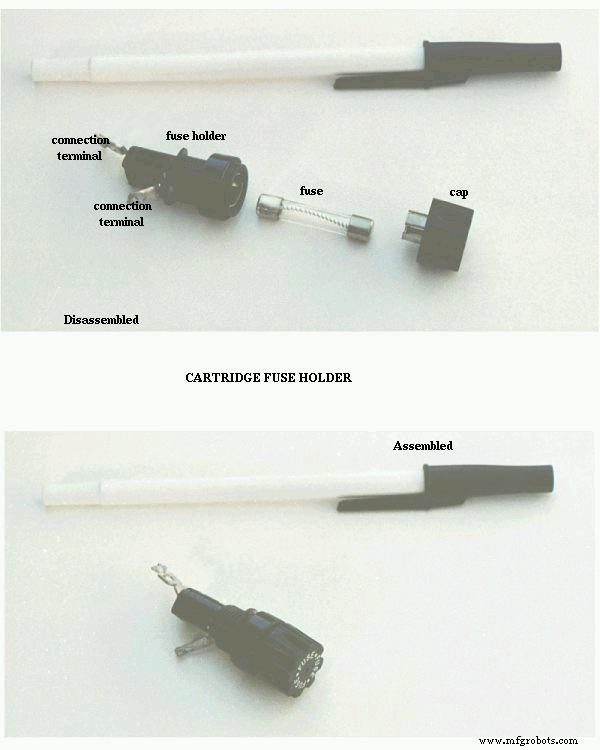
Spring clips retain the fuse, while the holder’s base is a good electrical insulator. A different holder type is often used in control panels where all contact points are concealed behind an insulating housing:
The modern workhorse for high‑current over‑current protection is the circuit breaker.
What Is a Circuit Breaker?
Circuit breakers are switches that automatically open when an over‑current condition is detected. Residential and light industrial breakers are thermally operated: a bimetallic strip bends as it heats, tripping the breaker once the strip has moved enough. Larger breakers use magnetic forces or external protective relays to initiate the trip.
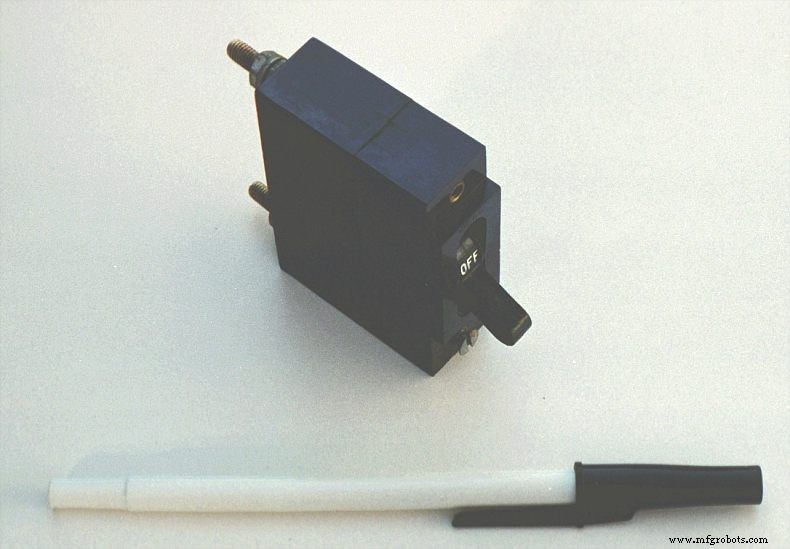
Unlike fuses, circuit breakers do not destroy themselves; they simply open and can be reset by moving a lever. Because of this, they are more commonly permanently wired into circuits. The following image shows a small residential breaker:
Some vehicles use inexpensive fusible links for battery charging circuits. These are simple rubber‑insulated wires that melt under over‑current. Such devices are not used in industrial or residential power systems because of the higher voltages and currents involved.
The schematic symbol for a fuse is an S‑shaped curve:
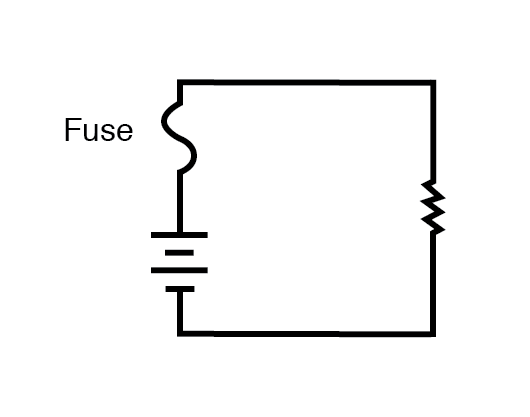
Fuse Ratings
Fuses are rated primarily in amps. The design ensures that the fuse wire itself adds negligible resistance, which is achieved by keeping the wire as short as practical. The current at which a fuse will melt is determined by the material and gauge, not by its length.
However, after a fuse blows the two ends of the melted wire are separated by an air gap. If the gap is too small on a high‑voltage circuit, a spark could jump the gap and restore the circuit. Consequently, fuses also carry a voltage rating indicating the maximum voltage the gap can withstand safely.
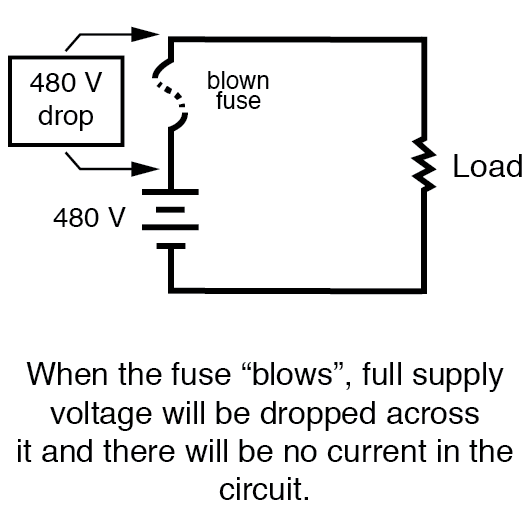
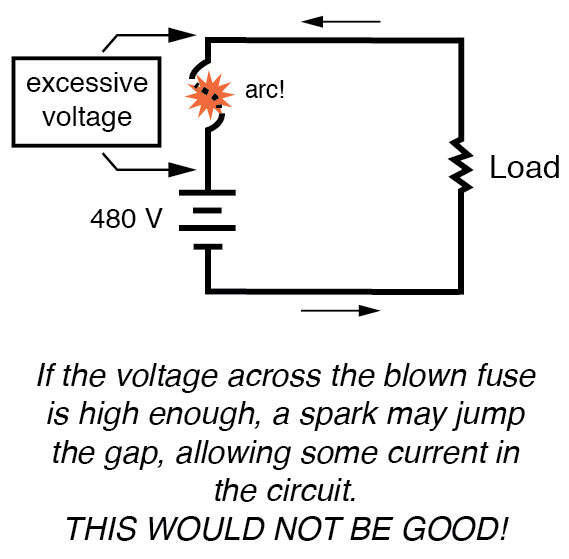
Some large industrial fuses feature replaceable wire elements to reduce cost. The cartridge is opaque and reusable, shielding the element from the environment.
There is more nuance to a fuse’s current rating. A 30‑amp fuse will not necessarily trip instantly if 35 amps flow; it may operate in a fast‑blow or slow‑blow mode depending on its design. Slow‑blow fuses are essential for applications with high inrush currents, such as electric motors, where a brief surge of up to ten times the operating current is normal at startup.
Conversely, semiconductor fuses open extremely quickly to protect delicate electronic components from transient over‑currents.
When installing a fuse, place it on the “hot” (ungrounded) side of a grounded system. This ensures the load is completely de‑energized when the fuse opens. The following two diagrams illustrate the difference:
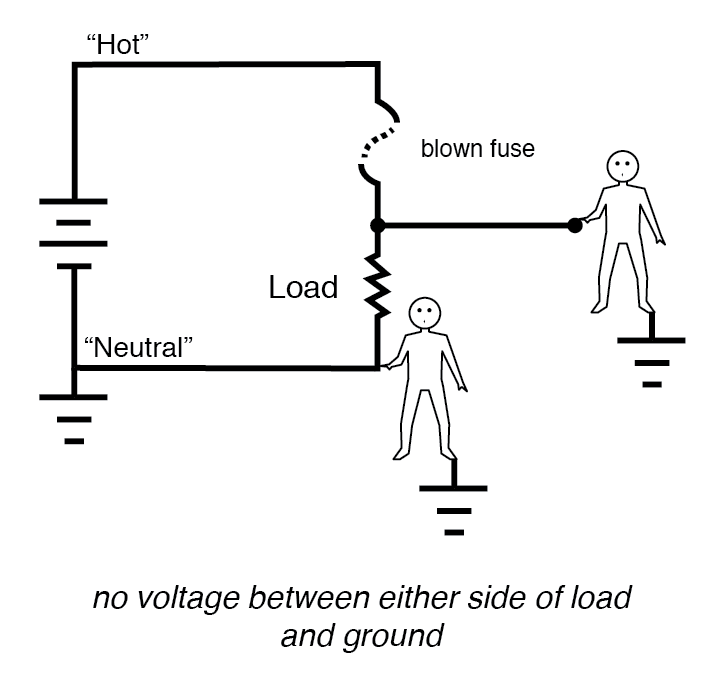
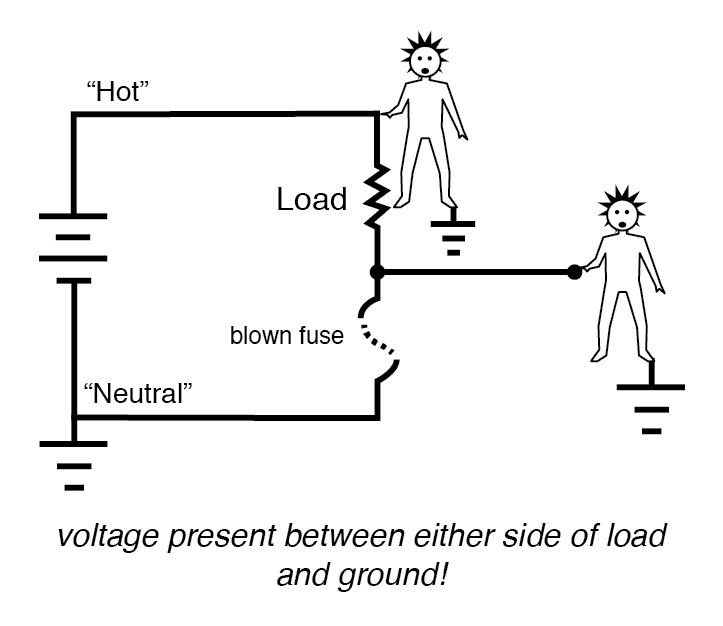
Both circuits interrupt the load, but the first design eliminates the risk of dangerous voltage on the neutral side. The same placement principle applies to circuit breakers.
Over‑current protection devices are not intended to guard against shock; they are designed to prevent conductor overheating and the resulting fire hazards. Ground‑fault devices are the appropriate solution for detecting person‑contact conditions.
REVIEW:
- A fuse is a thin conductor that melts to break a circuit when the current exceeds its rating.
- A circuit breaker is a switch that automatically opens on over‑current, using thermal, magnetic, or relay tripping mechanisms.
- Fuses are rated by maximum current and by the voltage the gap can safely withstand after opening.
- Fast, slow, and medium‑blow fuses are available for the same current rating, allowing engineers to match the fuse behavior to the application.
- Installing a fuse on the ungrounded conductor in a grounded system keeps the load safe after the fuse opens.
RELATED WORKSHEETS:
- Overcurrent Protection Worksheet
Industrial Technology
- Circuit With a Switch: A Practical Guide to Basic Electrical Circuits
- Voltage Follower Amplifier: Design, Build, and Measurement Guide
- Mastering AC Circuit Equations: Impedance, Reactance & Resonance
- Getting Started with SPICE: A Text‑Based Circuit Simulation Tool
- Mastering SPICE Netlist Syntax: Component Naming, Passive & Active Elements, and Source Definitions
- Demultiplexers Explained: How They Route Signals in Digital Circuits
- Understanding TRIACs: Bidirectional Power Control in AC Applications
- Understanding Fuses: A Comprehensive Guide to Protecting Your Circuits
- A Comprehensive Guide to Automotive Fuses: Types, Functions, and Locations
- The Complete Guide to Fuses: Protecting Your Electronics