



DIAC: The Bidirectional Trigger for AC Thyristors
DIACs are a specialized class of unidirectional semiconductor devices—essentially Shockley diodes connected in parallel with opposite polarity—to create a bidirectional trigger element for alternating‑current (AC) circuits. When a single Shockley diode conducts, it allows current flow in only one direction; a DIAC, however, can conduct in both directions, making it ideal for AC applications.
In a DC environment, a DIAC behaves identically to a Shockley diode: it conducts once the break‑over voltage is reached and then remains latched until the current falls below the holding current. Under AC, the situation changes dramatically. Because the current reverses twice per cycle, a DIAC will only stay latched for a single half‑cycle. When the polarity flips, the device drops out unless a new break‑over occurs, resulting in a characteristic waveform that repeats every half‑cycle. 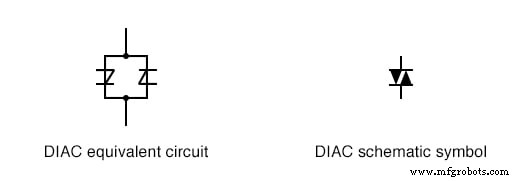
The DIAC
Figure 1 illustrates the waveforms produced by a DIAC under AC excitation. The device conducts briefly during each half‑cycle, creating a square‑like current pulse that is well‑suited for triggering other thyristors such as TRIACs. This behavior explains why DIACs are rarely employed alone; they are most valuable as trigger elements in circuits that require precise AC control—common examples include lamp dimmers, motor speed controllers, and HVAC fan speed regulators.
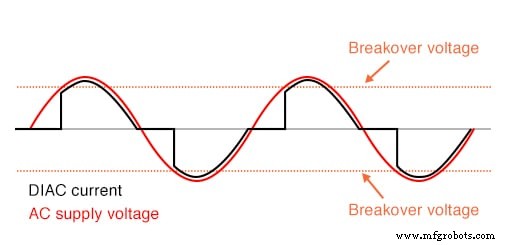
DIAC waveforms
In summary, a DIAC provides a simple, reliable, and low‑cost means of generating a bidirectional trigger pulse that can latch a TRIAC or other thyristor, thereby enabling efficient AC power control in a wide range of consumer and industrial applications.
Industrial Technology
- Hands‑On Guide to Current Dividers: Build, Measure, and Simulate with a 6 V Battery
- Understanding the NOT Gate (Inverter) in TTL Circuits
- BJT Switching: How Transistors Efficiently Control High‑Current Loads
- Understanding the Common-Emitter Amplifier: Switching, Amplification, and Biasing Techniques
- Understanding the Shockley Diode: A Comprehensive Guide to PNPN Thyristors
- Current Divider Circuits: Theory, Formula, and Practical Applications
- Calculate Battery Charging Time & Current: Step‑by‑Step Guide with 120Ah Example
- Understanding Fuses: A Comprehensive Guide to Protecting Your Circuits
- DIACs Explained: Design, Functionality, and Key Applications
- High-Current Voltage Regulator: The Complete Expert Guide