



Calculating Power Dissipation in Resistive Circuits
When determining the power dissipated by a resistor, you can use any of the three classic power formulas that relate voltage (V), current (I), and resistance (R):
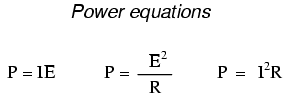
To streamline the calculation, simply extend our familiar table of voltages, currents, and resistances with an additional column for power:
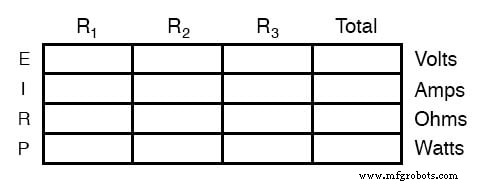
For each column, choose the Ohm’s Law relation that matches the values you have available—whether you know V, I, or R—and compute the power using the appropriate equation.
A key principle is that total power is the sum of the individual powers, regardless of the circuit layout. Whether the components are wired in series, parallel, or any hybrid configuration, the total dissipated power must equal the power supplied by the source(s) in accordance with the Law of Conservation of Energy.
Key Takeaway:
- Power is additive in every resistive network: PTotal = P1 + P2 + … + Pn
Explore our Power Calculators in the Tools section to automate these calculations.
Related Worksheet:
- Energy, Work, and Power Worksheet
Industrial Technology
- Understanding AC Circuits: A Beginner's Guide
- Power Sources: AC and DC Explained
- Protective Relays: Safeguarding Industrial Power Systems
- Amplifiers: Harnessing Active Devices to Boost Power
- Understanding Bels and Decibels: From Power Gain to Voltage Conversion
- Rectifier Circuits: From Half‑Wave to Polyphase Full‑Wave Designs
- Comprehensive Summary of Resistors, Inductors, and Capacitors in AC Circuits
- Bulldozer Technology: Design, Manufacturing, and Future Innovations
- Arduino Nano + 4‑Channel Relay: Control Blinds & AC Motors
- Wind Power: Converting Air Movement into Clean Electricity