



Understanding Bels and Decibels: From Power Gain to Voltage Conversion
The Bel is Used to Represent Gain
\nIn its most straightforward definition, an amplifier’s gain is the ratio of output power to input power. Because it is a ratio, it is dimensionless. Nevertheless, engineers use a dedicated unit—called the bel—to express gain in a more readable format.
\nThe bel was originally devised to quantify signal loss in telephone cabling rather than gain in amplifiers. Named after Alexander Graham Bell, the unit captured the power attenuation over a standard cable length. Today it is defined as the base‑10 logarithm of a power ratio:
\n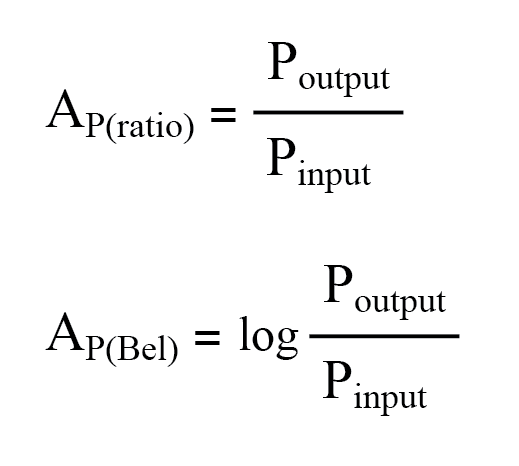 \n
\nThe Bel is Nonlinear
\nBecause the bel is logarithmic, it behaves nonlinearly. The following table illustrates how power losses and gains translate between simple ratios and bel values:
\n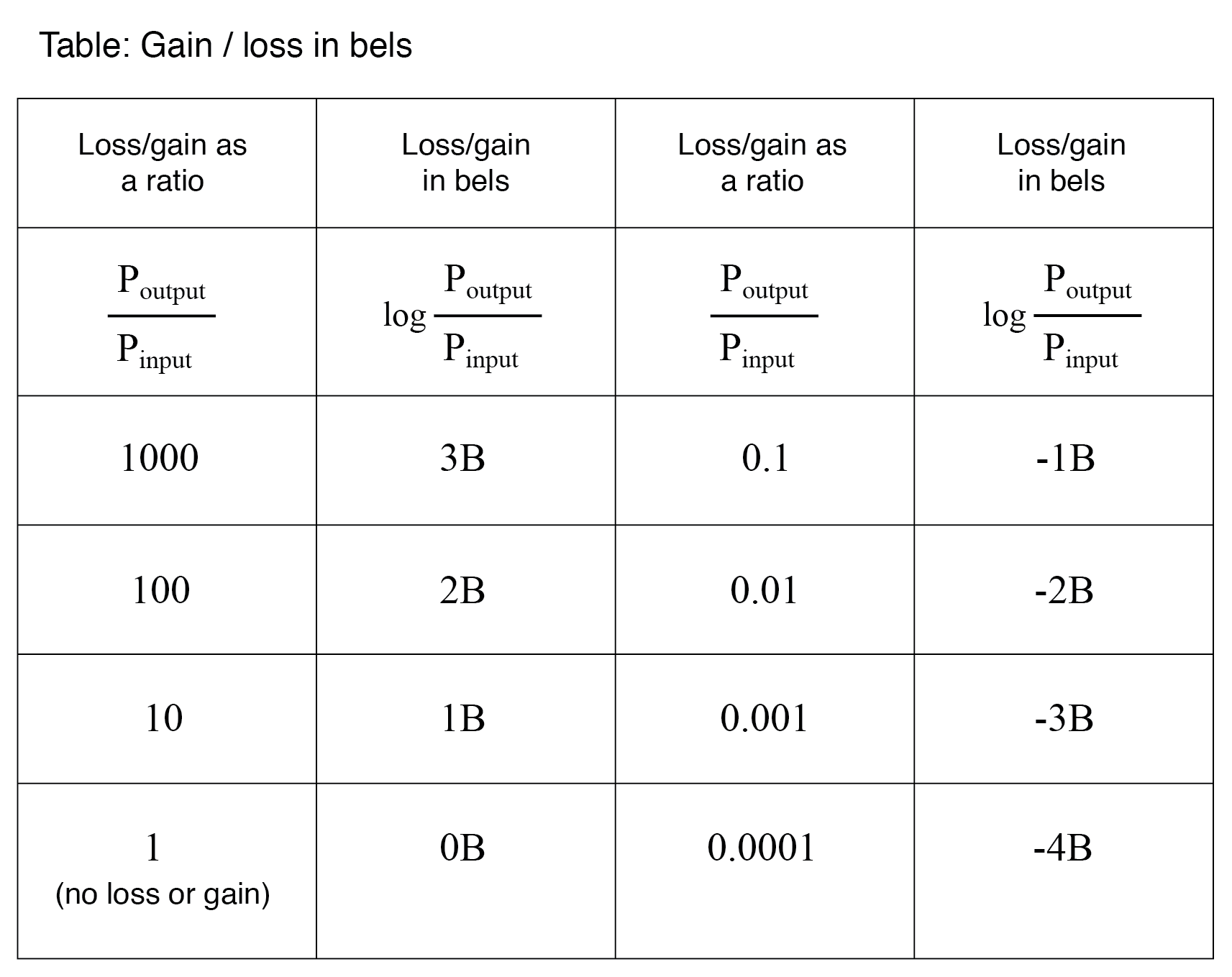 \n
\nMoving from the Bel to the Decibel
\nThe bel is a relatively large unit, so a metric prefix—deci—was applied to create the decibel (dB). The decibel is now the ubiquitous unit for expressing logarithmic gains and losses. Below is a comparison between power ratios and decibel values:
\n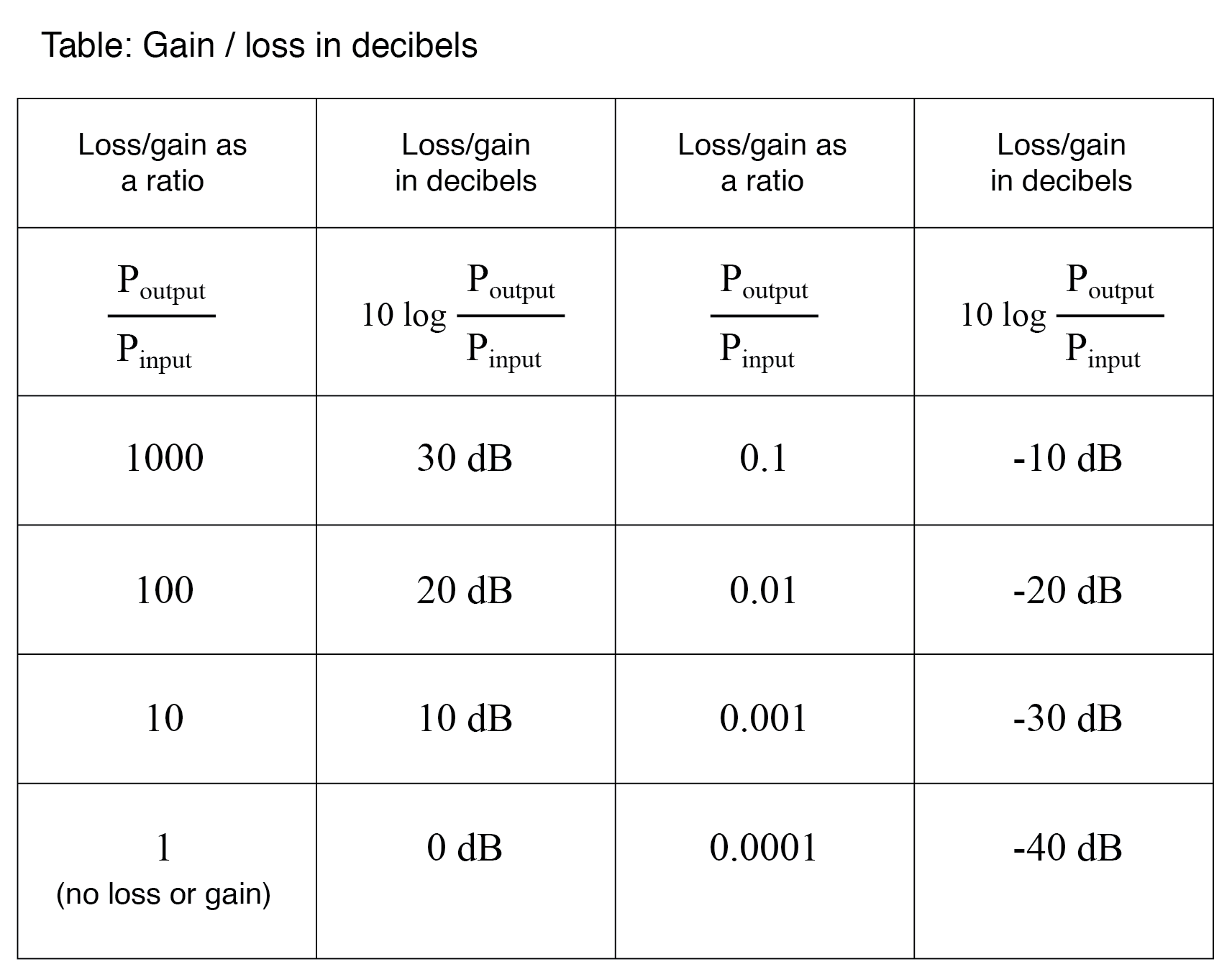 \n
\nLogarithmic scales are especially useful because human hearing is logarithmic: doubling perceived loudness requires a ten‑fold increase in physical sound power. A 1‑bel loss corresponds to a 50 % perceived loss, and a 1‑bel gain doubles perceived intensity.
\nOther Logarithmic Scale Examples: Richter Scale and Chemical pH
\nRichter Scale
\nThe Richter scale for earthquakes is a direct analogue. A 6.0 reading is ten times more powerful than a 5.0; a 7.0 is one hundred times more powerful than a 5.0; and a 4.0 is one‑tenth as powerful as a 5.0.
\nChemical pH
\nSimilarly, the pH scale is logarithmic: each unit represents a ten‑fold difference in hydrogen‑ion concentration. The power of logarithmic scales lies in representing vast ranges with a compact set of numbers.
\nUsing the Bel to Express System Gains and Losses
\nWhen multiple amplifier stages are cascaded, the overall power gain is the product of the individual ratios:
\nOverall gain = (3)(5) = 15\n
If each stage’s gain is expressed in bels, the total system gain is simply the sum of the individual bel values:
\n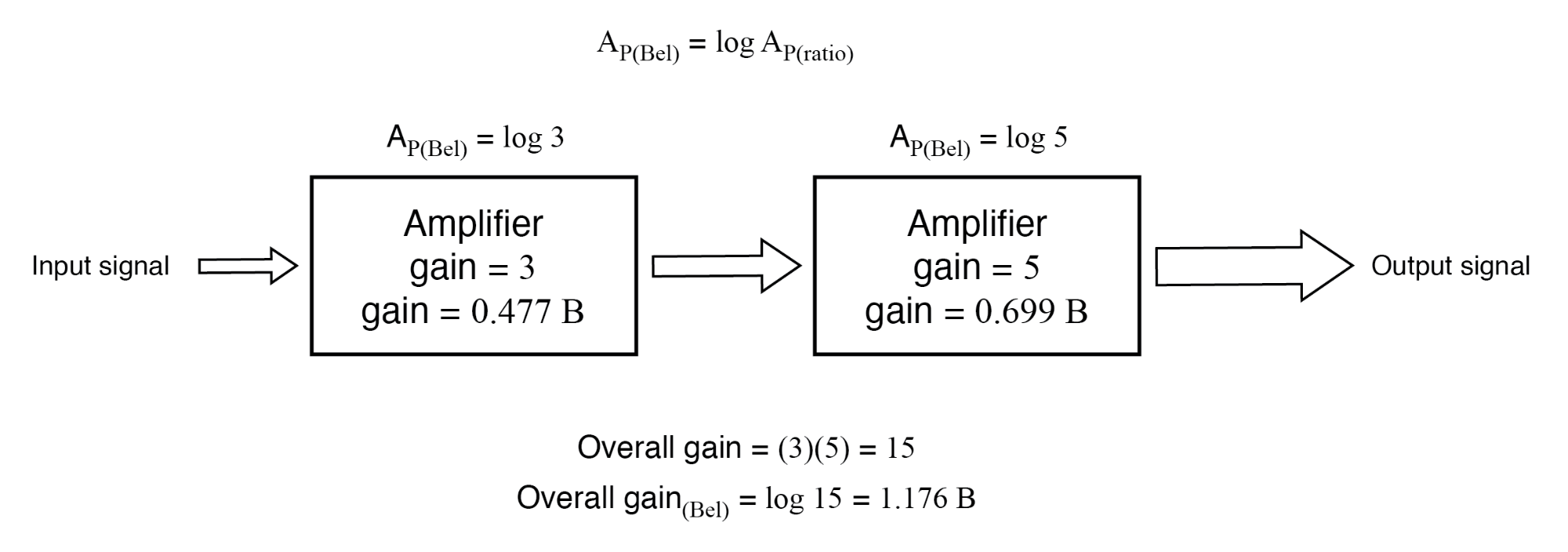 \n
\nIn this example, 0.477 B + 0.699 B = 1.176 B, demonstrating the additive property of logarithmic units.
\nGains using Decibels
\nApplying the same logic to decibels yields:
\n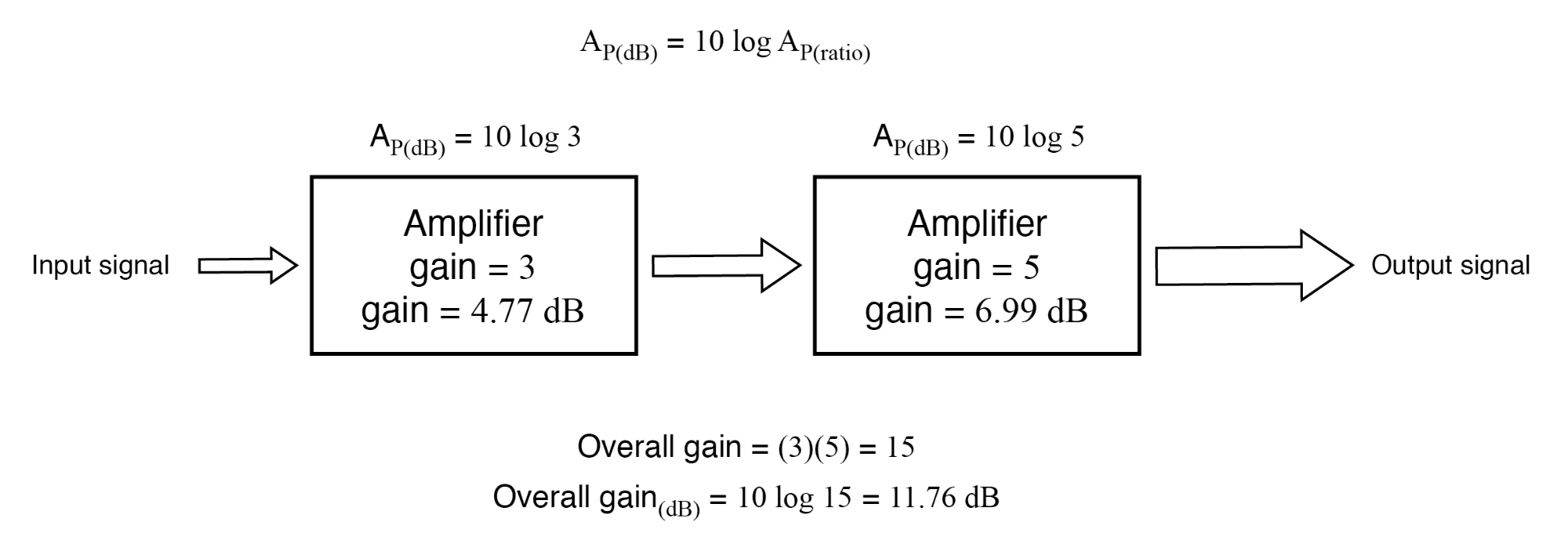 \n
\n4.77 dB + 6.99 dB = 11.76 dB.
\nMathematically, the sum of logarithms corresponds to the product of the original numbers—a principle exploited by slide rules and still fundamental when working with logarithmic scales.
\nConversion of Decibels and Unitless Ratio
\nTo revert from a decibel or bel value back to a plain power ratio, apply the antilogarithm (10 raised to the exponent). For decibels, the exponent is the decibel value divided by 10:
\n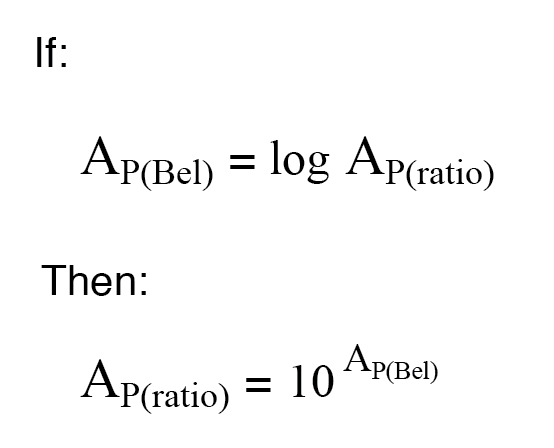 \n
\n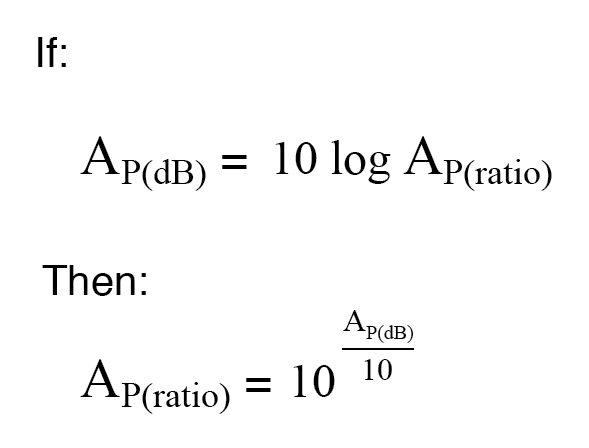 \n
\nExample: If a 1 W input yields 10 W output, the power gain in dB is:
\nAP(dB) = 10*log10(PO / PI) = 10*log10(10 /1) = 10*1 = 10 dB\n
Example: A 20 dB power gain corresponds to a ratio of 10^(20/10) = 100.
\nAP(dB) = 20 = 10*log10(AP_ratio)\n20/10 = log10(AP_ratio)\n10^(20/10) = 10^2 = 100 = AP_ratio\n
Converting Power Gain to Voltage/Current Gain
\nBecause a bel measures power, translating a voltage or current gain into bels or decibels requires converting that gain to an equivalent power gain. With a constant load, a voltage or current gain of 2 yields a power gain of 4 (2²); a gain of 3 yields 9 (3²). Consequently, when converting, an exponent of 2 is applied to the ratio inside the logarithm:
\n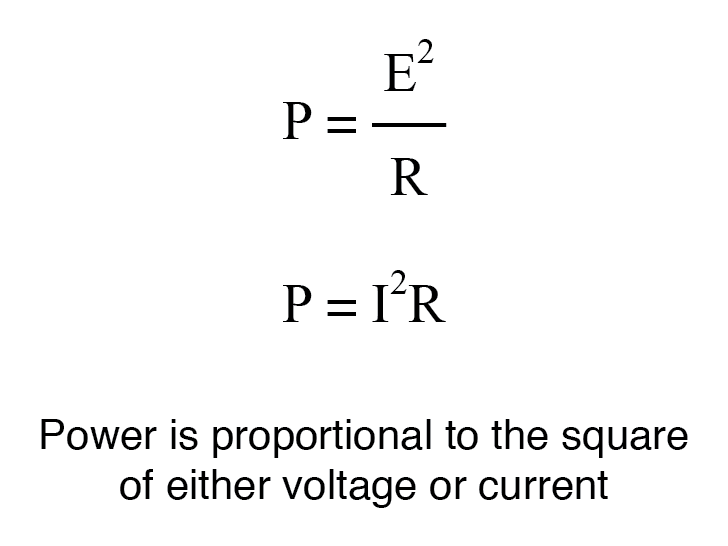 \n
\n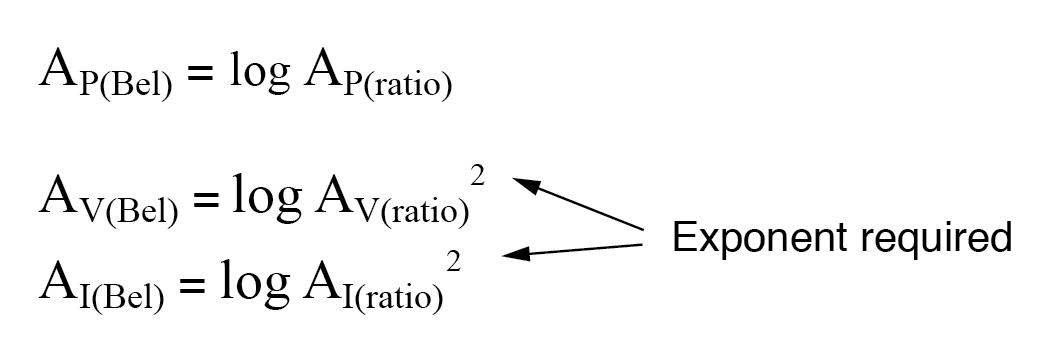 \n
\nBecause multiplying by 2 inside the log is equivalent to taking the log of the squared ratio, the formula simplifies to:
\n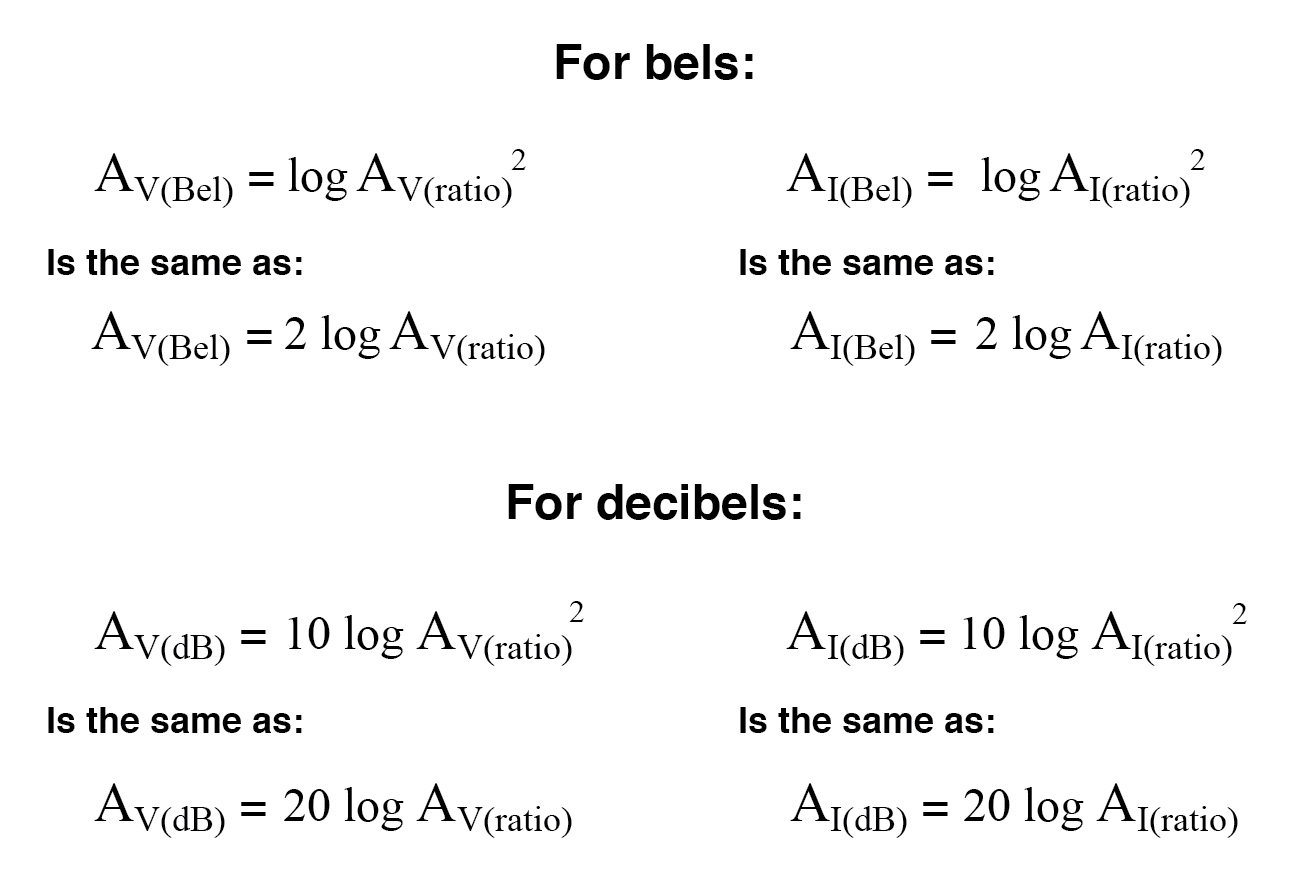 \n
\nTo recover a unitless voltage or current ratio from a decibel value, use:
\n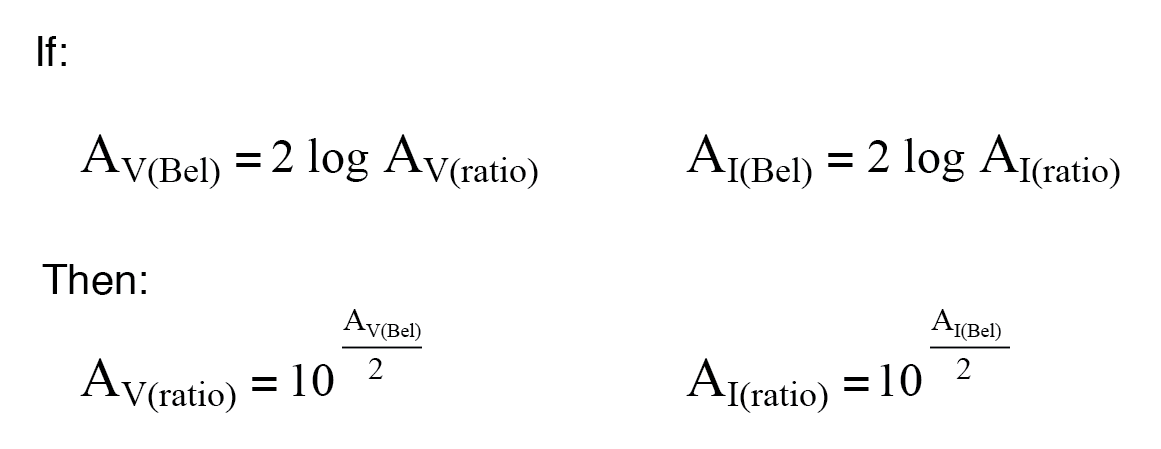 \n
\n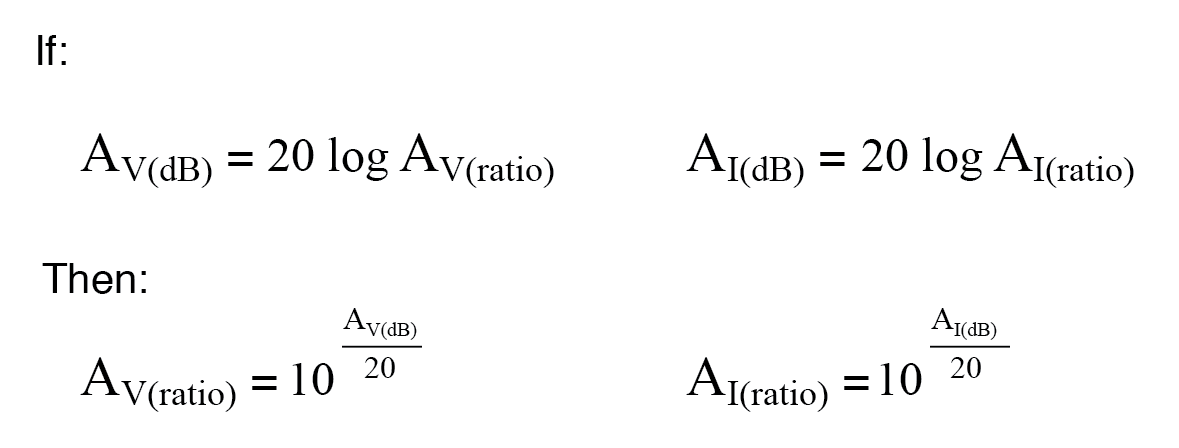 \n
\nWhile the bel is tailored for power, the neper (symbol Np) uses the natural logarithm and directly expresses voltage or current gains. In practice, the neper is rarely used in U.S. engineering; decibels remain the standard.
\nExample: A 600 Ω audio line amplifier receives 10 mV and delivers 1 V. The power gain in dB is:
\nA(dB) = 20*log10(VO / VI) = 20*log10(1 /0.01) = 20*2 = 40 dB\n
Example: For a 20 dB voltage gain with equal 50 Ω input and output impedances, the voltage ratio is 10^(20/20) = 10.
\nA Review of the Decibel
\n- \n
- Gains and losses can be expressed as a unitless ratio or in bels (B) or decibels (dB). A decibel is one‑tenth of a bel. \n
- To convert a power ratio to bels or decibels, use the equations shown above. \n
- When applying the bel or decibel to voltage or current ratios, include a factor of 2 in the logarithm to account for the squared relationship to power. \n
- A positive value indicates amplification; a negative value indicates attenuation. Zero denotes unity gain. \n
- For multi‑stage amplifier systems, multiply individual power ratios to obtain the overall ratio, but add the bel or decibel figures to find the total logarithmic gain. \n
RELATED WORKSHEETS:
\n- \n
- Decibel Measurements Worksheet \n
- Elementary Amplifier Theory Worksheet \n
Industrial Technology
- Understanding AC Circuits: A Beginner's Guide
- Power Sources: AC and DC Explained
- Protective Relays: Safeguarding Industrial Power Systems
- Amplifiers: Harnessing Active Devices to Boost Power
- Understanding Amplifier Gain: Voltage, Current, and Power
- Understanding Bels and Decibels: From Power Gain to Voltage Conversion
- Rectifier Circuits: From Half‑Wave to Polyphase Full‑Wave Designs
- Calculating Power Dissipation in Resistive Circuits
- Bulldozer Technology: Design, Manufacturing, and Future Innovations
- Wind Power: Converting Air Movement into Clean Electricity