



The Tetrode Tube: Design, Function, and Impact on Amplifier Performance
The tetrode tube, named for its four key elements—cathode, grid, screen, and plate—represents a significant evolution in vacuum‑tube technology. Its design builds upon the triode by adding a screen grid that dramatically improves performance in amplifier circuits.
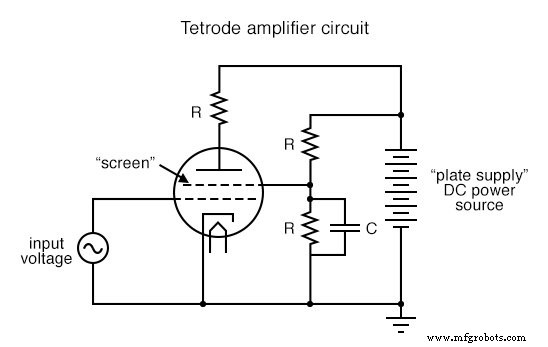
Unlike the triode, the screen grid is a wire mesh or coil placed between the control grid and the plate. It is held at a positive DC potential that is a fraction of the plate voltage. When the screen is connected to ground through an external capacitor, it electrostatically shields the grid from the plate. This reduces capacitive coupling that otherwise introduces high‑frequency feedback and can lead to unwanted oscillations.
The screen is intentionally of smaller surface area and lower positive potential than the plate, so the vast majority of cathode electrons pass the screen en route to the plate. With a steady screen voltage, the plate current becomes almost entirely governed by the grid voltage, allowing the plate voltage to swing over a wide range without significantly altering the current. This decoupling yields more stable gain and superior linearity, producing a cleaner reproduction of the input waveform.
Despite these benefits, the tetrode introduces a notable drawback: secondary emission. High‑velocity cathode electrons striking the plate can liberate additional electrons from the plate material. In a triode, these secondary electrons are largely lost, but in a tetrode, the positively charged screen attracts them. As a result, plate current is reduced, which in turn lowers amplifier gain.
Engineers responded with two key innovations that preserve the advantages of the tetrode while mitigating secondary‑emission losses: beam power tubes and pentodes. Both designs maintain comparable electrical characteristics but reconfigure the electrode geometry to redirect secondary electrons toward the plate.
For a deeper dive into the physics and history of tetrode tubes, consult resources such as the National Instruments “Tube Fundamentals” white paper or the classic text by Herman J. Mackintosh, “Vacuum Tube Electronics.”
Industrial Technology
- The 555 Integrated Circuit: A Timeless Benchmark in Analog Design
- The Quadratic Formula: A Reliable Tool for Solving Second‑Degree Equations
- Mastering the D Latch: A Clean 1‑Bit Memory Circuit
- Common‑Base Transistor Amplifiers: Design, Analysis, and Applications
- The Tetrode Tube: Design, Function, and Impact on Amplifier Performance
- Beam Power Tubes: Enhancing Efficiency with Electron Beam Focus
- Optimizing AZO Conductive Layers for Microchannel Plate Performance
- Proven Steps for Rapid, Affordable Industrial Touch Screen Repair
- DIY Arduino LCD Project: Assemble with Resistors, Pushbutton, and 16x2 Display
- Discover the Premier MIC-6 Tooling Plate Aluminum for Unmatched Stability and Consistency