



Thyristor Technology: From SCR to TRIAC, GTO, and UJT
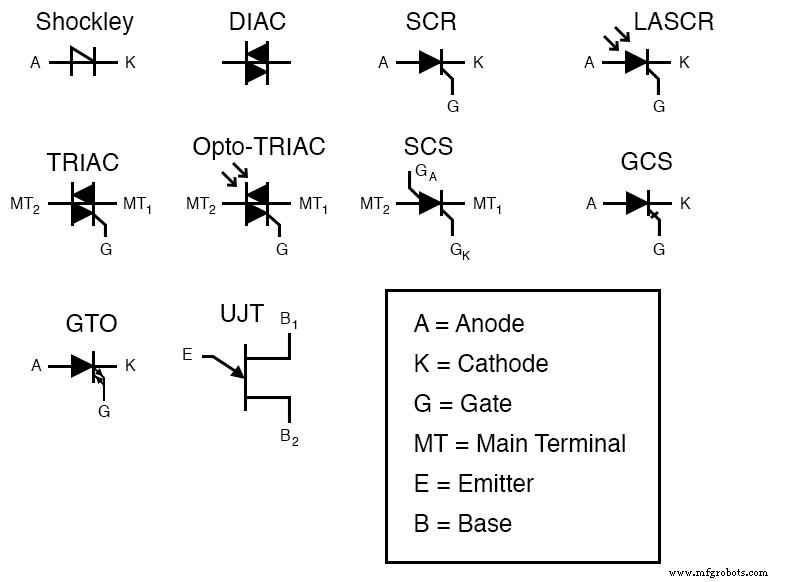
A thyristor is a solid‑state device that offers a range of distinctive features. It has three terminals—anode, cathode, and gate—reminiscent of thermionic valves and vacuum tubes.
The gate is the control terminal; the main current flows between the anode and cathode.
The DIAC symbol consists of two triangles bounded by two lines, visually representing its bidirectional nature.
This arrangement illustrates that the device is fundamentally built from two p‑n junctions.
The device terminals are usually labeled Anode 1 and Anode 2, or Main Terminals 1 and 2 (MT1/MT2).
A TRIAC can be viewed as two back‑to‑back thyristors; its symbol reflects this duality.
Unlike the SCR, which conducts in only one direction, a TRIAC is bidirectional and can conduct in either polarity.
The Gate‑Turn‑Off (GTO) switch is a unique member of the thyristor family because it can be shut off by applying a negative voltage to its gate—no need to remove the anode‑cathode voltage.
The Silicon Controlled Switch (SCS) is a unilateral, four‑layer P‑N‑P‑N silicon device with four electrodes: cathode (C), gate‑1 (G1), gate‑2 (G2), and anode (A).
A Gate‑Controlled Switch (GCS) closes with a positive trigger and opens with a negative trigger—or by low‑current dropout.
The Unijunction Transistor (UJT), also called a double‑base diode, is a 2‑layer, 3‑terminal silicon switching device. When triggered, its emitter current rises regeneratively due to its negative‑resistance characteristic, until limited by the emitter supply.
RELATED WORKSHEETS:
- Thyristors Worksheet
Industrial Technology
- The 555 Integrated Circuit: A Timeless Benchmark in Analog Design
- Compact DHT Temperature & Humidity Breakout for Raspberry Pi – ATtiny85 & DHT22/DHT11
- Top 4 Digital Transformation Challenges for Medical Device OEMs
- Understanding the FDA’s Final Rule on Unique Device Identification (UDI)
- Noise Filter Circuit: Elevate Audio Quality for Music Players
- Thyristor vs. Transistor: Core Differences Explained for Power Electronics
- DIY Car Alarm: Build a Reliable Protector & Save Money
- Zigbee Modules Explained: Features, Functionality, and Use Cases
- Mastering the PYNQ Board: A Comprehensive Guide for Programmable Projects
- The Crucial Role of Precision Machining in Medical Device Manufacturing