



Gas‑Filled Ionization Tubes: Principles, Types, and Applications
Up to now we have examined vacuum tubes, which are completely evacuated of gas and vapor. Introducing specific gases or vapors into the envelope transforms the tube’s behavior, enabling it to perform specialized functions in electronic circuits.
Applying a sufficiently high voltage across a gas‑filled region, or heating it, strips electrons from their atomic nuclei—a process called ionization. The liberated electrons drift as an electrical current, turning the gas into a conductive plasma.
Although ionized gas is not a perfect conductor, its resistance causes energy to be released as heat. This self‑heating sustains ionization, so once the tube starts conducting it remains on until the applied voltage or current falls below a threshold.
This behavior mirrors that of thyristors, which exhibit hysteresis: they stay on after being triggered and stay off until de‑triggered. Gas‑filled tubes likewise display hysteresis.
In contrast to vacuum tubes, ionization tubes were frequently built without a filament—known as cold‑cathode tubes—while those with a heater were called hot‑cathode tubes. Heat presence alters a tube’s characteristics, though the effect is less pronounced than in vacuum tubes.
The most basic ionization device is often not a tube but a spark gap: two electrodes separated by a gas‑filled space. The gap can be filled with ambient air or a special gas, the latter requiring a sealed enclosure.
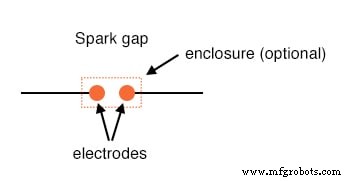
Spark gaps are widely used for overvoltage protection. Designed to remain non‑conductive under normal voltages, they trigger when voltage rises sharply. While conducting, they draw large currents, creating a voltage drop that clamps the system. When the voltage falls below the breakdown level, the gap extinguishes.
A key limitation of spark gaps is their finite lifespan. The intense discharge erodes electrode surfaces by pitting or melting.
Spark gaps can be triggered deliberately by inserting a third, pointed electrode and pulsing it with high voltage. The induced spark ionizes a portion of the path between the main electrodes, allowing conduction if the applied voltage exceeds the breakdown threshold.
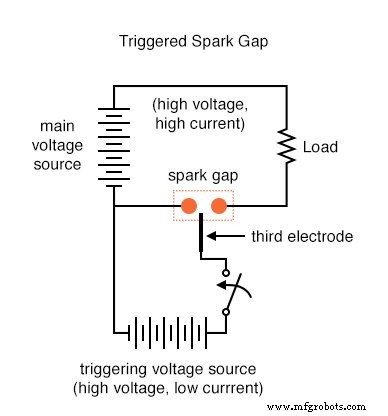
Both triggered and untriggered spark gaps can handle enormous currents, even up to mega‑amps. The principal limitation is the physical size of the electrodes and enclosure.
Enclosing the electrodes in a sealed tube with a special gas creates a discharge tube. The most familiar example is the neon lamp, whose glow color depends on the gas used.
Neon lamps share a similar construction to spark gaps, yet they operate differently:
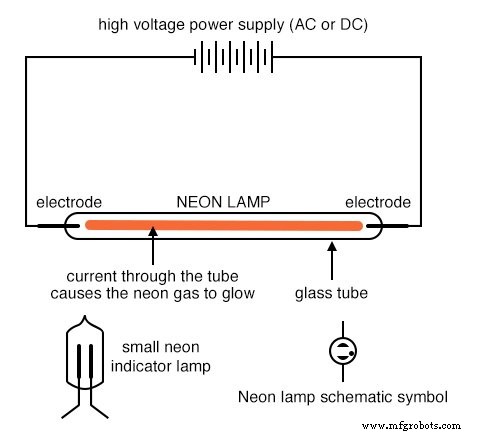
Adjusting electrode spacing and gas type allows neon lamps to conduct at modest currents. They still display hysteresis—higher ignition voltage than extinction voltage—and possess nonlinear resistance: higher voltage yields higher current, more heat, and lower resistance. Exceeding the design voltage risks overheating and damage.
The nonlinear behavior also makes neon tubes useful as voltage regulators, functioning like a zener diode by drawing more current as voltage falls. In that role they are called glow or voltage‑regulator tubes and were common in early tube‑era circuits.
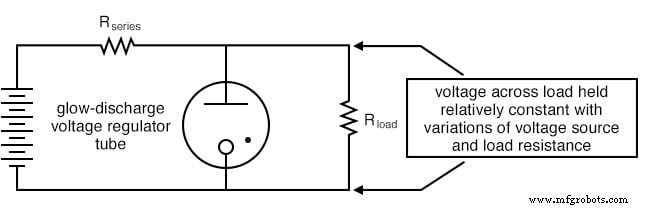
Notice the black dot in the tube symbol above—and in the neon lamp symbol. It denotes a gas‑filled tube, a standard convention in tube schematics.
A typical voltage‑regulating glow tube is the VR‑150, which maintains a nominal 150‑V output. Its resistance varies from 5 kΩ to 30 kΩ—a 6:1 span—allowing coupling to amplifying tubes for improved regulation and higher load currents, analogous to modern zener diodes.
A gas‑filled triode behaves like other gas tubes but offers an extra benefit: the grid‑to‑cathode voltage sets the minimum plate‑to‑cathode voltage required to turn on. Effectively, it serves as a gas‑filled counterpart to the semiconductor SCR, known as a thyratron.
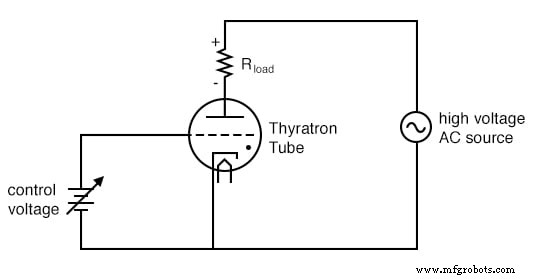
The schematic is a simplification. Certain thyratrons require the grid voltage to change polarity between on and off states, and some have multiple grids.
Thyratrons are employed similarly to SCRs, regulating rectified AC for large loads like motors. Manufacturers vary the gas fill— inert gases, hydrogen, mercury vapor, or even deuterium—to tailor performance for high‑voltage switching.
Industrial Technology
- Exploring Voltage Addition with Series Battery Connections
- Voltage Divider Lab: Design, Measurement, and Kirchhoff’s Voltage Law Verification
- Thermoelectricity: Understanding Thermocouples and the Seebeck Effect
- Potentiometric Voltmeter: Precise Voltage Measurement with Minimal Loading
- Build a Potato Battery: A Step‑by‑Step Guide to DIY Electrochemical Power
- Understanding Gas Discharge Tubes: From Lightning to Modern Thyristors
- Display Tubes: From CRTs to Cat‑Eye Indicators
- Tachogenerators: Precision Speed Measurement for Industrial Motors and Equipment
- Understanding AC Waveforms: Sine Waves, Frequency, and Oscilloscope Basics
- MIG Welder Setup Guide: Optimize Performance & Achieve Perfect Beads