



Understanding Gas Discharge Tubes: From Lightning to Modern Thyristors
Witnessing a lightning storm reveals the phenomenon of electrical hysteresis—though most observers are unaware of the physics behind it. Wind and rain accumulate static charges between cloud and ground, and among clouds themselves. These charge imbalances produce high voltages. When the insulating power of the air can no longer hold the voltage, a sudden surge of current—what we see as lightning—travels between opposite charge poles.
The accumulation of high voltage is a gradual, continuous process driven by atmospheric conditions. Lightning, however, appears as brief, intense bursts rather than a steady glow. The key lies in the nonlinear, hysteretic resistance of air.
Under ordinary circumstances, air presents an almost infinite resistance, acting as a negligible conductor. Adding water or dust lowers this resistance slightly, but it remains effectively an insulator for most practical purposes. When a sufficiently high voltage is applied across a gap in air, the electric field strips electrons from their atomic orbits, freeing them to flow as current. The resulting ionized air is known as a plasma—a fourth state of matter distinct from solids, liquids, and gases. Plasma is a much better electrical conductor, with resistance orders of magnitude lower than neutral gas.
As current passes through plasma, energy dissipates as heat—just as in a solid resistor. Lightning temperatures are extreme, and the heat generated can sustain or even create plasma without additional voltage. While the voltage between cloud and ground decreases as the current neutralizes the charge imbalance, the heat keeps the air ionized, maintaining low resistance. Once the voltage falls below a lower threshold, the plasma can no longer be sustained; the air reverts to a gas, stopping conduction and allowing the voltage to rebuild for the next surge. This hysteresis loop explains why lightning appears as fleeting bursts rather than continuous arcs.
Relaxation Oscillators
In electronics, lightning’s behavior is analogous to a relaxation oscillator. These circuits generate an AC waveform from a DC supply by charging a capacitor until a threshold voltage is reached, at which point the capacitor discharges rapidly. A classic relaxation oscillator uses only three components—resistor, capacitor, and neon lamp—besides the power source.
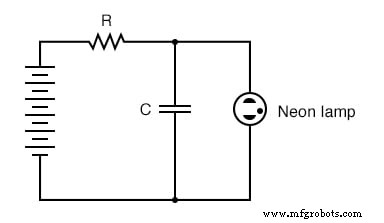
A neon lamp consists of two metal electrodes inside a sealed glass bulb filled with neon gas. At room temperature and without applied voltage, the lamp’s resistance is virtually infinite. When the voltage surpasses a specific threshold (dependent on gas pressure and lamp geometry), the neon gas ionizes into plasma, drastically reducing resistance and emitting light. The lamp’s behavior mirrors the hysteresis seen in atmospheric lightning.
During operation, the capacitor charges exponentially according to the resistor’s value. Upon reaching the lamp’s threshold voltage, the lamp “turns on,” discharging the capacitor quickly to a low voltage. The lamp then “turns off,” allowing the capacitor to recharge. This cycle produces brief flashes at a rate governed by battery voltage, resistor value, capacitor capacitance, and lamp threshold.
Thyratron Tubes
Neon lamps laid the groundwork for more sophisticated devices: thyratron tubes. A thyratron is a gas‑filled triode that can be triggered by a small control voltage between its grid and cathode and shut off by reducing the plate‑to‑cathode voltage. Unlike neon lamps, thyratrons provide controlled switching for current to a load.
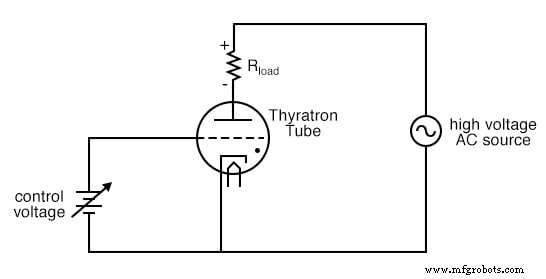
In the simple control circuit above, the thyratron conducts current in one direction (the load resistor’s polarity is shown) when triggered. The load’s AC source enables the tube to turn off naturally when the AC waveform passes through zero volts, allowing the gas to cool and return to its non‑conducting state. Current resumes only when the AC voltage rises again and the control voltage permits it.
An oscilloscope trace of such a circuit would display the load voltage as shown:
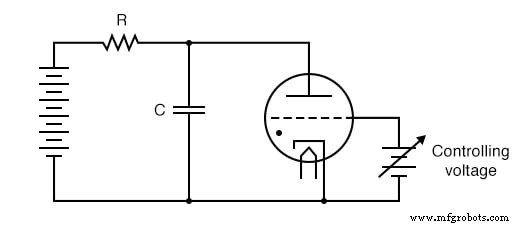
During the positive half‑cycle, the load voltage stays at zero until the threshold is reached, then follows the AC waveform for the remainder of the half‑cycle. Even after the AC voltage drops below the threshold, the tube remains conductive until the supply voltage approaches zero—a classic hysteresis effect. Because thyratrons are unidirectional devices, no voltage appears across the load during the negative half‑cycle. Practical circuits often combine multiple thyratrons in a full‑wave rectifier arrangement to deliver DC power to the load.
Thyratrons have largely been replaced by semiconductor devices, but their fundamental principle of hysteretic switching persists in modern thyristors. The similarity in nomenclature—thyratron and thyristor—reflects this shared heritage.
Key Takeaways
- Electrical hysteresis explains why lightning manifests as brief, intense bursts.
- Neon lamps demonstrate simple hysteretic behavior in a gas‑filled environment.
- Thyratrons added a controllable trigger, enabling precise switching of AC loads.
- Relaxation oscillators use hysteretic devices to generate non‑sinusoidal waveforms.
Related Worksheet
Industrial Technology
- Gas‑Filled Ionization Tubes: Principles, Types, and Applications
- Display Tubes: From CRTs to Cat‑Eye Indicators
- Tachogenerators: Precision Speed Measurement for Industrial Motors and Equipment
- Understanding AC Waveforms: Sine Waves, Frequency, and Oscilloscope Basics
- MIG Welder Setup Guide: Optimize Performance & Achieve Perfect Beads
- Unveiling Nuclear Fusion Inside Large Gas Bubbles
- Step-by-Step Guide to Winterizing Your Compressed Air and Gas System
- Discover 2020's Top 5 Compressed Air & Gas Blog Posts
- Oil-Free Air Explained: Class 0 Standards & Technical Definitions
- Expert Guide to Compressed Air Piping Materials – Aluminum, Iron, Copper Explained