



Combination Lock: Design, Manufacturing, and Historical Evolution
Background
The combination lock is a security device that relies on the precise alignment of internal discs rather than a key. Most common models feature three or four interlocking rings that rotate around a central shaft. Turning the external dial moves each disc to a specific notch, and when all notches align, a spring‑loaded bolt releases, unlocking the mechanism.
Four‑disc locks require a specific sequence of rotations: turn right past the first number four times, then left past the second number three times, right past the third number twice, and so on. Only when every aperture aligns does the bolt slide free.
Combination locks are available in two main types: hand‑change and key‑change. A popular hand‑change variant is the push‑button lock, commonly used on office doors. Three or four buttons must be pressed in the correct order to disengage the lock, operating on a mechanism similar to padlocks.
Many recall the classic school‑locker padlocks. Skilled pickers could hear distinct clicks as the bolt’s projections aligned with the discs’ notches. Modern locks counter this by adding false notches, making it extremely difficult for non‑experts to crack a lock. With four discs, a lock can have up to 100,000,000 possible combinations, rendering chance success virtually impossible.
Combination locks originated in China, though historical records are sparse. They gained popularity in the United States during the mid‑1800s, securing bank vaults. In 1873, James Sargent introduced a time lock that, paired with a combination lock, prevented vault access until a predetermined time—typically once a day—making bank robbery increasingly difficult.
Raw Materials
A typical padlock‑style combination lock consists of about twenty parts, primarily made from stainless steel or cold‑rolled steel coated to resist corrosion. Nylon spacers allow the discs to rotate independently, while zamak— a zinc alloy—forms the bar, shaft, and outer dial.
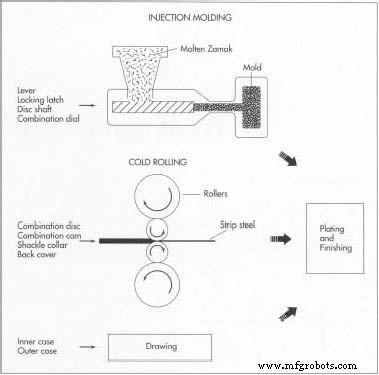 The components are produced through a mix of injection molding, cold rolling, and machining. After forming, most parts receive a protective plating to guard against corrosion.
Design
Internal components include the lever, lever post, disc shaft, and combination discs. The key precision element is the combination cam—a notched disc attached to the outer dial. Springs maintain tension on the discs, enabling smooth dialing. The shackle collar secures the shackle in the locked position, while the inner case houses all internal parts, giving the lock its structural strength.
External components comprise the outer case, shackle, back cover, and the dial. The entire mechanism is engineered to be compact, with internal parts not exceeding two inches (5.08 cm) in length.
The Manufacturing Process
The lock’s twenty parts are formed, drawn, cut, pressed, and molded using a combination of manual and automated machinery.
Making the Internal Components
- Lever, locking latch, and disc shaft are injection‑molded from molten zamak under high pressure. The disc cam and combination disc are cold‑rolled flat strip steel, then blanked into shape by a precision die. The internal spring is wound from stainless steel wire on an automatic spring winder.
- Shackle collar, inner case, and other flat‑steel parts are cold‑rolled and blanked, then drawn into their final shapes.
Making the Outer Parts
- Outer case and back cover are stamped from stainless steel sheet. The shackle is machined from round bar stock, forged into a U‑shape, notched, and annealed for strength. The dial is injection‑molded from zamak and chromized in a chromium salt bath, then painted for visibility.
Plating and Finishing
- Key components are chromized or cadmium‑plated for corrosion resistance. The shackle and latch receive copper‑nickel plating, while the outer case is mechanically polished to enhance luster.
Assembling the Lock
- Subassemblies—including the back plate, disc shaft, cam, and spacers—are integrated first. The outer and inner cases are riveted together, then the dial and cam are fastened. Finally, the shackle and latch are installed, and the lock case is sealed without removable fasteners.
Labeling and Packaging
- Each lock is tagged with its combination, determined by machine draw. Locks are typically sold in blister packs or individual boxes, ensuring tamper‑evidence and brand integrity.
Quality Control
Before packaging, manufacturers rigorously test each lock’s locking and unlocking sequence. Operators conduct additional inspections throughout production, ensuring that every lock meets stringent reliability and durability standards.
Manufacturing process
- Designing a 4‑Bit Combination Lock with XOR & NOR Gates
- Combination Tubes: Merging Multiple Functions into a Single Glass Envelope
- Inside Bank Vaults: History, Design, and Future of Security
- Canals & Locks: Engineering, History, and the Future of U.S. Water Transport
- The Evolution and Manufacturing of Modern Pin‑Tumbler Locks
- Create a Secure Arduino RFID Lock – Step‑by‑Step Guide
- Touch‑Free Gesture Lock: Secure Access with APDS‑9960 and Arduino
- Effortless Windows PC Security: RFID Lock & Unlock System
- M20 × 60 Mid‑Sized Combination Lathe – Versatile, High‑Performance Machine
- CNC Machine Lock: Accurate Program Testing Without Production