



The Evolution and Manufacturing of Modern Pin‑Tumbler Locks
Background
Locks have protected doors from theft since antiquity. The Old Testament references them, and the earliest physical evidence dates back roughly 4,000 years—Egyptian pin‑tumbler locks found in the pyramids. These early locks used a wooden housing, a wooden bolt, and iron pins that held the bolt in place until a specially shaped key lifted them.
By around 700 B.C., Greek engineers introduced a latch‑string mechanism that pulled a bolt through brackets. The key was a long, sickle‑shaped metal rod that could be inserted from the outside. While innovative, the design was vulnerable to simple curved tools and the cumbersome key size limited practicality.
Romans refined the system, creating the warded lock. Wards—notches in the keyhole—matched corresponding cuts in the key, allowing only the correct key to engage the bolt. Though smaller and easier to carry, warded locks remained relatively easy to pick, leading to widespread use across Europe until the 18th century.
Romans also employed padlocks: a key turned a bolt that released a spring‑loaded shackle. Parallel developments occurred in China, India, and Russia, including the Chinese combination lock that used interlocking rings to unlock a hasp when correctly aligned. These locks spread to Europe during the Middle Ages, especially in courier dispatch boxes.
During the Middle Ages, European locksmiths produced ornate but functionally limited locks. Apprenticeships lasted ten years; masters completed elaborate “masterpiece” locks that were more decorative than secure. Practical security improvements didn’t appear until the late 1700s, when Robert Barron patented the double‑action lever‑tumbler lock in 1788. Barron’s design introduced two spring‑loaded levers that had to be lifted simultaneously by the correct key, greatly increasing resistance to picking.
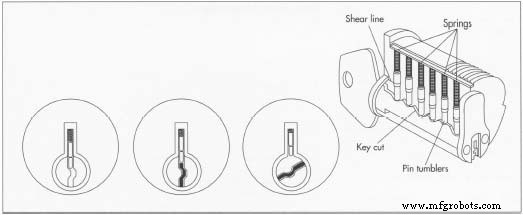
American locksmith Linus Yale Jr. made a breakthrough in 1861 with the modern pin‑tumbler lock. His design, similar in principle to the ancient Egyptian lock, used a rotating cylinder held by five spring‑driven pins of varying heights. The key’s five notches matched pin heights; correct alignment allowed cylinder rotation. Yale locks were difficult to pick and could be mass‑produced, rapidly becoming the industry standard.
In the 20th century, lock makers introduced timer locks for bank vaults, push‑button locks, and electronic locks that use magnetic or RFID cards. The following process outlines how a standard pin‑tumbler lock is manufactured today.
Raw Materials
Five‑tumbler locks are typically built from high‑strength metals. Internal components are usually brass or die‑cast zinc; the cam or bolt is steel or stainless steel; the outer casing can be brass, chrome, steel, nickel, or another durable alloy.
The Manufacturing Process
Design
- Locks are graded from low‑security to high‑security. Low‑security models use inexpensive materials and mass‑production techniques, often offering a limited range of configurations.
- High‑security locks are custom‑designed. The manufacturer first evaluates the customer’s specifications—door size, lock type, and keying options such as master keying. If a customer requests copies of existing locks from a different supplier, reverse engineering is performed to replicate functionality without infringing patents.
- Design phases can take 8–12 weeks for medium or high‑security orders, from specification receipt to shipping.
The Key
- For a five‑tumbler lock, key blanks are purchased and cut to five unique ridge levels—typically numbered 1 through 4 or 1 through 7. The combination (e.g., 12341) defines the ridge heights, generating up to 1,024 unique keys for a four‑level system.
Internal Mechanisms
- Custom‑engineered pins and springs are cast, grooved, and polished to tolerances of ±0.001 inch. Machines are often re‑tooled between orders, and trial runs verify precision before full production.
Other Parts
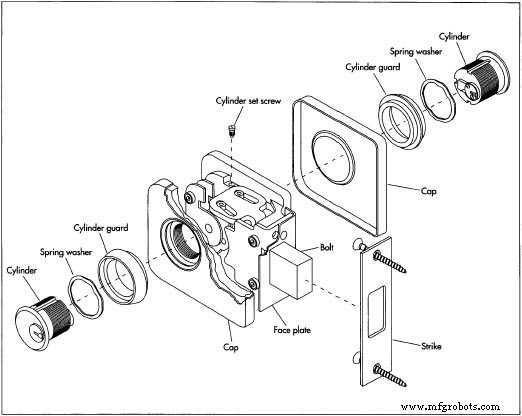
- The cylinder, guard plates, washers, bolt, and casing are die‑cast and machined to specification. A modest lock may contain around thirty separate components, some requiring multiple toolings, which can add weeks to production.
Assembly
- Skilled technicians assemble locks by hand. The cylinder is loaded with pins that match the key’s combination, a spring is inserted, and a lock pick—equipped with a screwdriver tip—places each component precisely.
Final Steps
- Once assembled, each lock is tested with the corresponding key. Approved units undergo a final quality check, dusting or polishing, packaging, and shipment.
Quality Control
Ensuring that each machined part meets exact specifications is paramount. For new orders, machinists produce and manually inspect trial samples with precision gauges. Subsequent parts may undergo spot checks, with one in every 500–1,000 units examined. Post‑assembly, locks are tested with keys, and a quality control specialist may conduct final inspections.
The Future
Large institutions—universities, corporate campuses, and governmental facilities—are increasingly adopting electronic pass‑key systems that use magnetic swipe cards, barcodes, or biometric sensors (voice, palm, or fingerprint). While offering enhanced security and audit trails, these systems raise privacy concerns and remain cost‑prohibitive for most homeowners. Nonetheless, the trend toward computer‑controlled locks is accelerating and is expected to dominate the security landscape in the coming decades.
Manufacturing process
- Amber: From Ancient Resin to Scientific Treasure – History, Properties, and Modern Uses
- The Guillotine: History, Design, and Legacy
- Silicon: Properties, Production, and Market Outlook
- The Ukulele: From Portuguese Roots to Modern Craftsmanship
- The Complete Guide to the U.S. Chicken Industry: History, Production, and Quality Control
- Compost: The Ultimate Soil Enrichment Solution
- Gelatin: From Ancient Protein to Modern Applications – Production, Uses, and Safety
- Vodka: From Ancient Distillation to Modern Production
- Milk: Production, Processing, and Nutrition in the United States
- The History and Modern Production of Mascara: From Ancient Kohl to Contemporary Formulations