



The Ukulele: From Portuguese Roots to Modern Craftsmanship
Background
The ukulele is a four‑string chordophone that evolved from the Portuguese machete, a small, guitar‑shaped instrument. Its sound is produced by plucking or strumming the strings, which vibrate inside a resonant wooden body. The construction techniques are closely related to those of full‑size acoustic guitars.
History
Stringed instruments have been crafted for millennia, with the earliest single‑stringed bows traced back over 3,000 years in Asia and Africa. In Portugal, the ancestor of the modern ukulele emerged around 139 B.C. within the Lusitani tribe. Subsequent influences from Spanish, South American, and African instruments led to the widespread use of four‑string chordophones by the 13th century.
While the ukulele is synonymous with Hawaiian culture, it was first introduced to the islands in 1879 by Portuguese immigrant João Fernandez aboard the ship Ravenscrag. Fernandez played a four‑string Portuguese instrument called a braghuina. Hawaiian listeners, captivated by the instrument’s lively, “jumping flea” feel—an apt translation of ukulele—quickly adopted and renamed it. Within a decade, it became Hawaii’s most beloved instrument.
Early ukuleles were handcrafted, resulting in limited production before 1910. The advent of specialized woodworking machinery accelerated manufacturing, and the instrument’s design was refined to resemble the modern ukulele. Pioneering luthier Manuel Nunes replaced steel strings with gut, introduced a chord‑friendly tuning pattern, and began using koa wood to achieve a lighter, more resonant tone.
The ukulele crossed the Atlantic during the 1915 Panama‑Pacific Exposition in San Francisco. Hawaiian music sales surged, prompting U.S. guitar manufacturers to produce their own versions. By the 1920s and 1930s, the ukulele had become a staple of vaudeville and later jazz, establishing itself as a versatile solo instrument.
In 1950, renowned guitar maker Mario Maccaferri introduced the plastic “TV Pal” ukulele. The durable, affordable instrument sold over nine million units by 1958, fueled by the popularity of the television show Arthur Godfrey and his Ukulele.
Raw Materials
The body of a ukulele is primarily wood, though plastic variants exist. Producers source hardwoods worldwide—including Hawaiian koa, maple, walnut, rosewood, myrtle, Brazilian canary, cocobolo, madrone, elm, lacewood, and black limba—each imparting distinct tonal characteristics. Mahogany, a “soft” hardwood, is prized for its warm, mellow tone and superior aging. Koa, revered for its unique grain and color, is often used in its entirety to create a singular instrument.
Other materials include nylon or steel strings, various glues (superglue, aliphatic, hide glue, epoxy), lacquers for protection and aesthetics, and synthetic adhesives for tropical durability.
Design
The ukulele is a portable, guitar‑shaped instrument featuring a short neck, a resonant body, four strings, tuning pegs, a bridge, a fretboard, and a soundhole. Variants—soprano, concert, tenor, baritone—differ mainly in scale length. The soprano is the most common, measuring roughly 21 in (53 cm), and its strings are tuned G‑C‑E‑A.
The Manufacturing Process
Each component is crafted separately before final assembly. The process begins with careful wood selection, the single most critical factor influencing tone and appearance.
Bookmatching
- The front and back plates are created by cutting a single board into two halves, producing a symmetrical grain pattern. After kiln drying, the halves are glued and sanded to the desired thickness.
- A shaping machine then carves the instrument’s outline, including the soundhole on the front plate.
Strutting
- Wooden braces are glued beneath the front plate to reinforce the structure against string tension and control vibrational modes. The back plate receives similar bracing for added strength.
Making the Sides
- The sides are cut, softened in water, and molded to the curved shape of the ukulele. The ends are joined with glue at the neck pocket, and endblocks are attached near the top and bottom to anchor the front, back, and neck.
- After side assembly, the front and back plates are glued on, excess wood is shaved off, and joints are sanded smooth.
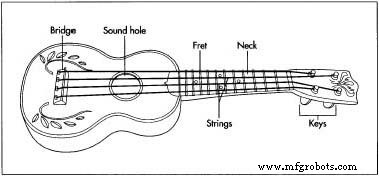
A ukulele.
Neck Production
- The neck is carved from a single, often harder wood to withstand string tension. It is sanded, and a fingerboard is affixed. Frets—thin metal or wooden strips—are inserted into cut grooves to enable accurate pitch changes.
- Once glued to the body, the entire instrument is finished with stain or paint.
Attaching the Bridge
- The bridge and saddle sit just below the soundhole, held in place by small screws and glue. A second bridge sits atop the neck, and the saddle anchors the string ends.
- At the top, four tuning pegs are drilled into the headstock, each fitted with a gear‑mechanism tuning key to tighten the strings.
Attaching the Strings
- Strings are tied to the saddle and routed to the pegs. The tuning keys are turned to set correct pitch. The finished instrument undergoes inspection before packaging. Depending on the maker, the entire process can span several weeks.
Quality Control
By 2000, only three major ukulele manufacturers remained worldwide, many of which produce instruments by hand. This allows for meticulous inspection at every stage—from raw material evaluation to final product testing—ensuring that flaws are identified and corrected before shipment.
The Future
Future advancements will aim to enhance quality, expand sales, and increase output. Innovations focus on sourcing new wood blends for cleaner, more consistent tone; improving string materials; and introducing automation to accelerate production while maintaining craftsmanship. These efforts will support the ukulele’s growing global popularity.
Manufacturing process
- Amber: From Ancient Resin to Scientific Treasure – History, Properties, and Modern Uses
- The Guillotine: History, Design, and Legacy
- Silicon: Properties, Production, and Market Outlook
- The Complete Guide to the U.S. Chicken Industry: History, Production, and Quality Control
- Compost: The Ultimate Soil Enrichment Solution
- Gelatin: From Ancient Protein to Modern Applications – Production, Uses, and Safety
- The Evolution and Manufacturing of Modern Pin‑Tumbler Locks
- Vodka: From Ancient Distillation to Modern Production
- Milk: Production, Processing, and Nutrition in the United States
- The History and Modern Production of Mascara: From Ancient Kohl to Contemporary Formulations