



The History and Modern Production of Mascara: From Ancient Kohl to Contemporary Formulations
Background
Mascara is a cosmetic designed to enhance the lashes by making them appear thicker, longer, and darker. Its roots trace back to ancient Egypt, where it may have been in use as early as 4000 B.C. Egyptians applied a substance called kohl—likely composed of galena, lead sulfite, malachite, and charcoal—to darken lashes, eyebrows, and eyelids. The Babylonians, Greeks, and Romans followed suit, while the Arab world preserved the tradition after the fall of Rome. A resurgence of eye cosmetics in Europe began during the Renaissance, setting the stage for modern mascara.
Early contemporary mascara appeared as pressed cakes that users applied with a wetted brush. These cakes typically contained 50 % soap and 50 % black pigment, ground, milled, and pressed into compact shapes. A later variation was the cream mascara, a lotion‑like formula housed in tubes; users would squeeze a small amount onto a brush, a process that proved cumbersome until the 1960s when a grooved applicator was patented. This device, later replaced by a flexible brush, made mascara easier to apply and contributed to its surge in popularity.
Raw Materials
Modern mascaras are formulated in countless ways, but all share a few core components. In the United States, federal regulations ban pigments derived from coal or tar, so manufacturers rely on natural colors and inorganic pigments. Carbon black provides the classic black hue, iron oxides deliver brown shades, and ultramarine blue appears in some specialty formulas. Many mascaras are emulsions of oils, waxes, and water: beeswax, carnauba wax, and paraffin are common waxes; mineral oil, lanolin, linseed oil, castor oil, turpentine oil, eucalyptus oil, and sesame oil serve as oils. Alcohol, stearic acid, ceresin, and gums such as tragacanth or methyl cellulose are also frequently added. Fine rayon fibers may be incorporated to increase viscosity.
The Manufacturing Process
Two primary manufacturing routes are employed today: the anhydrous method, which uses no water, and the lotion‑based emulsion method.
Anhydrous method
- Ingredients are precisely weighed and measured before being transferred to tanks or kettles that produce a batch of 10–30 gal (38–114 l). The mixture is heated to melt the waxes, then agitated—typically by a propeller blade—until a semi‑solid state is reached.
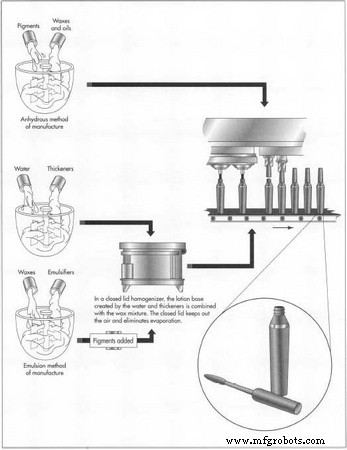 The resulting product is ready for packaging.
Emulsion method
- Water and thickeners are first combined to create a lotion or cream base. Separately, waxes and emulsifiers are melted and pigments added. The two mixtures are then combined in a high‑speed homogenizer that blends them without incorporating air or causing evaporation. The homogenizer reduces the waxes and oils into microscopic beads that remain suspended in water, producing a smooth, stable formula. Homogenizers vary in size—from as little as 5 gal (19 l) to as large as 100 gal (380 l)—and the mixing continues until the mixture cools to room temperature.
- Both methods share common downstream steps: cooling, transfer to a tote bin, rolling to the filling area, and emptying into a hopper.
Filling
- After cooling, the mascara is pumped by a filling machine that dispenses a measured amount—typically 0.175 oz (5 g)—into glass or plastic bottles. Bottles are capped manually, and samples are removed for inspection before the remaining units are prepared for distribution.
Quality Control
Quality checks occur at multiple stages: ingredients are verified in the tank before mixing, rechecked after mixing, and samples from the start, middle, and end of each batch are tested for chemical composition and microbiological purity.
The Future
Today’s market features mascaras with all‑natural ingredients, closely mirroring formulas that could have been crafted a century ago. Emerging developments include bold, vivid pigments derived from plastics, currently popular in lipsticks, which could offer new aesthetic possibilities for mascara manufacturers.
Manufacturing process
- Amber: From Ancient Resin to Scientific Treasure – History, Properties, and Modern Uses
- The Guillotine: History, Design, and Legacy
- Silicon: Properties, Production, and Market Outlook
- The Ukulele: From Portuguese Roots to Modern Craftsmanship
- The Complete Guide to the U.S. Chicken Industry: History, Production, and Quality Control
- Compost: The Ultimate Soil Enrichment Solution
- Gelatin: From Ancient Protein to Modern Applications – Production, Uses, and Safety
- The Evolution and Manufacturing of Modern Pin‑Tumbler Locks
- Vodka: From Ancient Distillation to Modern Production
- Milk: Production, Processing, and Nutrition in the United States