



The History, Ingredients, and Production of Marshmallows
Background
Marshmallows rank among the oldest sweets known to humanity. Modern varieties span solid pillows, semi‑liquid confections, and creamy toppings, yet all share a common airy structure.
History
Originally, marshmallows were crafted from the sap of the marsh mallow (Althaea officinalis), a herb native to parts of Europe, North Africa, and Asia. The plant thrives in wet habitats, sporting a fleshy stem, leaves, and pale five‑petaled flowers. Early Egyptians, as far back as 2000 B.C., blended marsh‑mallow root with honey to create a confection reserved for royalty and the divine.
The root also possessed medicinal properties: it functioned as a laxative, a poultice for inflammation, and a soothing remedy for coughs and sore throats. Because production was limited to small, artisanal batches, only the wealthy could indulge in these treats until the mid‑nineteenth century. Physicians sometimes hid medication inside candy to mask unpleasant tastes.
The first industrially‑produced marshmallows appeared in France around 1850. French confectioners used the root sap as a binder with egg whites, corn syrup, and water, pouring the heated, airy mixture into small corn‑starch molds. Though still handcrafted, these creations marked the beginning of mass production.
By 1900, marshmallows were available to the general public, sold in tins as penny candy. The late‑nineteenth‑century "starch mogul" system revolutionized production: a machine filled trays with a 2‑inch (5.08 cm) layer of starch, pressed a mold into it, and injected hot cream. The initial moguls were wooden, but steel versions were standard by 1911. Gelatin and other whipping agents replaced the marsh‑mallow root in the recipe.
In 1955, nearly 35 U.S. manufacturers produced marshmallows. Alex Doumak of Doumak, Inc. patented the extrusion process, cutting production time to just 60 minutes—a method still employed today. Currently, only three U.S. manufacturers remain: Favorite Brands International (Kraft marshmallows), Doumak, Inc., and Kidd & Company.
Raw Materials
Marshmallows are composed of a handful of ingredients that fall into two primary categories: sweeteners and emulsifying agents. Sweeteners—corn syrup, sugar, and dextrose—provide sweetness and control crystallization. Corn syrup predominates because it enhances solubility. Corn starch, modified food starch, water, gum, gelatin, and/or whipped egg whites are blended to achieve the desired texture, acting as emulsifiers that maintain fat distribution and create the airy foam. Plant‑derived gums also serve as gelling agents.
Most varieties contain natural or artificial flavorings; colored marshmallows typically use artificial dyes.
The Manufacturing Process
Cooking
- 1. A solution of sugar and corn syrup is dissolved in water and boiled. Egg whites and/or gelatin are incorporated, then heated in a cook kettle to about 240°F (115°C). The mixture is strained to remove any solids.
- 2. The resulting syrup is pumped into a mixer where it is beaten into foam that expands two to three times its original volume. Flavorings are added at this stage.
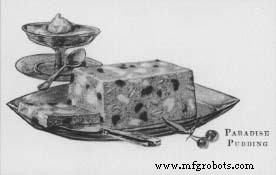 Paradise pudding from the recipe booklet \"The Jell‑O Girl Entertains\", circa 1930. (From the collections of Henry Ford Museum & Greenfield Village.)
In the early twentieth century, marshmallows were considered a child’s confection, sold as penny candy alongside licorice whips and peppermint drops. A fortuitous alignment with popular foods and savvy marketing transformed them into a staple at pot‑luck dinners, family gatherings, and even upscale events.
Cookbooks of the era reveal marshmallows as versatile ingredients in cakes, candies, and desserts, as well‑known toppings for hot cocoa, and as roasted treats at picnics. They also found their way into salads and side dishes—most famously atop baked sweet potatoes or yams at Thanksgiving tables.
The 1935 booklet "Campfire Marshmallow Cookery" expanded classic recipes with 50 "perfect" dishes, ranging from everyday items like marshmallow ice‑box loaf and campfire rice pudding to specialty desserts such as dainty marlow pastries and mallobets (ice creams and sherbets).
A defining moment came when marshmallows joined gelatin‑based salads and desserts, which surged in popularity during the 1920s and 1930s. Jell‑O and Knox Gelatine recipe books from that period frequently called for marshmallows, featuring treats like banana fluff, lime mallow sponge, cocoa tutti frutti, and paradise pudding.
Donna R. Braden
Forming
- 3. The heated mixture is transferred to a heat exchanger. Air is pumped into it, cooling it in a tempering kettle and passing it through a second filter before reaching the "hill." Marshmallows are extruded through a machine or deposited onto moving bands.
- The extrusion process forces the foam through a die, yielding the familiar pillow shape. A coating of corn starch is applied to reduce stickiness and preserve shape. In some lines, pillows are joined into ropes, then cut and dried on a rubber conveyor belt.
Cooling
- 4. After shaping, pillows travel through a cooling drum that removes excess starch and brings them to packaging temperature.
Packaging
- 5. Once cooled, marshmallows are weighed, packaged, and often screened by a metal detector. The case is coded, dated, and shipped to retail outlets.
Quality Control
Throughout production, marshmallows undergo rigorous checks for extraneous matter. Strainers, screens, metal detectors, and visual inspections ensure consistent quality. Manufacturers establish standards for size and texture; an ideal marshmallow is light and airy, a result of precise air incorporation during beating.
Optimal bubble size and distribution within the foam are critical. Small, evenly distributed bubbles yield a stable, syrup‑free product. Larger bubbles can cause syrupy layers and voids, indicating subpar quality.
Manufacturing process
- The Art and Craft of Headstones: History, Materials, and Modern Manufacturing
- The Spork: Evolution, Materials, and Modern Manufacturing
- The Evolution and Craft of the Modern Swimsuit: From Ancient Pools to High‑Tech Fabric
- The Art and Evolution of the Corkscrew: From Ancient Tool to Modern Engineering
- Footbag: From Ancient Training Tool to Global Sport
- The Craft and Science Behind Everyday Shoelaces
- Skateboarding: History, Design, and Modern Manufacturing
- Doorknob: History, Design, and Modern Manufacturing
- The Carousel: From Ancient Revolving Rides to Modern Craftsmanship
- Sofa: From Ancient Luxury to Modern Comfort – A Comprehensive Guide