



The Evolution and Craft of Modern Fishing Rods
Background
A fishing rod is a lightweight, flexible pole designed for casting and retrieving a line that is guided along its length by a series of rings. The line, usually wound on a reel, is deployed and reeled back by the angler. At the end of the line a hook holds bait—live worms, insects, or artificial lures—while bobbers and sinkers maintain the desired depth.
History
Humans have harvested aquatic life since the dawn of civilization, employing simple nets, weirs, and early rods. The earliest rods, called gorges, were short wooden or stone sticks. Over time, they evolved into longer, more sophisticated tools.
By 2000 B.C. ancient Egyptians were using rods as a recreational activity. Chinese records from the 4th century B.C. describe bamboo rods with silk lines and needle‑hooks, while Greek and Roman texts from 900 B.C. and 400 B.C. mention barbed hooks and horsehair or flax lines. The Mediterranean reed Arundo donax and hardwoods like cornel and juniper were common materials.
Roman scholars such as Plutarch emphasized a slender, springy rod to avoid casting shadows that might scare fish. In England, Dame Juliana Berners' 1496 treatise documented 18–22‑ft rods and horsehair lines that still influence fly‑fishing today.
The 17th century introduced the wire loop at the tip, making line handling easier and prompting the development of the first wooden reels with metal rings. By 1770, guided rods and reels were standard.
The 19th century saw the adoption of tough woods from the New World—lance‑wood, greenheart—and bamboo. Hexagonal rods laminated from six bamboo strips emerged, and reels became more efficient. The 20th century brought fiberglass, carbon fibre, nylon lines, and plastic lures. In 1992, the U.S. sold 31 million fishing licences—a stark increase from 20 million in 1959.
Raw Materials
- Blank cores: fiberglass or carbon fibre composites.
- Ferrules: metal or fiberglass.
- Grip: natural cork, occasionally foam or synthetic polymers.
- Reel seats: aluminum, brass, or durable plastics.
- Guides: chrome‑plated brass, tungsten carbide, or nickel‑silver alloys.
The Manufacturing Process
Making Bamboo Blanks
- Bamboo canes (6–8 ft long, 1.25–2 in wide) are split, partitions removed, and optionally resin‑treated for strength and waterproofing.
- Precision cutting produces strips with a tolerance of 0.03 mm. Six strips form a hexagonal blank; five can create a pentagonal one. Strips are glued under pressure, trimmed, and lightly sanded.
Making Synthetic‑Fiber Blanks
- Fiberglass is produced by melting a glass mixture (silicon dioxide, limestone, and other oxides) with cullet, then extruding the melt through spinnerets to form fibers. The fibers are woven into sheets.
- Carbon fibre originates from polymer precursors such as rayon or acrylic. Heat treatment removes non‑carbon atoms, leaving long chains of carbon atoms that are then spun and woven.
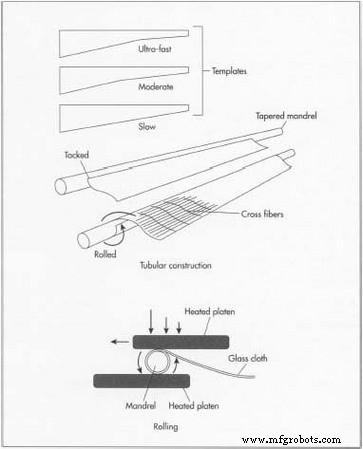
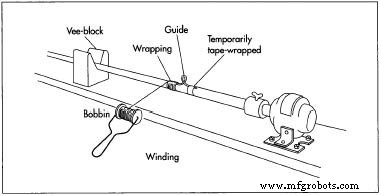
- Sheets are coated with liquid resin, rolled around a steel mandrel, and cured at 300–350 °F (150–180 °C). The hardened blank is stripped from the mandrel, cleaned, and finished with protective coatings.
Assembling the Rod
- Most rods comprise two or three blanks joined by ferrules and bonded with epoxy or high‑strength adhesive.
- Grips—usually cork—are glued to the blank ends.
- Guides are mounted along the rod, secured with nylon thread and lacquered.
- Reel seats are affixed, then the rod is packaged for shipment.
- Consumers assemble the rod, attach a reel, and thread line through the guides.
Quality Control
Every new design undergoes prototype testing across varied outdoor conditions. Adjustments continue until the rod meets performance targets. Uniform pressure during fiber wrapping, even protective finishes, and precise component fit—ferrule alignment, guide spacing—are critical to ensure reliability.
The Future
Innovation continues to push casting distance, accuracy, and specialization. Emerging models target specific fish sizes and species. A notable breakthrough is Daiwa’s Interline rod, which eliminates guides entirely; the line travels through the rod’s center, reducing tangles and guide wear.
As materials science advances, we can expect further reductions in weight, increases in strength, and greater customization for niche angling disciplines.
Manufacturing process
- The Art and Craft of Headstones: History, Materials, and Modern Manufacturing
- The Spork: Evolution, Materials, and Modern Manufacturing
- The Evolution and Craft of the Modern Swimsuit: From Ancient Pools to High‑Tech Fabric
- The Art and Evolution of the Corkscrew: From Ancient Tool to Modern Engineering
- Footbag: From Ancient Training Tool to Global Sport
- The Craft and Science Behind Everyday Shoelaces
- Skateboarding: History, Design, and Modern Manufacturing
- Doorknob: History, Design, and Modern Manufacturing
- The Carousel: From Ancient Revolving Rides to Modern Craftsmanship
- Sofa: From Ancient Luxury to Modern Comfort – A Comprehensive Guide