



The Spork: Evolution, Materials, and Modern Manufacturing
Background
A spork is a hybrid utensil that combines the scoop of a spoon with the prongs of a fork. Typically, it features a handle, a shallow bowl, and short tines that can pick up solid food. Often called a runcible spoon, the spork is widely used as a disposable utensil in take‑out restaurants and is usually made from polypropylene or polystyrene via thermoforming.
History
Human use of eating implements dates back to sharp stones and shells. Early spoons emerged from carved wood by the 5th century, while the first forks appeared in Greece around the 5th century BC and became common in Europe only in the 16th century. The concept of a combined spoon‑fork appeared in a U.S. patent in 1874 and the term “spork” was coined in 1970 by the Van Brode Milling Company.
Raw Materials
Sporks are produced from steel, wood, glass, and most commonly plastic. FDA‑approved polymers—polypropylene (PP) and polystyrene (PS)—provide chemical resistance, durability, and food safety. Additives such as titanium dioxide for whiteness, plasticizers for flexibility, and stabilizers for heat resistance enhance performance and manufacturability.
Design
Key design elements include a comfortable handle, a shallow bowl for liquids, and tines for solids. Some variants incorporate a knife edge for versatility. The shape balances strength with minimal material use.
The Manufacturing Process
1. Creating a Plastic Sheet
- Polymer pellets are melted in an extruder at 400–550°F (204–288°C) and extruded into a thin sheet.
- Water‑chilled rollers further thin and stretch the sheet, which is then wound onto spools or cut into flat sheets.
2. Thermoforming
- A steel mold with a mirrored cavity shapes the spork.
- Heat softens the sheet; a vacuum pulls it into the mold.
- Once cooled, a stamping plate cuts individual sporks and may emboss logos.
- Excess plastic is recycled or reprocessed.
3. Assembly and Packaging
- Sporks are typically wrapped in a thin film with a napkin; optional salt/pepper packets are added.
- Automated folding and stamping seal each package.
- Packages are stored, sealed, and palletized for shipment.
Quality Control
Quality assurance includes pre‑manufacturing material tests (molecular weight, composition), in‑line visual inspections, and mechanical testing (stress‑strain) to ensure sporks can reliably lift solid foods. Defective units are removed and reworked.
By‑Products and Waste Management
Unusable plastic is minimized through source reduction and recycling. Finished disposable sporks end up in recycling streams, incineration (producing CO₂, H₂O, and inert ash), or landfills.
The Future
Industry trends focus on faster production, lower material costs, and reduced waste. Biodegradable alternatives such as wheat‑gluten resin and soybean‑based polymers are emerging. Expanding adoption in fast‑food chains can further drive demand.
Where to Learn More
Books
Chabot, J. The Development of Plastics Processing Machinery and Methods. Society of Plastics Engineers, 1992.
Giblin, James Cross. From Hand to Mouth, Or, How We Invented Knives, Forks, Spoons and Chopsticks, and the Manners to Go with Them. Crowell, 1987.
Petroski, Henry. The Evolution of Useful Things. Vintage Books, 1994.
Seymour, R., and C. Carraher. Polymer Chemistry. Marcel Dekker, 1992.
Other Resources
Albanese, Joseph. U.S. Patent 4,984,367 Combination Utensil, 1991.
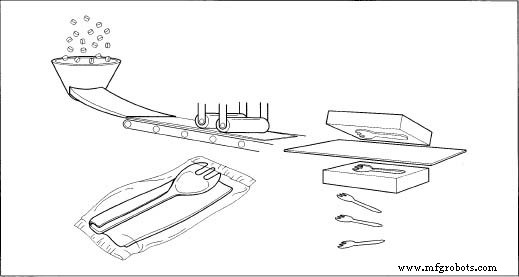
Manufacturing process
- Titanium: Key Properties, Applications, and Industrial Uses
- Skateboarding: History, Design, and Modern Manufacturing
- Castanets: History, Craftsmanship, and Performance
- The History, Production, and Future of Glue: From Ancient Adhesives to Modern Innovations
- Thread: Types, History, Production, and Quality Control
- Acetylene: Production, Uses, and Handling – A Comprehensive Overview
- Comprehensive Overview of Asbestos: From Ancient Uses to Modern Health Risks
- The Carousel: From Ancient Revolving Rides to Modern Craftsmanship
- The History, Design, and Manufacturing of Dice: From Ancient Tools to Modern Gaming
- Plywood: History, Production, and the Path Ahead