



The History, Production, and Future of Glue: From Ancient Adhesives to Modern Innovations
Background
In the United States, the average person uses roughly 40 lb (18.2 kg) of glue each year—an amount that underscores how integral adhesives are to modern life. From furniture and plumbing to shoes, books, buildings, and automobiles, glue plays a pivotal role in countless industries.
Glue belongs to the broader family of adhesives, distinguished by its origin in natural organic compounds versus chemically synthesized polymers. While epoxies, caulks, and sealants are also chemical-based, they contain specialized additives tailored to specific applications.
Historical glue recipes trace back to ancient tribes that processed animal tissues—bones, hides, skins, and sinew—to extract collagen, the protein responsible for stickiness. Milk solids (casein) and blood albumin have also served as bases; for example, cow serum becomes coagulated albumin when heated, yielding a water‑insoluble glue.
Fish glue, derived from heads, bones, and skins, was historically thinner and less adhesive. The breakthrough came with the use of fish air bladders, producing a white, tasteless adhesive known as isinglass or ichthocol.
Three primary categories of natural glue exist: bone glue, hide or skin glue, and fish glue. Other sticky substances—adhesives, gums, and cements—are often used interchangeably in everyday language, though they differ chemically.
Vegetable glues, sourced from plant starches, include agar (from marine plants), algin (from seaweed), and gum arabic (from the acacia tree). Marine glue, a tar or pitch mixture, is sometimes mistaken for true glue but is not a traditional adhesive.
History
The earliest evidence of glue dates to Neanderthal cave paintings in Lascaux, France, where artists mixed glue with pigments to preserve colors against cave moisture. Egyptian tomb artifacts reveal extensive glue use: from 3,000 B.C., veneers and inlays in wood furniture relied on animal‑based adhesives, and papyrus manufacturing also employed glue. Greek and Roman mosaics, still intact today, further attest to the durability of ancient adhesives.
Throughout the 16th–19th centuries, master cabinetmakers—Chippendale, Hepplewhite, Duncan Phyfe, the Adams brothers, and Sheraton—used animal hide glue for precision joinery. These glues, made from ground hide or bone jelly, were brown, brittle, hard, and non‑waterproof. They remained the standard until World War I, when casein and nitrocellulose glues entered production.
The 1930s saw the rise of synthetic adhesives, and World War II accelerated innovation with neoprene, epoxy, and acrylonitrile formulations. These advanced materials, initially restricted to military use, became commercially available in the late 1940s and 1950s. Today, highly specialized waterproof adhesives support industries ranging from aerospace—used in the Space Shuttle—to woodworking and industrial processes such as colloid formation for liquid purification.

Peter Cooper—philanthropist, inventor, and industrial pioneer—secured a near‑monopoly on American glue manufacturing after refining a glue‑making process and establishing a dedicated factory. His ventures spanned ironworks, railroads, telegraph infrastructure, and early mechanical inventions, exemplifying the transformative impact of adhesive technology on 19th‑century industry.
Raw Materials
Glue manufacturers source animal bones and tissues from slaughterhouses, tanneries, and meat‑packing facilities. The world’s largest glue producer, the Borden Company, exemplifies the dairy industry's role in providing casein‑based glues. Common raw inputs include ears, tails, hide scraps, tendons, bones, and feet. Fish glue producers similarly harvest heads, scales, and skins from canneries.
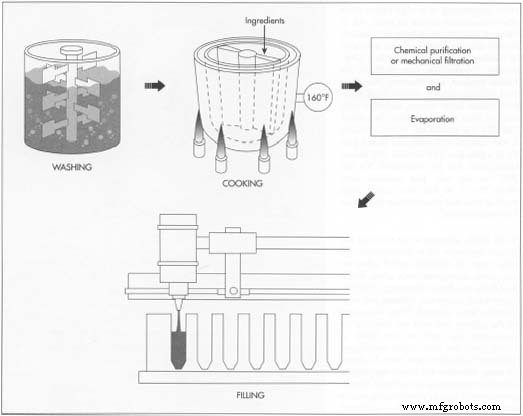
The core manufacturing steps—washing, soaking, cooking, and refining—are essentially identical for bone, hide, and fish glues. The process yields a “glue liquor” that is reheated, clarified with alum or acid, and optionally treated with egg albumin to remove impurities.
The Manufacturing Process
Making Hide or Skin Glue
- Hides and other scraps are washed to remove dirt and then soaked to soften them. The resulting stock undergoes successive lime baths to swell and break down the tissues. Lime is rinsed out, and weak acids (acetic or hydrochloric) eliminate residual lime before the stock is cooked either in open tanks or under pressure in autoclaves.
- Controlled heating—typically 160 °F (70 °C) with multiple temperature or pressure stages—breaks down collagen into glue. The extracted liquid, or “glue liquor,” is reheated to increase viscosity.
- After cooling, the gelatin‑like material contains impurities. Clarification with alum or acid followed by egg albumin precipitates these contaminants. Mechanical filtration or bone char can also be employed.
- Additives such as sulfurous acid, phosphoric acid, alum, or zinc oxide adjust the final product’s color and properties, producing brown, clear, or white “school glue.”
- The liquid is concentrated in vacuum evaporators and dried into sheets, blocks, or beads. These are then mixed to the desired consistency and bottled for distribution.
Making Bone Glue
Bone glue production is more intricate. Bones are degreased, then treated with an 8 % hydrochloric acid solution to remove calcium phosphate and other minerals, leaving collagen in its native shape. The acid is neutralized and the collagen dried to produce ossein or acidulated bone. This base is then processed via the same open‑tank method used for hide glue.
Quality Control
Manufacturers monitor every step with precision instruments, computerized controls, and visual inspection to prevent temperature or pressure errors that could compromise large batches. Proximity to raw material sources reduces contamination risks and enhances worker safety, while strict sanitation protocols ensure a pure final product.
Byproducts & Waste
Glue is an inevitable byproduct of dairies, meat‑packing plants, and other facilities that generate the raw materials required for its production.
The Future
Adhesives are increasingly replacing traditional fastening methods—stitching, stapling, and mechanical fasteners—across manufacturing sectors. Medical adhesives are poised to treat roughly one‑third of all wounds, potentially eliminating sutures in many cases. Researchers continue to explore novel applications, reinforcing glue’s reputation as a versatile, life‑enhancing material.
Manufacturing process
- Titanium: Key Properties, Applications, and Industrial Uses
- Castanets: History, Craftsmanship, and Performance
- Thread: Types, History, Production, and Quality Control
- Acetylene: Production, Uses, and Handling – A Comprehensive Overview
- Comprehensive Overview of Asbestos: From Ancient Uses to Modern Health Risks
- The History, Design, and Manufacturing of Dice: From Ancient Tools to Modern Gaming
- Plywood: History, Production, and the Path Ahead
- Tin: From Bronze Age to Modern Industry – Uses, Production, and Future
- Silver: History, Properties, and Modern Applications
- The Evolution and Production of Toothpaste: From Ancient Remedies to Modern Fluoridated Formulas