



The History, Design, and Manufacturing of Dice: From Ancient Tools to Modern Gaming
Background
Dice are small, weighted objects used to generate random outcomes in games and divination. With a history spanning thousands of years, they are among the earliest gaming instruments known to humanity.
History
Evidence of dice in Egyptian tombs dates back to 2000 B.C., indicating that the civilization used bone and clay tools for gaming and divination. Similar bone dice, marked on four faces, were found in pre‑Columbian cultures across the Americas, suggesting a magical use to predict the future. The ancient Greeks and Romans also employed bone and ivory dice in a variety of shapes and sizes. The modern six‑sided cube, first documented in China around 600 B.C., likely entered Europe in the 14th century via Marco Polo. Until the 20th century, dice were handcrafted and produced on a small scale; the advent of plastic manufacturing enabled mass production and numerous patents for improved processes.
Design
The standard die is a six‑sided plastic cube, each face marked with one to six dots arranged so that opposite sides sum to seven. When rolled, a fair die has an equal probability of landing on any side. Dice find use in gambling games such as craps, chuck‑a‑luck, and poker dice, as well as in board games like backgammon, Monopoly, and Parcheesi.
Standard board‑game dice are typically 12 mm in size and feature rounded corners, which slightly reduce randomness but meet toy‑safety standards for children. Casino dice are larger (33 mm), precision‑cut with sharp edges, and usually translucent red with white dots, providing the highest level of fairness.
Specialty dice expand the classic format: words, images, or symbols replace dots; divining dice carry predictive messages; poker dice display card faces; Braille dice serve visually‑impaired players; and poly‑dice (3–20 sides) offer expanded outcome ranges for fantasy role‑playing games.
The core of dice production is the mold. A typical mold consists of two halves that form a cavity. For standard dice, a single‑piece mold would cool too slowly; therefore, a multi‑chamber design is used. Each chamber forms a die segment that cools rapidly; the segments are then assembled into a single cube. Release agents aid in ejecting the finished die, saving time and ensuring quality.
Raw Materials
Historical dice were made from bones, glass, wood, seeds, and metals. Modern dice are almost exclusively plastic. The preferred material is a thermoset polymer such as polymethyl methacrylate (PMMA) or cellulose‑based plastics, chosen for impact strength, colorability, heat stability, and clarity. Colorants—soluble dyes or pigment powders—add visual appeal. Titanium dioxide creates white, iron oxides yield yellow, red, black, brown, or tan hues, while organic dyes (e.g., pyrazolone reds, quinacridone violet) offer vivid colors.
Additional additives improve performance: plasticizers (paraffinic oils, glycerol) increase flexibility; reinforcements (fiberglass) enhance durability; stabilizers (soybean oil, benzophenones) protect against heat and UV degradation; antioxidants (aliphatic thiols) mitigate environmental oxidation; and processing aids (ethoxylated fatty acids, silicones, metal stearates) facilitate mold release.
The Manufacturing Process
The production cycle for mass‑produced dice typically follows injection molding, painting, and packaging. Below is a step‑by‑step overview.
Forming
- 1. Plastic pellets, pre‑colored and filled, are fed into a hopper and conveyed by a hydraulically‑controlled screw. The screw heats and melts the material, which is then injected by a spreader into a cooled, closed two‑piece mold.
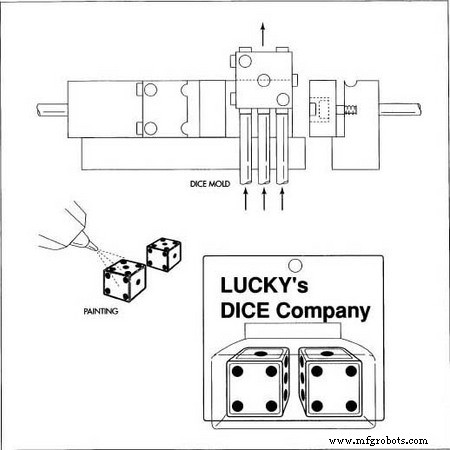 The mold’s chambers produce separate die segments that cool rapidly and lock together into a single cube once the mold opens.
 - 2. After cooling, the die is ejected, inspected for dimensional accuracy, and conveyed to the next stage. The mold immediately closes for the next injection cycle.
Painting and Labeling
- 3. Dice are washed and dried. For standard dice, the dots are painted with a fast‑drying, adhesion‑promoting coating. Specialty dice receive printed words, images, logos, or Braille; stickers or thermally‑applied coatings may also be used.
Packaging
- 4. Finished dice are packaged based on end‑use: bulk cartons for board‑game manufacturers or individually blister‑packed with cardboard backing for direct consumer sales. Packaging protects the dice during shipping and serves as a marketing platform.
Quality Control
Quality assurance begins before manufacturing, with chemical and mechanical testing of raw plastics: molecular‑weight analysis, composition checks, visual inspection, stress‑strain, and impact testing. During production, line inspectors conduct visual checks at critical points, verifying shape, size, color, and packaging integrity. Defective dice are removed for rework or disposal. Computer controls monitor plastic usage, mold retention time, and line speed, ensuring consistent output.
The Future
Future advancements focus on expanding sales through new game development that demands novel dice shapes, sizes, and materials, while improving production efficiency by increasing throughput, reducing chemical waste, and lowering costs.
Manufacturing process
- Titanium: Key Properties, Applications, and Industrial Uses
- Castanets: History, Craftsmanship, and Performance
- The History, Production, and Future of Glue: From Ancient Adhesives to Modern Innovations
- Thread: Types, History, Production, and Quality Control
- Acetylene: Production, Uses, and Handling – A Comprehensive Overview
- Comprehensive Overview of Asbestos: From Ancient Uses to Modern Health Risks
- Plywood: History, Production, and the Path Ahead
- Tin: From Bronze Age to Modern Industry – Uses, Production, and Future
- Silver: History, Properties, and Modern Applications
- The Evolution and Production of Toothpaste: From Ancient Remedies to Modern Fluoridated Formulas