



Thread: Types, History, Production, and Quality Control
Background
In sewing, a thread is a tightly twisted strand of two or more plies that appears circular in cross‑section. While yarn is the raw material used to weave or knit fabrics, thread is the finished product that joins those fabrics together. Commercial and industrial sewing accounts for roughly 95 % of all thread production.
Thread for hand‑sewing or machine‑sewing must be smooth, friction‑free, and easy to feed through needles. It should maintain tension, withstand laundering, and exhibit adequate elasticity for both the stitching process and everyday wear.
Threads are classified by their source: animal, plant, or synthetic. Each type offers distinct performance characteristics and suitable applications.
Types of Thread
Animal‑Derived – Silk
Silk thread, prized for its strength, fine diameter, and natural elasticity, is ideal for wool and silk fabrics. It is also used in tailoring, buttonhole finishing, and decorative stitching. Buttonhole twist, a silk variant, is three times the diameter of standard sewing silk and offers permanent stretch.
Plant‑Derived – Cotton
Cotton thread, made from cellulose fibers, is best for linen, rayon, and cotton fabrics. It does not stretch, making it suitable for woven materials but not for knitwear. Cotton is also the material of choice for inexpensive basting threads, which are loosely twisted to allow easy removal after permanent stitching.
Synthetic – Nylon & Polyester
Nylon and polyester threads dominate the synthetic market. They share key attributes: no shrinkage, high tensile strength, and excellent stretch‑recovery. Polyester is favored for stretch knits and preshrunk fabrics; nylon was popular in the 1960s and 1970s for its color neutrality but is now less common due to brittleness. Other synthetics include polypropylene, Kevlar, Teflon, and Nomex, the latter being UL‑approved for fire‑resistant applications such as firefighter suits and infant bedding.
Specialized Threads
Threads may be treated or blended for specific uses. Metal‑coated threads provide decorative sparkle but are heat‑sensitive. Invisible nylon threads are ultra‑fine for light to medium synthetic fabrics. Upholstery threads are reinforced for strength, while mending threads come in short lengths for economical repairs. Decorative threads—soft cotton embroidery, pearl‑finish perle, stranded cotton, tapestry wool—serve needlepoint and other ornamental projects.
Composite Threads
Core‑and‑wrap designs combine fibers—e.g., a polyester core wrapped in cotton or rayon—to deliver hybrid properties, with the outer fiber influencing appearance.
History
Thread’s origins trace back to early garments made from animal hide. As civilizations advanced, so did spinning and dyeing techniques. Egyptians pioneered plant‑fiber spinning and dyeing with natural pigments; Phoenicians expanded color longevity. The Chinese and Japanese mastered silk spinning, producing the finest threads.
The Middle Ages saw a boom in tapestry and needlework, fueled by the Silk Road and improved wool processing. The Industrial Revolution shifted thread production from cottage workshops to factories, enabling higher uniformity, stronger fibers, and a wider color palette.
Raw Materials
Silk
Silk worms feed on mulberry leaves, spin cocoons, and transform into moths over 2–3 weeks. Harvesting cocoons before pupation yields nett silk, while post‑hatching cocoons produce schappe silk. The choice affects silk toughness and texture.
Cotton
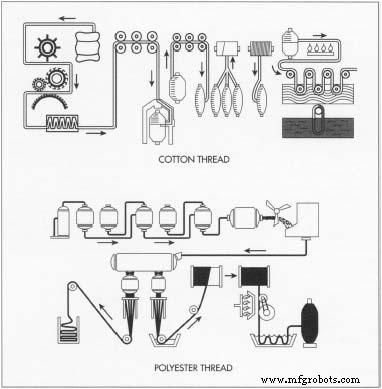
Cotton bales—often contaminated with soil, seeds, and impurities—undergo cleaning, carding, and combing to produce laps. These fibers are drawn, twisted, and spun into thread. A final singeing and caustic soda mercerization strengthen the fibers and impart a lustrous finish.
Polyester
Polyester originates from petroleum. Cracking crude oil yields xylene, which reacts with nitric acid and glycol to form long polymer chains. The resulting melt is extruded, cooled, and cut into chips that are shipped to thread manufacturers for spinning.
Design & Development
Seam engineers—experts in sewing technology and garment construction—analyze market needs, prototype new threads, and rigorously test them under real‑world conditions to ensure performance and durability.
Manufacturing Process
Nett Silk
- 1. Cocoons containing pupae are gently heated to keep them inside.
- 2. The cocoons are immersed in water; brushing releases threads that can reach up to 1,000 yd (3,000 m). Hot air is used to prevent pupa growth.
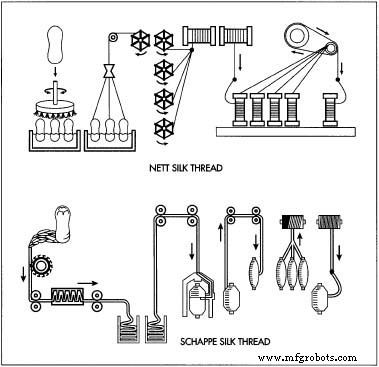
- 3. Multiple yarns are wound together, forming a single nett silk thread.
Schappe Silk
- 4. Cocoons are soaked, softened, washed, and dried after moth emergence.
- 5. Steel rollers with combs produce bundles of straight fibers—combed top or peigné.
- 6. Bundles are combed into a narrower band, rotated through rollers, and slightly twisted into roving.
- 7. Roving is spun into thread; several threads are twisted and wound onto bobbins or cones.
Cotton Thread
- 8. Cleaned cotton is drawn into a narrow fiber band.
- 9. The band is slightly twisted into roving and then drawn again.
- 10. Roving is spun into single thread, which is wound and twisted with others.
- 11. The thread undergoes singeing and caustic soda mercerization before being wound on bobbins.
Spun Polyester Thread
- 12. Polyester chips are spun into long filaments, forming tow.
- 13. Tow is stretched to break weak filaments; fibers 2.5–4.75 in (60–120 mm) remain.
- 14. Strong fibers are banded together into a uniform, high‑quality parallel band.
- 15. Bands are further stretched, slightly twisted into roving, then spun into single thread. Spinning speeds reach 12,000 rpm, extending fibers 10–20× their original length.
Dyeing & Packaging
All threads are dyed in computer‑controlled vats, producing hundreds of colors. Pressurized vessels ensure even color uptake, and threads are dried for 24 hours. A typical day dyes about 6.6 tons (6 metric tons), equivalent to 66 million yd (200 million m) of thread—enough to circle the equator five times. Finished threads are wound onto smaller spools, inspected with optical devices, and boxed for shipment.
Quality Control
Thread must withstand metal guides, needle tension, interlocking, abrasion, laundering, and mechanical stresses. Manufacturers employ automated systems—such as the Autoconer—to detect imperfections, cut, and rejoin ends, producing a smooth, knot‑free yarn. Special lubricating finishes are applied when stitching thermoplastics to prevent needle overheating.
Byproducts & Waste
Cotton thread production generates more waste than other fibers due to unusable portions of the cotton. Early stages produce fiber dust and imperfect strands, all of which must be responsibly disposed of.
The Future
Thread manufacturing will continue to evolve with new fabrics and design trends. While some futurists predict the obsolescence of clothing, the enduring desire for personalized wardrobes ensures that specialized threads remain essential to garment construction.
Manufacturing process
- Titanium: Key Properties, Applications, and Industrial Uses
- Castanets: History, Craftsmanship, and Performance
- The History, Production, and Future of Glue: From Ancient Adhesives to Modern Innovations
- Acetylene: Production, Uses, and Handling – A Comprehensive Overview
- Comprehensive Overview of Asbestos: From Ancient Uses to Modern Health Risks
- The History, Design, and Manufacturing of Dice: From Ancient Tools to Modern Gaming
- Plywood: History, Production, and the Path Ahead
- Tin: From Bronze Age to Modern Industry – Uses, Production, and Future
- Silver: History, Properties, and Modern Applications
- The Evolution and Production of Toothpaste: From Ancient Remedies to Modern Fluoridated Formulas