



Castanets: History, Craftsmanship, and Performance
Castanets consist of two shell‑shaped clappers joined by a string. A Spanish dancer holds a pair in each hand, striking them in rapid succession to create rhythmic patterns that enhance the dance. Although castanets are integral to many Spanish dance styles, they are not employed in flamenco, where rhythm is provided by footwork.
Background
Etymology: The term 'castanet' derives from the Spanish word castaña, meaning 'chestnut'. Other regional names include castainuelas, pulgaretes (named for thumb‑attachment), and platillos (saucers).
The classical technique places one clapper in the palm, with the string looped around the thumb. The dancer strikes the other clapper with fingertips, producing a tone. Rapid finger succession yields trills that embellish the music and provide counter‑rhythms. The opposite hand’s pair is played with single strokes to mark the basic beat. Folkloric dancers sometimes loop the string around mid‑hand fingers and flick the wrist, sending the clappers toward the palm to collide.
A pair of castanets should fit comfortably in the dancer’s hand, so the diameter is about 1.5–2.75 in (4–7 cm). Smaller sizes, usually used by women, produce higher, crisper tones; larger sizes, typically for men, yield lower, richer, mellower sounds.
Mass‑produced sets made from low‑grade wood or plastic cost under $10. Custom‑handcrafted sets, built from premium hardwoods or composites and tailored to a performer, range from $100 to $400.
History
Clapper‑like instruments have appeared worldwide—from ancient Egyptian, Greek, Roman, Arab, Moorish, to Chinese dancers. Whether Iberian castanets were introduced via Greek traders or developed independently remains debated. Archaeological evidence shows Iberians fashioned clappers from sticks, shells, flat stones, and bone.
Raw Materials
Prestige castanets historically use dense, non‑brittle hardwoods such as granadillo, rosewood, ebony, pomegranate, or oak. While these woods deliver superior tone, their scarcity has driven prices up and prompted some makers to seek sustainable alternatives. Many modern professional sets are constructed from a laminated synthetic called Micarta—also known in the craft as 'tela de música'. Micarta is produced by heat‑and‑pressure‑curing of layers of paper, cotton, or glass‑fiber cloth saturated with phenolic resin, producing a material comparable in hardness to ebony or granadillo.
Cotton strings are the standard for dance pairs. Nylon may be used in orchestral contexts, though its slipperiness can hinder control when arms are elevated.
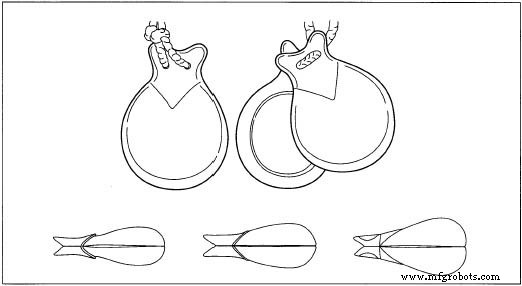
The classic clam‑shell silhouette—circular or slightly oval with a hinge‑extension—is ubiquitous, though variations in square, rectangular, or triangular forms exist.
Design
Key design factors beyond size and material include the depth of the internal hollows and the contact area at the tips where the clappers collide. Traditionally, a set contains a bass pair—called the 'macho'—and a treble pair—'hembra'. The macho, played with the left hand, provides the beat, while the hembra, played with the right, embellishes the rhythm.
The slope of the clapper faces, the angle of the string holes, and the curvature of the wood between holes all influence playability. A steeper slope facilitates finger action, while a well‑shaped base ensures smooth pivoting.
In orchestral settings, castanets may be mounted on wooden handles or fixed to a base, allowing performers to flick or tap them without gripping the thumb.
The Manufacturing Process
- Cut a block of the chosen material roughly to the desired size and split it lengthwise to create two blanks. Rejoin the halves with a sheet of paper between centers and glue them together to preserve symmetry.
- Trace the shell outline on each half using a standard pattern or a custom hand‑trace from the intended user.
- Cut the shells to shape with a bandsaw.
- Drill two holes for the connecting cord.
- Separate the halves to reveal the shell cavity.
- Smooth the exterior with hand tools and sandpaper until the final contour is achieved.
- Carve the internal hollow using a Carborundum wheel or sanding ball; adjust depth to fine‑tune tone.
- Shape the clapper faces so they meet only at the base and lips, rounding the hinge area for proper pivot.
- Test for sound quality; if necessary, deepen or broaden the hollow to refine pitch.
- Polish the finished shells with jeweler’s rouge; optional olive oil treatment can enhance durability and give a subtle sheen.
- Mark the treble pair with a maker’s signature—whether a notch, paint, or engraved pattern—to indicate authenticity.
- Join the pair with a cord approximately 12 in (30.48 cm) long. Thread the cord through the four holes, knot each end externally to prevent fraying, and create a slipknot for tension adjustment.
Manufacturing process
- Titanium: Key Properties, Applications, and Industrial Uses
- The History, Production, and Future of Glue: From Ancient Adhesives to Modern Innovations
- Thread: Types, History, Production, and Quality Control
- Acetylene: Production, Uses, and Handling – A Comprehensive Overview
- Comprehensive Overview of Asbestos: From Ancient Uses to Modern Health Risks
- The History, Design, and Manufacturing of Dice: From Ancient Tools to Modern Gaming
- Plywood: History, Production, and the Path Ahead
- Tin: From Bronze Age to Modern Industry – Uses, Production, and Future
- Silver: History, Properties, and Modern Applications
- The Evolution and Production of Toothpaste: From Ancient Remedies to Modern Fluoridated Formulas