



Crane Technology: Design, Materials, and Future Innovations
Background
Crane systems are the backbone of modern construction, manufacturing, and logistics. Unlike hoists, which merely lift, or conveyors, which move bulk materials continuously, cranes combine vertical lifting with horizontal travel, enabling precise placement of heavy loads.
The name “crane” comes from the bird’s long neck—an apt metaphor for the machine’s towering boom and sweeping reach.
Humans have been lifting heavy objects for millennia. The earliest documented crane is the Egyptian shaduf, invented around 4 000 BCE. This simple pivoting beam balances a bucket against a counterweight, allowing water to be drawn from a well. The shaduf remains in use in rural Egypt and India today.
By the first century AD, cranes were powered by human or animal treadmills that turned a drum to wind a rope around a pulley at the boom’s apex. These early machines were purely mechanical, relying on wooden booms and wooden or hemp ropes.
The Middle Ages saw a pivotal innovation: the jib. A hinged, horizontal arm extended the boom’s reach and enabled more versatile load handling. By the sixteenth century, twin treadmills powered cranes with larger booms, dramatically increasing their lifting capacity.
The nineteenth century ushered in steam power, followed by internal combustion engines and electric motors by the century’s end. Steel replaced wood as the primary construction material, thanks to its superior strength and durability.
In the early twentieth century, European cranes evolved into slender, electric‑powered tower cranes suited to narrow city streets, while American cranes favored mobile configurations—trucks or crawlers—driven by internal combustion engines. The post‑war boom in skyscraper construction spurred the development of long‑boom tower cranes and mobile cranes equipped with caterpillar tracks.
Raw Materials
Steel is the cornerstone of crane construction. The alloy consists of iron and a small percentage of carbon. For most cranes, carbon steel—containing less than 2% alloying elements—is sufficient. Its properties vary with carbon content, ranging from <0.015% to >0.5%.
When exceptional strength is required, high‑strength low‑alloy (HSLA) steels are used. These contain ~0.05% carbon plus trace amounts of chromium, nickel, molybdenum, vanadium, titanium, or niobium, offering superior strength, corrosion resistance, and weldability.
Other materials also play critical roles: rubber for mobile crane tires, bronze or aluminum for specific structural components, copper for electrical wiring, silicon or germanium for electronic circuitry, ceramics, and high‑strength plastics.
Design
Cranes come in a staggering variety of configurations, each tailored to its intended site and payload. No two cranes are identical.
Industrial cranes are typically fixed installations that perform repetitive tasks. The bridge crane—running on rails along two horizontal beams—uses a trolley to move along parallel tracks, covering large rectangular areas. Variants include center‑pivot bridge cranes that can swing around a circular rail, expanding coverage to circular work zones.
Overhead traveling cranes, a subtype of bridge crane, run on rails mounted high in the building’s ceiling, freeing the workspace below.
Construction cranes fall into two categories: mobile and tower. Mobile cranes, mounted on trucks or crawlers, travel between job sites. Articulating cranes feature a jointed boom that folds like a human finger, offering a wide range of motion for short‑distance lifts. Telescoping cranes have extendable booms that can reach further distances but with slightly less versatility.
Tower cranes dominate the construction of high‑rise buildings. External tower cranes are erected outside the structure and extended upward as the building grows, adding sections beneath the existing tower. Internal tower cranes are built within the building and lifted incrementally as the height increases. 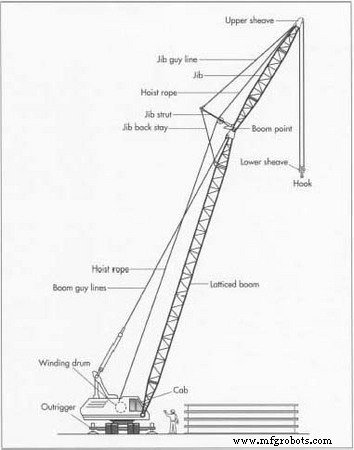 A mobile crane.
The Manufacturing Process
Making Steel Components
- Molten steel is produced by smelting iron ore with coke in a blast furnace, followed by oxygen blowing to reduce carbon content. The resulting steel is poured into thick‑walled molds, cooling into ingots.
- Ingots are rolled into plates, sheets, bars, or rods under immense pressure. Hollow tubes—used for crane booms—are created by bending steel sheets and welding the long sides, or by piercing rods with a rotating steel cone.
- Wire rope for lifting is made by rolling steel into long rods, drawing them through dies to achieve the desired diameter, and twisting multiple strands into a cable.
- Steel arrives at the factory, undergoes rigorous inspection, and is stored until needed. Precision equipment—lathes, drills, CNC machines—shapes each component to exact specifications.
Assembling the Crane
- Components are welded or bolted onto a chassis or tower frame as the crane progresses along the assembly line. Assembly methods differ by crane type; mobile cranes are integrated onto standardized trucks or crawlers.
- After assembly, the crane undergoes static and dynamic testing. Depending on size, it may be shipped as a whole on specialized flatbeds or disassembled for site‑assembly.
Quality Control
Safety is paramount in crane manufacturing. Steel is inspected for structural integrity; welds and bolts are scrutinized for defects. 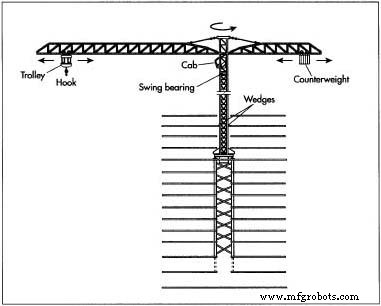 An internal tower crane.
Regulatory compliance is achieved through U.S. Occupational Safety and Health Administration (OSHA) standards, which set load limits and operational guidelines. The Crane Manufacturers Association of America (CMAM) establishes safety standards that exceed OSHA’s requirements, incorporating built‑in safeguards that prevent over‑loading.
Operational safety depends on rigorous operator training. Certified operators must pass competency exams, undergo regular health checks, and perform daily pre‑use inspections. Monthly reviews focus on motors and lifting mechanisms, while operators remain vigilant to environmental conditions—e.g., avoiding crane use during high winds.
The Future
Innovation continues to drive crane technology. Next‑generation cranes will integrate advanced control systems, real‑time telemetry, and high‑definition displays, enabling operators to place loads with unprecedented precision.
A striking example is the Stewart Platform Independent Drive Environmental Robot (SPIDER) developed by James S. Albus at the National Institute of Standards and Technology. SPIDER’s octahedral design uses six cables to manipulate a lower platform, achieving positioning accuracy of 0.04 in (1 mm) and maintaining an angular tolerance of 0.5°. It can lift loads up to six times its own weight.
Manufacturing process
- Titanium: Key Properties, Applications, and Industrial Uses
- Castanets: History, Craftsmanship, and Performance
- The History, Production, and Future of Glue: From Ancient Adhesives to Modern Innovations
- Thread: Types, History, Production, and Quality Control
- Acetylene: Production, Uses, and Handling – A Comprehensive Overview
- Comprehensive Overview of Asbestos: From Ancient Uses to Modern Health Risks
- Essential Guide to Mini Cranes: Types, Uses, and Selection Tips
- Ship‑to‑Shore Cranes: Essential Insights for Efficient Container Transfer
- What Is an Ichabod Crane? A Comprehensive Guide
- 5 Key Benefits of Owning a Norma Crane