



The History, Production, and Quality of Paint: From Ancient Pigments to Modern Standards
Background
Paint—defined as pigment suspended in a liquid or paste vehicle—serves both protective and decorative purposes. Applied with brush, roller, or spray gun, it coats wood, metal, stone, and more.
The earliest known paintings, dated between 20,000 and 25,000 years ago, survive in French and Spanish caves. Primitive artists used readily available natural substances—earth pigments, charcoal, berry juice, lard, blood, milkweed sap—to create images of humans and animals. Later civilizations, including the Chinese, Egyptians, Hebrews, Greeks, and Romans, refined techniques, combining pigments such as yellow and red ochre, chalk, arsenic sulfide yellow, and malachite green with binders like gum arabic, lime, egg albumen, and beeswax. Oil varnishes and linseed oil were among the first solvents, and the 15th‑century masters introduced drying oils to accelerate evaporation.
Egyptians and Hebrews pioneered protective coatings, applying pitches and balsams to ship timbers. During the Middle Ages, interior wood received protective paint, though scarcity limited its use to storefronts and signs. By the 1700s, Thomas Child’s granite‑ball paint mill in Boston marked the first American industrial production, grinding pigment by hand. Subsequent patents in the 19th century—such as D. P. Flinn’s 1865 water‑based paint containing zinc oxide, potassium hydroxide, resin, milk, and linseed oil—ushered the era of commercial paint mills that blended vehicle and pigment for consumers in 1867.
The 20th century saw a revolution in composition and manufacturing. Synthetic pigments and stabilizers enabled uniform mass production. Polymer‑based vehicles—polyurethane, styrene‑butadiene—emerged in the 1940s, followed by alkyd resins that dominate today. Grinding evolved from stone mills to steel balls, then to sand mills and high‑speed dispersion mixers that produce finely dispersed pigments.
Paint’s proliferation—spanning interior and exterior house painting, marine, automotive, aerospace, appliances, furniture, and more—reflects its essential role in protection and aesthetics. The first step in paint production is the careful mixing of pigment with resin, solvents, and additives to form a paste. Industrial paint typically passes through a sand mill—a large cylinder agitating sand or silica to reduce pigment particle size and disperse them evenly. Commercial‑use latex paints, however, often undergo high‑speed dispersion in a rotary tank with a toothed blade, achieving uniform pigment distribution.
Raw Materials
Paint comprises pigments, solvents, resins, and additives. Pigments provide color; solvents ease application; resins facilitate drying; additives perform functions from fillers to antifungal agents. The dominant white pigment is titanium dioxide, prized for its excellent hiding power; black is usually carbon black. Other pigments include iron oxide and cadmium sulfide for reds, metallic salts for yellows and oranges, and iron blue and chrome yellow for blues and greens.
Solvents are low‑viscosity, volatile liquids—petroleum mineral spirits, aromatic solvents like benzene, alcohols, esters, ketones, and acetone. Natural resins—linseed, coconut, soybean oil—coexist with synthetic resins such as alkyds, acrylics, epoxies, and polyurethanes. Additives span fillers (calcium carbonate, aluminum silicate) that provide body without altering performance, to functional agents—thixotropes, driers, anti‑settling, anti‑skinning, defoamers—that enhance coverage, texture, and longevity.
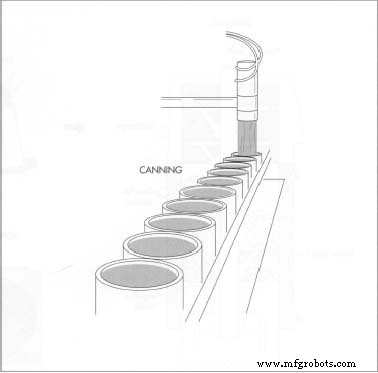
Paint canning is a fully automated process. For the standard 8‑pint (3.78‑liter) can, empty containers are labeled, then positioned upright for filling. A machine applies lids, a second presses them to seal, and a bailometer shapes handles from wire, which are then inserted into pre‑cut holes. Cans are boxed, stacked, and dispatched to the warehouse.
Design
Industrial paint is custom‑tailored to specific performance criteria: fast‑drying, long‑lasting coverage, etc. Consumer paint, meanwhile, offers a virtually infinite palette. Manufacturers select a base color—high titanium dioxide for pastels, lower for dark tones—and blend calibrated pigments to achieve the requested hue, such as aquamarine, canary yellow, or maroon.
The Manufacturing Process
Making the paste
- 1. Pigment manufacturers deliver fine‑grain pigments to paint plants. The pigments are premixed with resin (a wetting agent), solvents, and additives to create a paste.
Dispersing the pigment
- 2. For most industrial and some consumer paints, the paste enters a sand mill—a large cylinder agitating sand or silica to grind pigment particles and disperse them. The mixture is then filtered to remove sand.
- 3. Up to 90 % of water‑based latex paints for homeowners are processed in a high‑speed dispersion tank. A circular, toothed blade on a rotating shaft subjects the paste to vigorous agitation, blending pigment into solvent.
Thinning the paste
- 4. Whether from a sand mill or dispersion tank, the paste is transferred to large kettles and thinned with the appropriate solvent to achieve the final viscosity.
Canning the paint
- 5. The finished paint is pumped into the canning room. Empty 8‑pint cans are labeled, filled, sealed with lids, handles are attached, and the cans are boxed before shipping.
Quality Control
Manufacturers employ rigorous quality control: ingredients, processes, and finished products undergo stringent testing. Key metrics include density, fineness of grind, dispersion, and viscosity. Paint is applied to test surfaces to evaluate bleed resistance, drying time, and texture.
Color fidelity is verified by experienced observers and spectral analysis. Fade resistance is assessed by exposing samples to arc light and comparing against unexposed controls. Hiding power is measured by painting over black and white surfaces; a ratio above .98 indicates high quality. Gloss is quantified by reflected light measurement.
Functional tests include mar resistance (scratching), adhesion (cross‑hatch with tape), scrubbability (machine‑rubbed soapy brush), settling (six‑month observation, score 0–10), weathering (exposure to sun, water, temperature extremes, humidity, sulfuric gases), and fire retardancy (burn test with weight loss <10 % considered acceptable).
Byproducts/Waste
California Rule 66 limits volatile organic compounds (VOCs) from paint production. Paints and coatings account for 1.8 % of the 2.3 million metric tons of VOCs released annually. The rule caps solvent content at 250 g per liter, encouraging substitution with pigments, fillers, or solids to create thicker, solvent‑reduced paints. Alternative strategies—powder coatings, closed‑system application, water‑based solvents, UV or heat‑curing acrylics—help minimize VOC emissions. Unused paint may be returned to retailers for proper disposal.
Large manufacturers operate on‑site wastewater treatment facilities that process all liquids, including stormwater. The EPA conducts periodic inspections. Liquid waste is treated to local treatment plant standards and can be reused for low‑quality paint; latex sludge becomes industrial fillers; recovered solvents serve as fuels for other industries. Paint containers can be recycled or sent to landfill.
Manufacturing process
- Spray Paint: History, Manufacturing, and Future Trends
- Titanium: Key Properties, Applications, and Industrial Uses
- Paintball: From Survival Game to Global Sport
- Castanets: History, Craftsmanship, and Performance
- The History, Production, and Future of Glue: From Ancient Adhesives to Modern Innovations
- Thread: Types, History, Production, and Quality Control
- Acetylene: Production, Uses, and Handling – A Comprehensive Overview
- Comprehensive Overview of Asbestos: From Ancient Uses to Modern Health Risks
- The History, Design, and Manufacturing of Dice: From Ancient Tools to Modern Gaming
- Plywood: History, Production, and the Path Ahead