



The Evolution, Materials, and Manufacturing of Modern Toilets
Background
A system for managing human waste is essential for any community, and the demand rises sharply with population density. While pit latrines remain common in rural areas, sophisticated toilet designs have existed for millennia.
The Old Testament records laws about covering waste outdoors and mentions an indoor privy for King Eglon of Moab. Evidence of flushed toilets in the Indus Valley dates to around 2000 B.C.. Even earlier, Mohenjo‑Daro (circa 2750 B.C.) featured toilets linked to a drainage system. The Neolithic stone huts at Scara Brae in the Orkney Islands (≈4000 B.C.) and the Sumerian city of Ashnunna (≈4000 B.C.) also contained indoor lavatory facilities. By 2000 B.C., King Minos’ palace on Crete boasted marble toilets flushed with water from an adjoining vase.
Roman architecture left a lasting legacy of public lavatories. Private Roman homes often had a seat over a cesspit, while public facilities were more elaborate, built alongside baths. Rows of stone or marble seats over a trench received excess bathwater, which carried waste into the main sewer. A secondary trench supplied fresh water for rinsing. Roman forts, such as Housesteads (122 A.D.), diverted a nearby river beneath the latrine, transporting waste out of the fort. The latrine was a large room with benches around three walls, each with roughly 20 holes and no privacy dividers. Roads also featured large vases for travelers to relieve themselves, keeping streets clean.
In the Middle Ages, many British abbeys installed running‑water lavatories for large monastic communities. Stone castles employed vertical shafts that directed waste into moats. Indoor toilets were often wooden closets concealing a chamber pot, emptied by servants into the moat.
European cities traditionally emptied chamber pots directly into streets, fostering unsanitary conditions. The first flushing toilet emerged in England at the end of the sixteenth century. Sir John Harrington’s “water closet” (1596) was installed in Queen Elizabeth I’s palace and set a trend among the nobility. However, widespread adoption lagged until the eighteenth century. Alexander Cumming received the first British water‑closet patent in 1775, featuring a pan with a sliding door and a lever that released waste while refilling the pan with fresh water. Joseph Bramah’s 1778 model ran water for about 15 seconds. By 1815, such toilets were common in London households. London’s modern sewer system completed in 1853 spurred a burgeoning toilet‑manufacturing industry.
Raw Materials
Toilet bowls and tanks are crafted from vitreous china—a blend of ball clay, china clay, silica, and a fluxing agent. The mixture is first dried, then fired in a kiln. Unlike typical ceramics that require a separate glaze firing, vitreous china vitrifies (turns glassy) during a single firing, rendering the entire piece waterproof and stain‑resistant.
Seats are usually made from one of two materials. Plastic seats are composed of polystyrene, a thermoplastic. The more common wood‑plastic blend uses hardwood flour (maple or birch) mixed with melamine resin; zinc stearate prevents sticking during molding. Metal fixtures are typically stainless steel or copper, and seat‑to‑bowl joints use rubber‑like plastic.
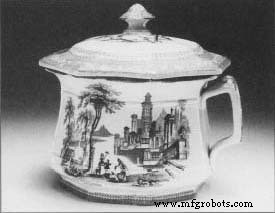 A chamber pot.
Victorians often resisted indoor toilets because of concerns about odor and “unclean gases.” Today it’s hard to imagine life without indoor plumbing. Instead of venturing to an outhouse, many used a ceramic chamber pot—a non‑flushing indoor toilet. These were sometimes adorned with lacy covers called silencers to muffle noise at night.
The chamber pot shown is part of a larger set of personal hygiene ceramics common before indoor plumbing. Bedrooms typically held a pitcher for fresh water, a basin for washing, a soap dish, and a chamber pot, all fashionably decorated to make the space inviting even for these tasks.
The Manufacturing Process
Plastic seat
- 1. Plastic seats begin as polystyrene pellets, fed into a hopper connected to an injection‑molding machine. The pellets melt in a heated chamber and are forced into a chrome‑plated, two‑part mold. The mold, sealed by a hydraulic press applying 10,000 lb per sq in, heats the material to 400 °F (204 °C).
- 2. As the plastic solidifies, cool water circulates around the mold to lower the temperature. The hydraulic clamp releases, the mold halves separate, and the seat is removed, trimming excess material. The seat and cover are then submerged in a water bath to finish cooling.
- 3. In the finishing area, workers drill hinge holes, sand rough edges with abrasive wheels, and polish the surface. Any residual fragments from drilling or molding are removed before the final coat.
Wooden seat
- 4. The wood‑plastic blend starts with wood flour and 15 % powdered melamine resin, plus a small amount of zinc stearate. Workers grind the mixture in an attrition mill, then measure it into boxes for molding.
- 5. The mixture is poured into the bottom half of a mold, ensuring even distribution. The top half closes, and the assembly heats to 300 °F (149 °C) under 150‑ton force. After 6.5 minutes, the components fuse, forming a solid seat and cover. The piece is then lifted onto an overhead conveyor to the finishing station.
- 6. Wooden seats undergo the same finishing steps as plastic seats: drilling, sanding, painting, and drying. A conveyor automatically submerges the seats in paint, then into a vapor chamber where solvent vapors remove excess paint. Multiple coats—primer followed by enamel—are applied and dried, yielding a hard, smooth finish.
- 7. Both seat types are assembled, fitted with mounting hardware, boxed, and dispatched to warehouses or distribution centers.
Bowl and tank
- 8. Bowl and tank production takes place in a pottery. The factory receives vitreous china as a liquid slurry, which is thinned, filtered, and stored for casting.
- 9. The slurry fills plaster‑of‑Paris molds that are 12 % larger to accommodate shrinkage. After about an hour, excess slip is drained and recycled. The clay dries to a semi‑solid state—greenware—while still in the mold. Hand tools smooth the edges and create drain and fitting holes.
- 10. Greenware pieces dry in the open air for several days, then in a dryer at 200 °F (93 °C) for 20 hours. After drying, the pieces are glazed.
- 11. Kilns at industrial potteries are tunnel‑shaped. Products move on a conveyor car through graded temperature zones: 400 °F (204 °C) to 2,200 °F (1,204 °C), then cooling to 200 °F (93 °C). The full firing cycle lasts roughly 40 hours.
- 12. Once cooled, each piece undergoes inspection. The flushing mechanism—either factory‑made or sourced from a plumbing supplier—is installed, and seats may be fitted before shipment or sold separately for later assembly.
Quality Control
Quality assurance occurs at multiple stages. Clay is sieved and purified before casting. Hand‑finished castings are examined for cracks and deformities. After firing, every toilet is individually tested; a simple method involves striking the piece with a rubber ball—an intact toilet rings clearly, whereas a cracked one produces a dull sound.
Byproducts / Waste
Potteries can recycle a large portion of un‑fired clay. Greenware that has not been fired can be softened and reprocessed into slurry, reducing material waste.
Manufacturing process
- How Lawn Sprinklers Work: Design, History, and Modern Manufacturing
- Dishwasher Technology: History, Design, and Future Innovations
- Toilet Paper: From History to Sustainable Production
- The Evolution of Pump‑Action Water Guns: From Invention to Global Market Leader
- Fire Hydrants: Design, Manufacturing, and Their Role in Urban Fire Safety
- Water: History, Types, and Modern Treatment Processes
- Portable Toilet: History, Design, and Environmental Impact
- The Science Behind Shampoo: Ingredients, Manufacturing, and Future Trends
- Salt: Production, Uses, and Health Impact
- Revolver: From Origins to Modern Manufacturing