



Revolver: From Origins to Modern Manufacturing
Background
The term handgun refers to any small firearm designed for single‑hand use. Today the primary categories are revolvers and automatic pistols. Revolvers feature a rotating cylindrical magazine that holds multiple chambers, allowing the shooter to fire successive rounds without reloading. Automatic pistols, in contrast, use a detachable magazine and a self‑loading mechanism that feeds each cartridge into a single chamber using recoil energy. This article focuses exclusively on the revolver, tracing its evolution from early black‑powder guns to contemporary production.
The first firearms emerged with the invention of black powder in 9th‑century China. The Chinese used the powder to launch primitive rockets, and the recipe eventually reached Europe via Mongol intermediaries. By the 14th century, Europeans had refined the substance, and within a century small‑hand weapons began to appear. Early handguns were difficult to aim because their short barrels offered little sighting aid, and most could carry only a single cartridge that had to be muzzle‑loaded. Accuracy and firepower were limited, making them impractical for most soldiers.
Significant progress came in 1835 when Samuel Colt patented the first practical revolver, the cap‑and‑ball design. Colt’s cylinder could hold five or six chambers, and the hammer’s motion automatically advanced the cylinder—an improvement over earlier models that required manual alignment. Subsequent iterations eliminated muzzle loading, introduced cartridge feeding, improved ejection, and added double‑action cocking mechanisms.
By the late 19th century, mass production had refined the revolver into a mature, reliable platform. It remained the weapon of choice for military and law‑enforcement units until the 1920s, when automatic pistols began to dominate. Despite predictions of obsolescence, revolvers have persisted, favored by police, armed forces, and competitive shooters worldwide.
Design
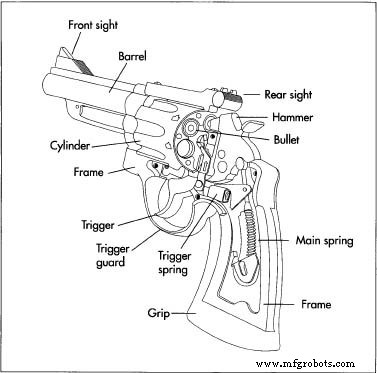
A revolver’s performance hinges on four subsystems: the Frame Group; the Cylinder, Extractor, and Crane Group; the Barrel and Sight Group; and the Trigger, Timing Hand, and Hammer Group.
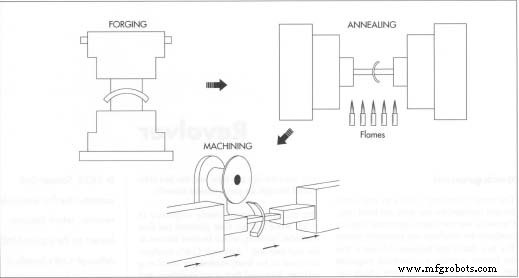 Most parts originate as steel or stainless‑steel blanks that are forged into near‑final shapes. Forging applies several hundred tons of force, forcing the metal into a die that replicates the intended geometry. After forging, parts undergo heat treatment and basic machining—milling, drilling, and tapping—using automated, computer‑controlled centers that achieve tolerances within one or two thousandths of an inch.
The Frame Group comprises the main frame, trigger guard, and grip. Its role is to absorb the force of a cartridge discharge, provide a stable platform for the shooter’s hand, and ensure precise trigger operation. Modern revolvers feature a solid top strap that links the grip area to the barrel mounting point, enhancing structural integrity. Some designs include a removable sideplate for maintenance access, while others integrate the trigger group as a separate assembly.
The Cylinder, Extractor, and Crane Group houses the rotating cylinder, extractor, extractor shaft, return spring, and crane. A typical six‑chamber cylinder holds cartridges of the correct caliber in a circular arrangement. The extractor’s semicircular ledge holds the cartridge rim, and the cylinder locks into the frame via a pin that engages both the frame and the crane. A forcing cone on the barrel ensures a clean transition of the bullet from the cylinder face to the barrel.
The Barrel and Sight Group is critical for accuracy. The barrel, threaded onto the frame, contains rifling—grooves that impart spin to the bullet. Standard rifling twist is approximately one turn per 16 inches (40.6 cm). Sights typically include a rear notch and a front blade or post that can be adjusted to align with the target. Many high‑quality revolvers use precision sights from specialists, and optional optical, low‑light, or laser sights are available.
The Trigger Group operates through a firing sequence initiated by pulling the hammer spur. This action compresses the hammer spring and rotates the cylinder to align the next chamber. The trigger mechanism engages the cylinder’s locking grooves, preventing further rotation. Upon full trigger depression, the hammer releases and strikes the primer, firing the cartridge. This is the single‑action sequence.
Double‑action design, introduced later, allows the trigger to rotate the cylinder, cock the hammer, and fire in a single motion. Most modern revolvers employ this mechanism, increasing rate of fire and simplifying draw‑and‑fire scenarios. After firing, the trigger spring returns the mechanism to its forward position, preparing the next shot. When all chambers are empty, the cylinder latch disengages the pin, allowing the cylinder to swing out on the crane for reloading. The extractor shaft then ejects spent casings, and the cylinder re‑engages for the next round.
Raw Materials
Except for grips—which may be wood or polymer—revolver components are metal. Steel dominated early production, but shortages during the Civil War prompted the use of brass frames. World War II’s demand for lightweight aircraft weapons spurred aluminum alloy frames. The advent of stainless steel further enhanced corrosion resistance and reduced maintenance requirements.
The Manufacturing Process
Forging the components
- Initial parts are forged from steel or stainless‑steel blanks. A heated blank is struck by a forging press, shaping it within a die that approximates the final geometry.
Annealing and machining
- Heat‑treating stabilizes the metal’s flow patterns, relieving internal stresses without sacrificing strength.
- Automated machining centers perform milling, drilling, and tapping with tolerances within one or two thousandths of an inch. Older manufacturers sometimes retain 50‑year‑old equipment due to its proven accuracy.
- Custom fixtures clamp parts during machining, providing tool guides and bushings that enhance precision.
Rifling the barrel
- Barrel rifling imparts a stabilizing spin to bullets, with a typical twist of 1 turn per 16 inches. Cutting rifling uses a broach tool that removes ~0.01 in (0.025 cm) of metal per pass. While scratches can affect accuracy, they also create unique bullet imprints that forensic analysts use for identification.
- Button rifling draws a hardened form through the barrel under high force, displacing metal without cutting. This method yields smoother surfaces and higher production rates.
Applying protective coatings
- Post‑machining, parts receive protective coatings—commonly referred to as blueing—to resist corrosion. This process involves submerging components in acid baths that form a durable barrier. Variants include chrome, gold plating, parkerizing, and anodizing for aluminum parts.
- Electroplating uses an electric current to deposit metal ions onto the surface, bonding them tightly to the substrate.
Assembly
- Assembly is typically performed by a single technician who manually fits components. While dimensional accuracy has improved, trigger timing and pull weight are still fine‑tuned by hand. Law‑enforcement models often feature a heavier trigger pull for safety, whereas target models use a lighter pull to enhance accuracy. Final adjustments include filing, polishing, and functional testing.
Quality Control
After assembly, revolvers undergo dry firing to verify trigger function, sight alignment, and cylinder spacing. Proof firing follows, using cartridges that are heavier than standard service rounds to test structural integrity under maximum stress. Successful units are then packaged and shipped to law‑enforcement agencies, military contractors, and licensed dealers.
The Future
Manufacturing continues to evolve with investment castings, net‑shape forgings, and lightweight alloys, promising incremental design improvements. Socially, the handgun remains a focal point of debate since the 1960s. Advocates for gun control argue that limiting access reduces violence, while supporters emphasize the Second Amendment’s protection of individual rights. The conversation persists in media and legislative arenas. Today, revolvers maintain popularity among police, military, and civilian shooters, with regulatory changes primarily centered on background checks and waiting periods.
Manufacturing process
- The Evolution, Materials, and Manufacturing of Modern Toilets
- Embedding AI in Microcontrollers: Unlocking TinyML’s Potential
- Arduino Car Temperature Monitor – Prevent Heat Stroke in Children
- The Complete Guide to Fiberglass Production
- Pocket Metal Locator – Arduino Pro Mini Powered Metal Detector
- Yahoo! Stock Ticker Project: Build a Live Market Display with Arduino and Python
- From Data to Decisions: Real-Time Insights for Manufacturing
- Adjustable Shock Absorbers: Enhancing Ride Height and Performance
- Mastering Centerless Grinding: Fundamentals & Benefits
- Investment Casting Explained: Process & Principles