



Embedding AI in Microcontrollers: Unlocking TinyML’s Potential
When artificial intelligence meets the Internet of Things, the result is AIoT—an expansive frontier for microcontrollers that leverages breakthroughs in neural‑network compression and efficient inference. Modern smartphone application processors already perform sophisticated AI tasks such as image recognition and recommendation engines; bringing similar capabilities to tiny, battery‑powered devices unlocks a world of new possibilities.
Imagine a hearing aid that filters background noise with AI, a smart‑home appliance that recognizes a user’s face and applies personalized settings, or sensor nodes that run for years on a coin‑cell battery—all powered locally. Edge processing delivers lower latency, stronger security, and heightened privacy, which are hard‑to‑overcome advantages.
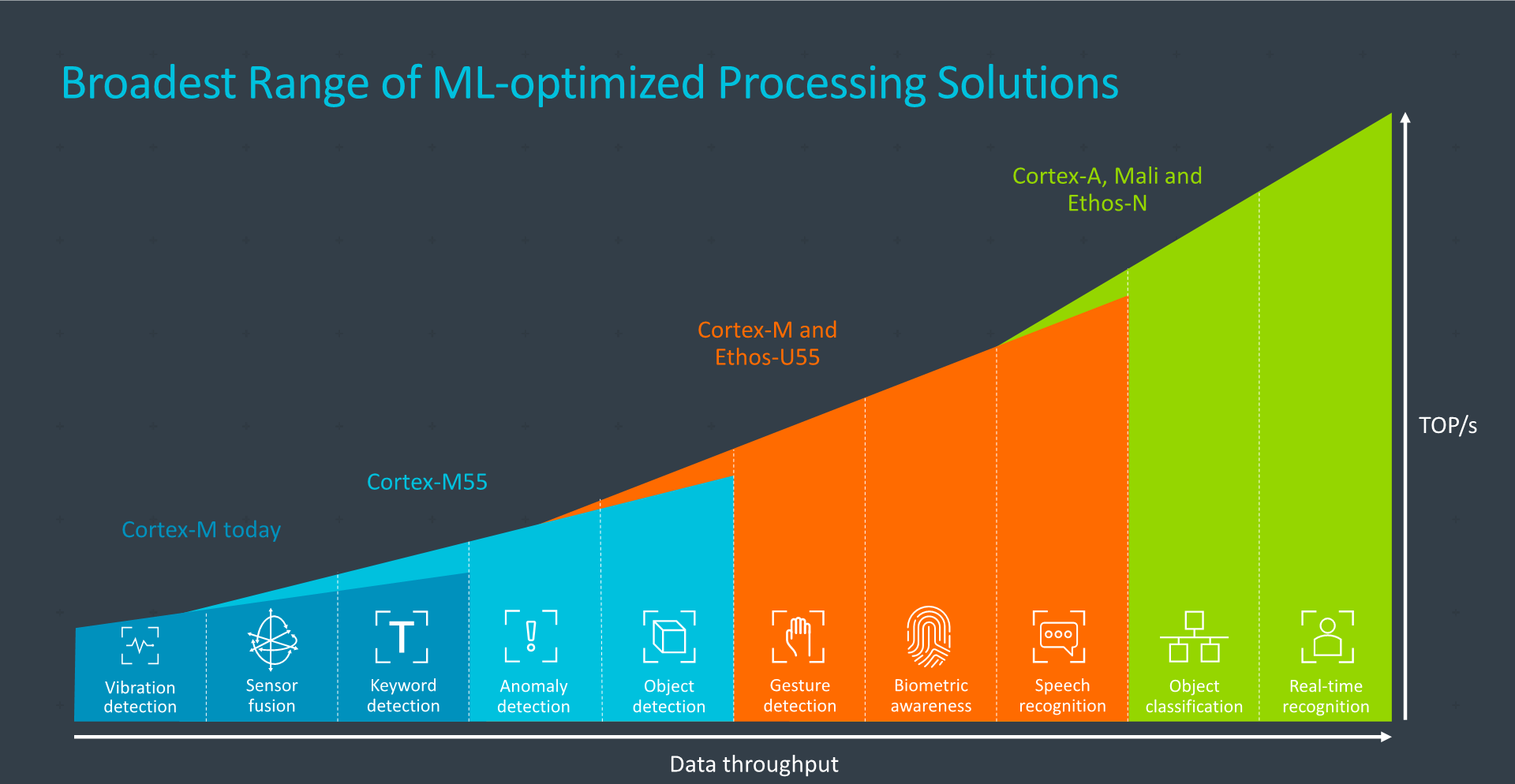

Arm’s Cortex‑M55 combined with the Ethos‑U55 accelerator delivers enough throughput for gesture, biometric, and speech recognition workloads (Image: Arm).
However, deploying meaningful machine learning on microcontrollers is non‑trivial. Limited memory and compute resources make it difficult to run large models, but data‑science teams are shrinking network footprints while vendors provide hardware‑aware toolchains and dedicated IP blocks to meet the constraints of embedded AI.
TinyML Takes Off
The rapid growth of TinyML is evident in the expanding TinyML Summit. The inaugural event in Silicon Valley attracted 11 sponsors; the second summit drew 27 and sold out weeks in advance. Global meet‑ups for designers have likewise seen a dramatic increase in attendance.
“We are entering an era of trillions of intelligent devices powered by TinyML that sense, analyze, and act autonomously to create healthier, more sustainable environments,” said Qualcomm Senior Director Evgeni Gousev, co‑chair of the TinyML Committee, during a recent conference. Gousev highlighted the synergy of energy‑efficient hardware, streamlined algorithms, and mature software ecosystems as the engine behind corporate and venture‑capital investment, startup activity, and M&A.
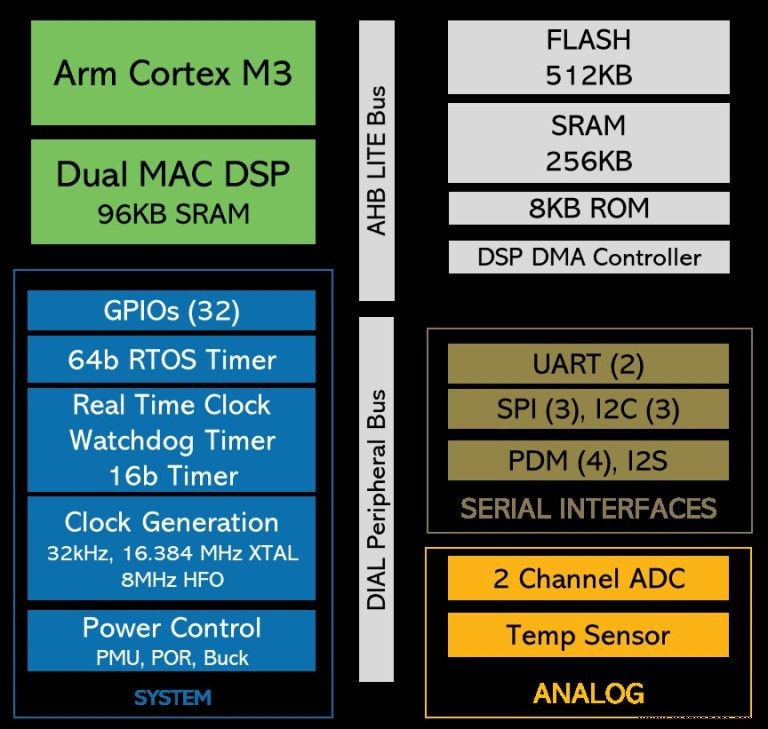

Eta Compute’s ECM3532 uses an Arm Cortex‑M3 core together with an NXP CoolFlux DSP core, allowing the machine‑learning workload to run on either or both processors (Image: Eta Compute).
According to the TinyML Committee, the technology is now validated and productized microcontroller‑based AI is expected to reach the market within two to three years, with flagship “killer” applications arriving in three to five years.
A key milestone came last spring when Google released TensorFlow Lite for Microcontrollers. The lightweight runtime—just 16 KB on an Arm Cortex‑M3—supports inference for models such as speech keyword detection, requiring a total footprint of 22 KB. Training is not supported.
Big Players Respond
Leading microcontroller vendors are fast‑tracking their own AI support. STMicroelectronics offers STM32Cube.AI, an extension pack that maps and runs neural networks on its STM32 Cortex‑M family. Renesas Electronics provides an e‑AI development environment that translates models into native C/C++ code for its e2 studio. NXP Semiconductors demonstrates machine‑learning workloads on its lower‑end Kinetis and LPC MCUs and is expanding its AI ecosystem across application processors and crossover solutions.
Arm‑Powered Dominance
Arm’s Cortex‑M series remains the cornerstone of the microcontroller market. The newly announced Cortex‑M55 is engineered for AI workloads and pairs seamlessly with the Ethos‑U55 accelerator, both designed for ultra‑low‑power environments. Competing firms are now focusing on architectural differentiation rather than building Arm‑based SoCs.
“Competing against the giants requires an architectural edge—performance and flexibility beyond the standard Cortex‑M,” said XMOS CEO Mark Lippett. XMOS’s Xcore.ai crossover processor, targeting voice interfaces, illustrates how a differentiated core can carve out niche applications, though it does not directly compete with microcontrollers.
>> Continue reading page two of this article originally published on our sister site, EE Times Europe.
Embedded
- SPICE Diode Modeling: A Practical Guide to Accurate Simulation
- The History, Design, and Future of Toy Model Kits: From Ancient Origins to Modern Manufacturing
- The Evolution, Materials, and Manufacturing of Modern Toilets
- Revolver: From Origins to Modern Manufacturing
- Microcontrollers Power the Next Wave of Edge AI
- Arm Introduces Cortex‑M55 & Ethos‑U55: New IP Cores Empowering TinyML on Low‑Power Endpoints
- Arduino Car Temperature Monitor – Prevent Heat Stroke in Children
- The Complete Guide to Fiberglass Production
- Advanced Microcontrollers Lab: ESP32, Arduino, PIC, and Sensor Modules
- FPGA vs Microcontroller: Selecting the Right Programmable Chip for Your Projects