



The History, Design, and Future of Toy Model Kits: From Ancient Origins to Modern Manufacturing
Background
Scale models—miniature replicas of real objects—are produced in the millions, offering hobbyists countless hours of creative satisfaction. Sold across specialized hobby shops, department stores, drugstores, and even supermarkets, these kits come in a range of scales, typically from 1:24 to 1:100. A 1:24 model, for instance, measures one‑twenty‑fourth the size of its real counterpart. Common scales include 1/24, 1/48, 1/72, and 1/100, each demanding the same level of engineering precision as the original machine.
Model kits are categorized into five skill tiers. Snap‑together kits provide pre‑colored plastic pieces with tabs that fit into shaped holes, requiring no tools or adhesives. They introduce novices to the types of components and assembly sequence depicted in an instruction sheet. The remaining tiers—beginner, intermediate, advanced, and customized—progress in complexity, detailing, and build time. Customized kits offer a wide array of interchangeable parts, allowing builders to craft truly unique vehicles that reflect their personal vision.
History
Model making dates back to ancient civilizations. Tombs of Egyptians contain miniature buildings, ships, and furniture—artifacts that survived while their originals perished. During the Napoleonic Wars (1799‑1815), French POWs carved intricate wooden warship models from scrap; these artifacts now serve as detailed historical records and are prized by collectors.
The Industrial Revolution sparked a wave of model construction as inventors built scaled replicas of their prototypes. Early 20th‑century kits featured balsa wood ships and aircraft, fragile yet faithful to their real counterparts. By the 1920s, companies such as Citroën produced metal and wood models as promotional items, and these early collectibles have gained significant value today.
World War II accelerated the industry. The advent of plastics and the public’s fascination with aircraft and naval vessels created a mass‑production market. Monogram Models released its first warship kits in 1945, and returning veterans—now owners of newly built automobiles—spurred demand for automotive kits. In 1951, Revell introduced an all‑plastic kit of a 1910 Maxwell, featuring a scaled‑down version of radio comedian Jack Benny. By the 1960s, the hobby boomed: thousands of models covered diverse subjects, and by 2000, the industry had produced more automobiles than Detroit’s original automakers combined.
The 1960s also saw expansion into historical and speculative themes. Dinosaurs, Godzilla, superheroes, and space‑race spacecraft were all produced in scale, often before their real‑world counterparts launched. The precision casting of true‑color parts made models valuable teaching tools, from anatomical figures in classrooms to intricate aircraft replicas in museums.
Raw Materials
Plastic dominates today’s model kits. Manufacturers purchase bulk pellets—often in standard colors—with pigments added during melting to achieve precise hues. Decals, instruction sheets, and packaging are printed by specialized presses. While paint and glue are sold separately (to avoid spoilage and damage), many manufacturers also produce branded tools and adhesives.
Balsa wood, once the primary material before plastics, remains available for hobbyists who prefer a traditional approach. Though its use has been eclipsed by plastic in volume, it still offers a tactile building experience.
Design
Creating a new kit can take up to a year and cost up to $250,000. The process starts with exhaustive research: hundreds of photographs of the real object from every angle, meticulous measurements, and, for new car models, confidential CAD data supplied by manufacturers. Designers translate this data into precise drawings using computer‑aided design (CAD) software.
Pattern makers then craft a scaled‑up model from balsa or soft wood, often 2–3 times larger than the final scale, to allow fine detail. The wood model is coated with epoxy resin, creating a mold that captures its shape. The resin is then removed, leaving a cavity that forms the basis for the plastic part. This step alone can consume over 1,000 hours of labor.
Tool engineers use the design drawings to layout a “tree”—a metal mold that holds multiple parts in a single injection cycle. The tree’s geometry is critical; it must fill perfectly under high pressure (≈1,000 psi) and allow quick release. CAD ensures each part’s orientation is optimized for uniform plastic flow.
After the tree is fabricated, a pantograph copies the resin mold’s shape onto steel tools at the correct scale. Skilled artisans polish the tools and add hand‑crafted details that would otherwise be invisible.
Parallel to the mechanical design, artists develop the kit’s instruction booklet and decals. They dissect a finished model, document each assembly step, and create clear, step‑by‑step diagrams. Decal designs are either faithful reproductions of real vehicle graphics or stylized interpretations of thematic elements.
The Manufacturing Process
- The completed steel tools are assembled into a die—often weighing over 1.4 metric tons—and lifted into an injection‑molding machine. A steel frame holds the tool’s halves, which form a cavity for the plastic tree.
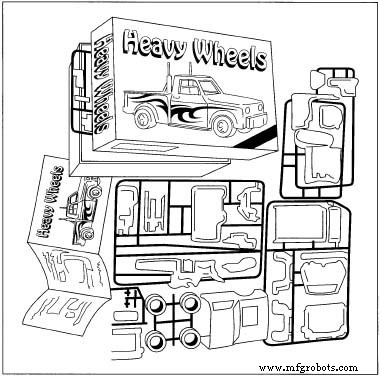
- Plastic pellets are fed into a hopper and melted in a heating chamber at 500 °F (260 °C). The molten plastic is injected into the tool at 1,000 psi, filling every groove in seconds. The tree cools and is ejected onto a conveyor. A new injection cycle follows, producing roughly two trees per minute. Flash—thin excess plastic at the edges—is trimmed by the builder during assembly.
- Specialized machines mold clear parts (e.g., windshields), rubber tires, and colored components. Chrome parts undergo a dip‑coating process: after molding, they are submerged in metallic paint, dried, and re‑deposited onto the conveyor for final assembly.
- At the packaging station, workers place each tree into a plastic bag, add decals, instructions, and any additional materials, and seal the bag into the box bottom. A capping machine then seals the lid, and the finished kits are shrink‑wrapped and carted to shipping.
Quality Control
Design studios hold the highest quality standards, with reviewers approving every phase—from concept sketches to mold samples. Factory inspectors monitor injection, dipping, and assembly lines, sampling finished kits to ensure all parts are present and meet dimensional tolerances.
Byproducts/Waste
Recycling is integral to the industry. Plastic scrap is remelted and reused; steel tools are sent to metal recyclers, and paper packaging is made from recycled fibers.
Safety Concerns
Pattern makers and mold technicians wear gloves, safety glasses, and work in ventilated enclosures to protect against resin fumes. Injection‑molding operators use heat‑resistant gloves and rely on fully automated systems that require minimal manual intervention.
The Future
Indicators of a thriving hobby are evident: the 1990s merger of Revell and Monogram produced 10 million kits annually by 2000, and the International Plastic Modelers’ Association boasts clubs worldwide. Fairs and contests celebrate everything from snap‑together kits to scratch‑built masterpieces, underscoring the hobby’s enduring appeal.
Model kits serve as more than toys; they are educational tools that foster research, historical knowledge, and STEM learning. By manipulating physical parts, builders gain hands‑on insight into engineering, design, and cultural history, making model kits a timeless bridge between imagination and reality.
Manufacturing process
- SPICE Diode Modeling: A Practical Guide to Accurate Simulation
- Lionel Model Trains: History, Manufacturing & Future
- The Evolution and Production of the Classic Toy Wagon
- The Slinky Toy: From Accidental Invention to Iconic Plaything
- Yo‑Yo: From Ancient Toy to Modern Masterpiece
- 7 Proven IoT Business Models That Drive Growth & Profit
- Integrating Dual Deep Learning Models for Enhanced Industrial Automation
- BLE Bot 9000: Advanced Bluetooth‑Enabled Arduino Robot Kit
- Create a 3D Model from Any Photo in 5 Simple Steps – Free Guide
- Choosing the Right CNC Machining Center for Your Applications