



7 Proven IoT Business Models That Drive Growth & Profit
In this article, I explore the seven most effective IoT business models that can elevate revenue, drive adoption, expand market share, and boost profitability.

I recently attended a highly attended IoT summit in Silicon Valley. During the keynote, the speaker asked the audience, “Who here is building a connected product?” Nearly two‑thirds raised their hands. When he followed up, “Who is profiting from IoT today?” no one did. That simple poll highlights a widespread gap: many firms rush into hardware development without a clear revenue engine, and as you know, that model is unsustainable.
What Is an IoT Business Model?
In his book Business Model Generation, Alexander Osterwalder defines a business model as:
“A business model describes the rationale of how an organization creates, delivers, and captures value.”
This definition underscores the product‑manager’s mandate: design solutions that deliver tangible value. In IoT, a common pitfall is simply attaching sensors to an existing product and calling the resulting dashboard “value.” Such offerings rarely generate traction because the perceived benefit is minimal.
I view an IoT business model as a two‑part framework:
- It centers on capturing and delivering genuine value.
- It harnesses IoT’s unique 24/7 connectivity to create innovative, differentiated outcomes.
Below, I detail seven leading IoT business models, each grounded in real‑world experience and best practices.
1. Subscription Model
Leveraging constant connectivity, a subscription model turns a one‑time hardware sale into recurring revenue. Customers pay a regular fee for ongoing services, updates, or premium features—mirroring the success of SaaS.
By adopting a subscription approach, manufacturers can monetize software upgrades, introduce freemium tiers, or bundle predictive maintenance and monitoring services. This model also fosters an ongoing relationship with the customer; as the device collects more data, you can tailor features to their evolving needs.
Typical use cases include “monitoring as a service” and “predictive maintenance as a service.”
Featured article: A Product Manager’s Framework for the Internet of Things
2. Outcome‑Based Model
Rather than selling a device, you sell the outcome it delivers. Think of the adage, “People don’t buy drills, they buy holes.” For a pump manufacturer, the true value lies in moving water, not in the pump itself.
With an outcome‑based model, the customer pays a variable fee based on the volume of water transferred. This eliminates the customer’s capital expense and aligns pricing with tangible benefits.
Outcome models can be implemented via leasing, pay‑per‑use, or subscription, depending on the customer’s preference and the product’s capabilities.
Recommended article: What Is an IoT Platform?
3. Asset‑Sharing Model
High‑cost equipment often sits idle, reducing ROI. Asset‑sharing flips that paradigm: multiple customers share a single device’s capacity, lowering individual costs and accelerating market penetration.
Examples include car‑sharing, bike‑sharing, self‑driving fleets, virtual power plants, and shared drones. In my experience at Stem, Inc., we deployed commercial‑grade batteries that supplied building energy and sold surplus capacity back to the grid—creating a shared asset that benefited both the building and the utility.
Because many IoT systems cannot be scaled to smaller, custom sizes, monetizing unused capacity is a practical strategy for maximizing utilization.
To dive deeper into this model, listen to my interview with Stem’s CTO, Larsh Johnson.
4. Razor‑Blade Model
Sell the core device at cost—or even give it away—to drive adoption, then monetize consumables that must be replenished. This approach works exceptionally well for products with continuous replacement needs.
Illustrations include Brita’s Infinity Water Pitcher (auto‑reorders filters), HP’s connected printers (auto‑reorder ink), and Amazon’s Dash Buttons (contextual re‑ordering of household staples).
For enterprises, the razor‑blade model applies to consumables like hoses, bearings, or tires—removing purchase friction and creating a steady revenue stream.
5. Monetize Your IoT Data
The true power of IoT lies in the insights it uncovers. Many platforms, such as LinkedIn or Facebook, generate revenue by selling aggregated data to advertisers.
Similarly, an IoT device can collect data at scale, offer it to third parties, and monetize that information. By deploying a network of free or low‑cost devices, you create a data asset that attracts high‑value buyers—utility aggregators, insurers, or analytics firms.
When adding a data‑commerce layer, it is essential to communicate data usage to users, safeguard privacy, and treat the API as a standalone product with a robust developer experience.
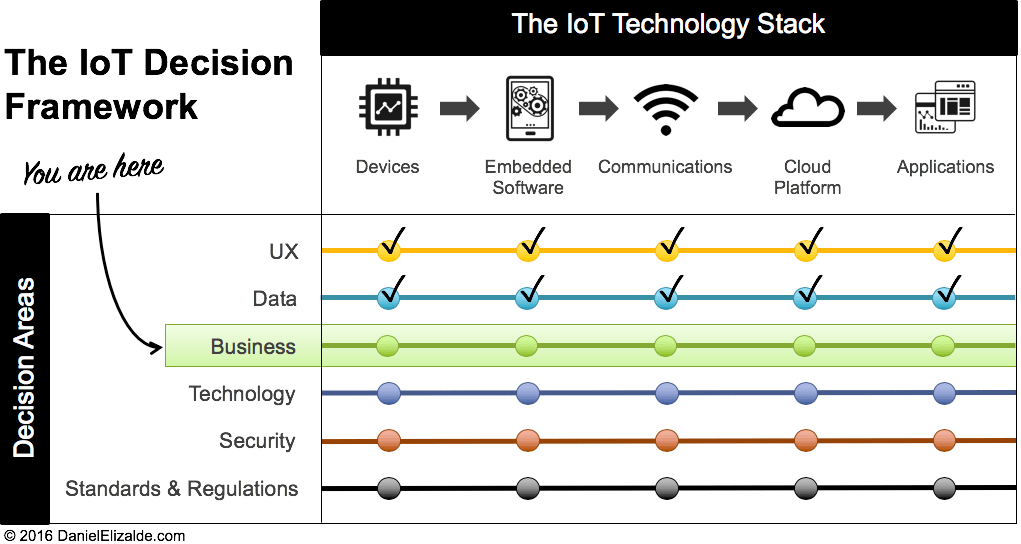
Use the IoT Decision Framework to evaluate how data monetization fits within your existing product strategy.
6. Pay‑Per‑Usage
IoT sensors can track real‑time consumption, enabling a pay‑per‑usage model that charges customers for actual device utilization rather than ownership.
Metromile, a San Francisco‑based insurer, exemplifies this approach: its in‑car IoT unit measures miles driven, allowing the company to price insurance on a per‑mile basis.
7. Offer a Service
Beyond hardware and data, IoT can be a catalyst for new service offerings. Use device insights to sell maintenance contracts, energy audits, or consulting services that add measurable value.
Examples include predictive maintenance for industrial machinery, energy‑optimization consulting for smart buildings, and throughput‑analysis services on manufacturing floors.
Combining hardware sales, data monetization, and service delivery can create a diversified revenue ecosystem.
To learn more about the benefits and pitfalls of this approach, listen to my podcast interview with Cesar Games, Global Head of Integration Services at National Instruments.
A cautionary note for product teams: transitioning to services demands new resources, expertise, and governance. Approach it strategically and validate demand early.
How to Get Started
Adopting a new IoT business model is a strategic endeavor that impacts sales, marketing, finance, supply chain, and engineering. Begin with focused research: identify customer pain points and adoption barriers. Formulate a hypothesis—perhaps one of the seven models could eliminate a key friction point—and test it on a small scale.
My IoT Decision Framework guides this process. Start with the UX and Data Decision areas to capture user insights and data requirements, then move to the Business Decision area to craft the model.
Remember: this is an iterative journey. Continuous customer engagement and rapid experimentation are essential to refine your model and achieve sustainable growth.
The Bottom Line
Product managers must articulate how their IoT solutions create real value and devise a clear monetization strategy. With the models outlined above, you can transform a hardware offering into a recurring revenue engine, a data asset, or a service platform—driving adoption and profitability simultaneously.
Internet of Things Technology
- Building an IoT‑Enabled Car‑Sharing Business Model in Two Days: Lessons from a Bosch Hackathon
- Essential Lessons from Validating IoT Business Models
- How to Build and Validate IoT Business Models That Work – A Practical Guide
- Why IoT Startups Must Nail Their Business Model Before Building
- Impact Pricing: Expert Guide to IoT Business Models & Pricing Strategies
- 6 Ways AI & IoT Are Revolutionizing Business Operations in 2019
- How to Build a Profitable IoT Business Model
- Top 10 IoT Innovations Revolutionizing Retail
- 5 Game-Changing IoT Trends Powering the Modern Fleet Industry
- IoT: Driving Mainstream Adoption and Business Model Disruption