



Why User Onboarding Is Critical—and How to Get It Right
Your product’s user onboarding experience matters, probably more than you think. A great onboarding experience can increase product adoption, reduce support costs, and lower sales and marketing expenses—all of which boost your bottom line.

So where should Product Managers start, and what are the essential ingredients of a great onboarding experience? In this article, I present the business case for investing in onboarding and provide actionable guidance to elevate your product’s onboarding journey.
Good Onboarding Drives Adoption and Revenue
People don’t buy products; they buy solutions to problems. The faster new users master how to use your tool to solve their problem, the happier they become.
Onboarding blends documentation, in‑product tutorials, videos, and training so that users cross the initial adoption hump quickly. It is a core part of the product experience but often overlooked.
Good onboarding boosts customer adoption
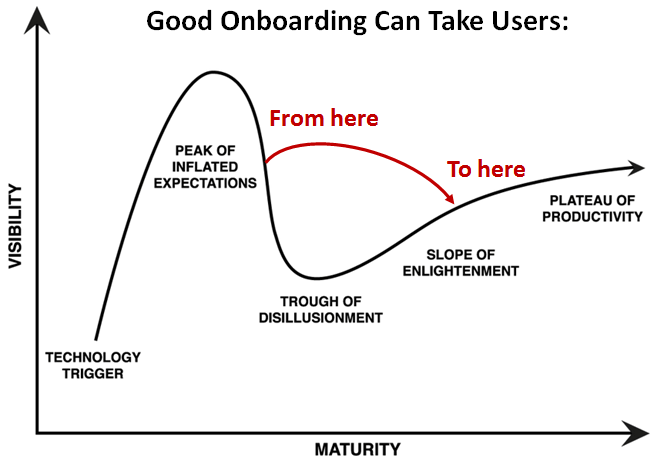
Consider the Gartner Hype Cycle. Users start at the “Peak of Inflated Expectations,” hoping the product will meet all needs. Without a solid onboarding strategy, many slide into the “Trough of Disillusionment” and never recover.
A robust onboarding journey moves users directly into the “Slope of Enlightenment” and beyond, increasing the likelihood that they become advocates who spread the word—free marketing for you.
Onboarding Differs Between Consumer and Industrial IoT
Onboarding depends on product type. A consumer IoT device, like a fitness band, is usually set up and used by the same person, so the experience must guide that individual from start to finish.
Industrial IoT products involve multiple personas—technicians, managers, developers—each requiring tailored onboarding. A technician’s journey to install hardware differs from a developer’s journey to integrate APIs.
In either case, onboarding must align with the user’s needs, expectations, and skill level. Consumer products may use quick guides, in‑app walkthroughs, or videos. Industrial solutions often need detailed manuals, augmented‑reality demos, or in‑person training.
Bad Onboarding Translates into Hidden Costs
It can feel tempting to skip onboarding and focus on new features, but the true cost shows up elsewhere. A weak onboarding strategy forces other departments to absorb the burden.
Impact on Support
Engineering may save money by skimping on onboarding, but support costs can rise 10×. Poorly documented features generate more tickets, draining resources and eroding customer satisfaction.
In startups with immature support teams, escalated tickets often loop back to Product and Engineering, stalling innovation and driving churn.
Impact on Sales, Marketing, and Customer Success
If customers struggle to get started, trial users are less likely to convert to paid plans. For recurring revenue models, this undermines growth.
Investing in a smooth, self‑serve onboarding experience reduces the total cost of ownership and becomes a competitive advantage.
Proactive Strategies for Product Managers
1. Embed Onboarding in Feature Definition
Onboarding should be part of your roadmap, acceptance criteria, and prioritization. Frame it as an investment that directly influences retention and revenue, not as an optional add‑on.
2. Deliver Meaningful Documentation
Choose the format that resonates with your audience—long guides, short tutorials, in‑app help, or videos. Focus on the why and the key tasks users must complete. Avoid generic UI instructions; instead, provide actionable steps that drive outcomes.
3. Prioritize UX Design
Good UX reduces friction for new users. Collaborate with designers to create intuitive interfaces across hardware, APIs, and digital touchpoints. A polished UI shortens the learning curve and lowers the need for extensive onboarding.
4. Leverage User Testing and Analytics
- Pre‑Launch—test with real users to validate ease of use and task completion speed.
- Post‑Launch—use analytics and user feedback to pinpoint pain points and refine onboarding.
For IoT, test both the digital and physical layers to ensure all personas enjoy a cohesive experience.
Bottom Line
Onboarding is not a luxury; it’s a strategic necessity that drives adoption, reduces costs, and fuels revenue. As a Product Manager, make the case to stakeholders that investing in onboarding now yields measurable returns in conversion, satisfaction, and operational efficiency.
Internet of Things Technology
- Predictive Maintenance Explained: How It Cuts Downtime and Drives Value
- Unlock Operational Excellence with Smart Maintenance: How IIoT, Big Data, and CMMS Drive Predictive Care
- Why D.E.F.I. Is the Premier Choice for Houston Fiberglass Solutions
- Why City Data Matters: Turning Insights into Urban Innovation
- Industrial Automation Security: Why It Must Be a Top Priority
- Why Blockchain Should Operate Quietly in the Background, Not Steal the Spotlight
- Why Won’t My 3D Pen Work? Quick Troubleshooting Tips
- Avoid Mixing Tube Fittings: Why Consistent Manufacturers Matter
- Troubleshooting Low Pressure in Your Pump: Common Causes & Fixes
- Diagnosing Common Causes of Hydraulic Pump Failure