



A Practical IoT Decision Framework for Product Managers
This article introduces a proven IoT Decision Framework that simplifies product management across the entire IoT stack—device hardware, device software, communications, cloud platform, and cloud applications. It guides you through consistent, strategy‑aligned decisions for every layer, helping you avoid costly missteps before you invest time and money.
Why IoT Product Management is Complex
Managing an IoT product is inherently more challenging than traditional software or hardware because you must make critical business and technical choices across five interconnected layers:
- Device Hardware
- Device Software
- Communications
- Cloud Platform
- Cloud Applications
Each layer demands its own set of decisions, yet those decisions must align with a single overarching strategy. The resulting complexity can overwhelm even the most seasoned product managers.
The IoT Decision Framework
The framework provides a structured, step‑by‑step approach that forces you to evaluate every decision area at every layer. It prevents hidden gaps and ensures consistency across the entire stack.
Step 1: Identify the Five Layers of the IoT Technology Stack
These layers are defined in the IoT Primer for Product Managers and include:
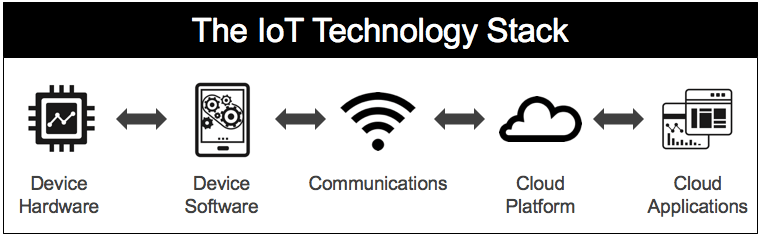
While a SaaS product typically deals only with the Cloud Platform and Cloud Applications layers, an IoT solution must also consider the three lower layers, exponentially increasing decision complexity.
Step 2: Evaluate Six Decision Areas at Each Layer
These are the core decision categories that shape every IoT product:
- User Experience (UX)
- Data Strategy
- Business Model
- Technology Architecture
- Security & Privacy
- Standards & Regulations
For each layer, ask the relevant questions for each decision area. The framework’s visual layout helps you map these interactions.
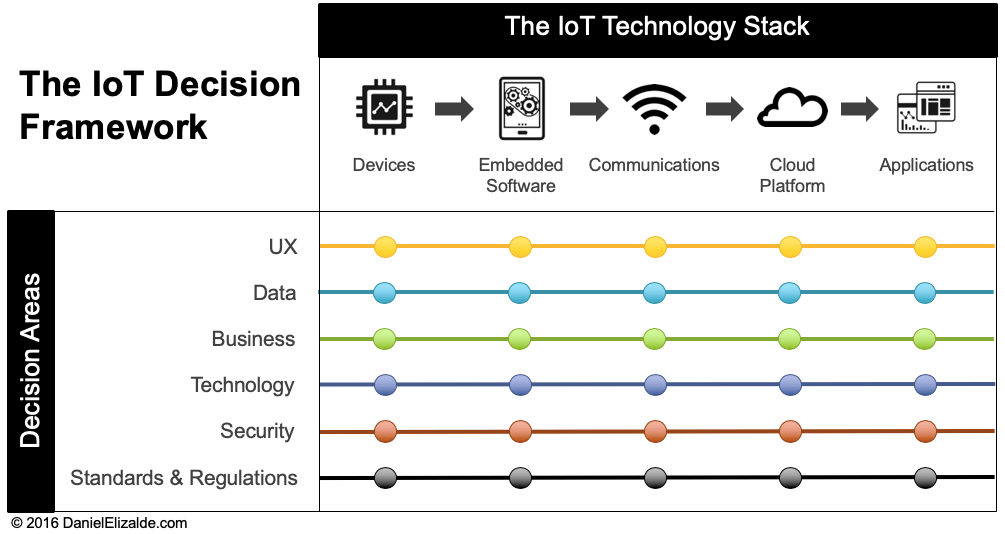
Detailed Walkthrough of Decision Areas
1. User Experience (UX)
Identify who your users are, their core pain points, and what constitutes a great experience at every stack layer. Include secondary stakeholders such as fleet operators, installers, and developers.
Related post: Why It’s Hard to Create a Good UX in IoT
2. Data Strategy
Define what data the device produces, how much to transmit, frequency, and where analytics will occur (edge, cloud, or both).
Related post: Differentiate Your IoT Product: Provide Insights, Not Data
3. Business Model
Assess revenue potential, monetization layers, build vs. buy decisions, and API strategy. Translate UX and data insights into financial projections.
Related post: How to Monetize Your IoT Product
4. Technology Architecture
Collaborate with engineering to select sensors, hardware, software, communication topology, protocols, cloud platform, and application form factors. Supply clear requirements rather than prescribing technology.
Related posts:
- How to Make Sense of IoT Hardware
- Behind the Scenes of the Microsoft Azure IoT Cloud Platform
- What is an IoT Platform?
5. Security & Privacy
Define threat models for each layer, response plans for breaches, and security testing scope. Protect against external and internal threats.
Related posts:
- How to Protect Your IoT Product from Hackers
- The Role of Product Managers in Securing the Internet of Things
6. Standards & Regulations
Identify industry‑specific standards, compliance requirements, and data format or protocol mandates for each layer.
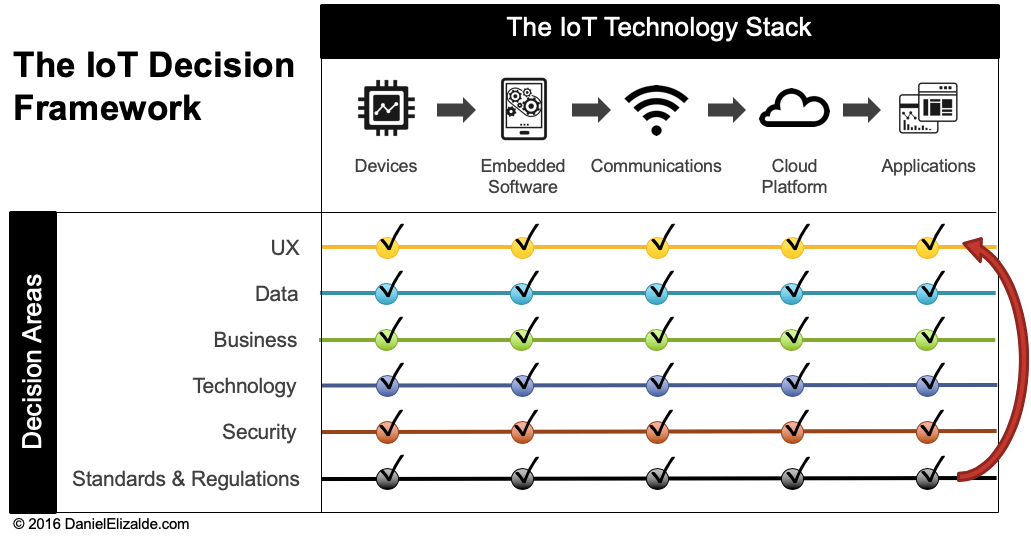
Iterate Until Alignment Is Achieved
Because decisions are interdependent, revisit the framework repeatedly. Adjusting one area—such as shifting from real‑time to minute‑interval data—will cascade changes across UX, business, and technology.
When and How to Use the Framework
Apply the framework after completing foundational product work: target audience, value proposition, competitive analysis, and revenue estimation. It then informs:
- Business plan development
- MVP definition
- Roadmap creation
- Feature prioritization
- Product line extensions
- Partnership evaluations
- Risk assessments of stack changes
Lead cross‑functional workshops to gather input from UX, engineering, finance, and executive stakeholders. A shared framework ensures a consistent strategy and stronger executive buy‑in.
Frequently Asked Questions
Is this framework suitable for both consumer and industrial IoT?
Yes. While the product journey differs, the strategy‑building process is the same. Over 1,500 professionals across industries have used this framework successfully.
Can I use it for product development?
The framework is designed for strategy, but a solid strategy streamlines development. It reduces wasted effort and accelerates time to market.
How long does it take to complete?
With pre‑collected data, an experienced PM can finish the framework in about an hour. Otherwise, it serves as a roadmap for the research and stakeholder engagement needed.
Why start with UX?
Understanding users first ensures that subsequent data, business, and technology decisions are customer‑centric. A technology‑first approach often leads to a misaligned product.
Do templates exist?
Yes. The IoT Decision Workbook, PowerPoint strategy template, and workshop guides are available through the IoT Product Manager Certificate Program and can be downloaded for free.
How does the framework feed into roadmap creation?
After completing the framework, you possess a complete decision matrix that feeds directly into a structured roadmap. Refer to the article How to Build an IoT Product Roadmap for step‑by‑step guidance.
The Bottom Line
IoT products demand a holistic view across multiple layers. The IoT Decision Framework equips product managers with a repeatable, evidence‑based method to capture user needs, data flows, business viability, technical requirements, security, and regulatory compliance—all in one cohesive strategy.
© 2016 Daniel Elizalde – All Rights Reserved.
Internet of Things Technology
- Designing an IoT Data Product UI: 9 Essential Considerations
- Why Edge Computing Is Essential for IoT Success
- Fog vs. Cloud: Optimizing IoT Deployments for Speed and Scale
- 5 Proven Principles for Designing Reliable Wireless IoT Products
- B2B Product Innovation: A Strategic Roadmap for Product Managers
- What Is an IoT Product Manager? A Practical Guide to the Role and Skills
- Mastering Data Acquisition for IoT Product Managers
- How to Launch a Career in IoT Product Management: 5 Proven Steps
- How to Secure Authentic Proposals for IoT Product Development
- Why Your Connected Devices Need an IoT Framework: 5 Key Benefits