



What Is an IoT Product Manager? A Practical Guide to the Role and Skills

As the Internet of Things (IoT) expands, businesses are increasingly leveraging connected devices to drive growth and improve profitability. Yet, despite the promise, many companies struggle to launch and manage IoT products successfully.
What they often lack is a dedicated professional who understands the unique complexities of IoT product development—an IoT Product Manager. In this article, I’ll share my definition and explain how the role differs from traditional product management.
What Is an IoT Product?
IoT products are physical devices that connect to the Internet, enabling data exchange, automation, and new business models. Common terminology includes:
- IoT device or product
- Edge device
- Connected product
- Smart device or smart product
- Internet‑enabled product
For consistency, I’ll use the term IoT Product throughout this guide.
An IoT Product typically comprises hardware, embedded software, networking components, cloud services, and a user interface—all of which must work together seamlessly.
Examples across industries include:
- Drones and autonomous vehicles
- Smart home devices such as Amazon Echo and smart locks
- Industrial control systems and smart grids
- Connected medical devices like pacemakers
- Agri‑tech solutions such as smart irrigation systems
For a deeper dive, read What is an IoT Platform?
What Is an IoT Product Manager?
Think of an IoT Product Manager as a specialist who builds on core product‑management principles—understanding customer needs, defining value, and steering cross‑functional teams—but adds a layer of expertise in the five components that make up every IoT solution.
Like a cardiologist is a doctor with a niche focus, an IoT PM is a product manager who has mastered the intricacies of hardware, software, networking, cloud, and user experience.
Key Differences from Traditional PMs
Larger Scope
Every IoT product involves five technology layers, each with its own roadmap and dependencies. The diagram below illustrates the IoT Technology Stack:
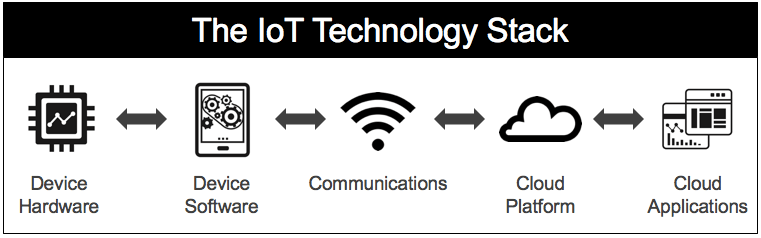
While a traditional PM may focus on one or two layers (e.g., a cloud‑only SaaS product), an IoT PM must orchestrate all five, demanding a systems‑thinking mindset.
Hardware, Software, and the Full Stack
IoT products blend physical components with embedded firmware, networking firmware, cloud back‑ends, and front‑end applications. Successful IoT PMs grasp the fundamentals of each domain without necessarily being deep experts in every one.
More Stakeholders
The breadth of an IoT solution expands the stakeholder ecosystem: customer success, field operations, security & compliance, supply chain, engineering (hardware, embedded, cloud, UX, QA, integration), and more. Securing alignment across this spectrum is a core PM challenge.
Ecosystem and Partnerships
Because no single company can build every component, IoT PMs must cultivate strategic relationships with vendors, service providers, and channel partners. These alliances shape the product roadmap and time‑to‑market.
Security at the Core
IoT devices expose a larger attack surface across all five layers. Compromise can damage property or jeopardize lives, so security must be baked into every phase of product development. For further guidance, see The Role of the PM in Securing Your IoT Product and How to Protect Your IoT Product from Hackers.
Embracing Uncertainty
The IoT landscape is still evolving—new sensors, networking standards, AI integration, and business models emerge regularly. An IoT PM must be agile, experiment with untested models, and pivot quickly to capture value. Learn more about evolving business models in 7 IoT Business Models That Are Transforming Industries.
The T‑Shaped IoT Product Manager
Because IoT spans hardware, software, networking, cloud, and UX, no single individual can master every detail. Instead, companies build IoT Product Teams that collectively cover all necessary expertise. A successful individual in this environment is a T‑shaped IoT Product Manager—broad knowledge across the stack (horizontal) paired with deep specialization in one area (vertical).
For example, a PM with cloud expertise would have:
- Horizontal understanding of hardware, embedded firmware, networking, and front‑end development
- Vertical depth in cloud‑specific decision areas: UX, data, business, security, integration, and operations
Conversely, a device‑hardware specialist would focus deeply on hardware design, manufacturing, and supply‑chain decisions while maintaining a holistic view of the overall stack.
The Bottom Line
IoT is not a passing fad; it is reshaping how products connect, gather data, and deliver value. As every layer of the technology stack—microprocessors, sensors, networking, cloud, and AI—continues to evolve, the need for skilled IoT Product Managers will only grow.
To keep pace, product professionals must adopt an IoT mindset, build cross‑functional teams, and prioritize security and agility. By doing so, they can stay relevant and drive transformative outcomes for their companies and customers.
Ready to step into the IoT product arena? Explore our short online course, How to Get a Job in IoT Product Management, for practical career guidance.
Internet of Things Technology
- The Role of an Automotive Service Manager: Duties, Career Path, and Compensation
- Machine‑to‑Machine (M2M) Explained: How Devices Talk and Why It’s Transforming Business
- Understanding the True Cost of Building an IoT Product
- Five Essential Principles for Successful IoT Product Development
- Choosing the Right IoT Platform: A Practical Guide
- What Is an IoT Product Manager? A Practical Guide to the Role and Skills
- Creating a Stakeholder‑Focused IoT Product Roadmap
- IoT Security Demystified: Protecting Your Connected Devices
- Advanced Product Quality Planning (APQP): Definition & Benefits
- Product Layout Explained: Design, Process, and Benefits