



4 Proven Strategies to Seamlessly Customize Your Industrial IoT Product
Industrial IoT solutions rarely come with built‑in customization, leaving many customers short of the “last mile” they need for a turn‑key deployment.
When product teams add one‑off features for a single client, they risk creating a slippery slope of tech debt that erodes margins and threatens long‑term growth. The goal is to deliver customer success, but without a clear strategy, the effort becomes a drain on resources.
Rich Mironov’s second law of software economics states, “All the profits are in the nth copy or nth user.” Extending this to IIoT, we see that the real value lies in the nth system—both hardware and software—rather than isolated custom builds.
Related content: Listen to the interview in my IoT podcast with Rich Mironov and learn how his four laws of software economics apply to IoT products.
Industrial customers often require a certain degree of customization to fit their unique processes or to integrate seamlessly with existing infrastructure. The challenge is to meet these needs without turning your roadmap into a series of bespoke requests.
How can you avoid the one‑off development trap? How can you provide a turn‑key solution that still respects your core roadmap? And how can customization become a source of new revenue rather than a liability? The answer lies in a deliberate IIoT product strategy.
Make Customization a Pillar of Your IIoT Product Strategy
If you keep encountering requests for unique features, it’s time to decide early how much flexibility your core product will allow. This decision will shape your roadmap, influence cross‑functional teams, and define new revenue streams.
Consider the ripple effect of enabling customization:
- Monetization: develop a pricing model for custom solutions.
- Product personas: research integrators and developers who will extend your platform.
- Engineering: re‑architect hardware and software to expose clean interfaces.
- Marketing: reposition your offering to highlight modularity and extensibility.
- Sales: train reps to sell custom configurations and articulate the added value.
- Business development: build partnerships with integration firms or third‑party developers.
- Customer success & support: create playbooks for troubleshooting customized deployments.
Choosing not to support customization also requires clear messaging that differentiates your product from competitors. You’ll need disciplined gating of custom feature requests to preserve your core roadmap.
What Does a Customizable Product Look Like?
The spectrum ranges from minimal add‑ons to a full‑blown platform. The key is a well‑defined boundary between the core product, its exposed interfaces, and the one‑off customizations.
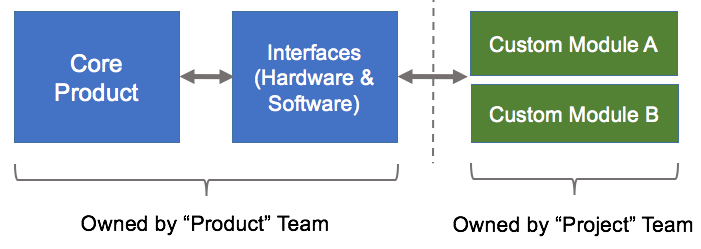
The core—hardware, firmware, APIs—belongs to the product team and is delivered to every customer on a shared roadmap. The right side of the diagram represents customer‑specific modules, each treated as a separate project rather than a product extension.
Define clear ownership: does your organization handle custom projects in‑house through a professional services arm, or do you outsource them to third‑party integrators? This decision will influence cost, speed, and quality.
Recommended article: Podcast interview with Peter Bourne, CEO of Bright Wolf, on how integration companies can unlock IIoT value.
4 Ways to Enable Customization
Customization can be introduced at any layer of the IoT stack. Use the IoT Decision Framework to assess impacts on UX, monetization, cost, security, and regulatory compliance.
Success hinges on clearly defined interfaces—whether hardware connectors or software APIs—that allow third parties to extend the core without compromising stability.
1) Device Hardware Customizations
Design a modular architecture that lets you swap components without redesigning the PCB or recertifying the device. Typical options include:
- Power source: battery module vs. wall‑mounted.
- Battery duration variations.
- Generic sensor bus for interchangeable sensors.
- Hard‑drive size options.
- CPU module upgrades.
- Multiple communication ports.
- Choice of wireless radios (Wi‑Fi, LoRa, Bluetooth, etc.).
Decide whether to offer plug‑and‑play modules or require engineering effort for new SKUs, based on your business model.
2) Device Software Customizations
Expose robust APIs at the edge to give integrators the tools they need. Consider enabling:
- Access to raw sensor data.
- Actuator control.
- Connectivity to other edge devices via wired or wireless ports.
- Edge analytics for custom analysis.
- Local data storage access.
3) Cloud Platform Customizations
Open cloud APIs so developers can extend analytics and operations. Potential customizations include:
- Raw data access from specific edge devices.
- Aggregated data from device groups.
- Custom analytics on top of your cloud platform.
- Health and operational metrics for edge devices.
- Integration of third‑party data streams into your control loops.
4) Cloud Application Customizations
Provide front‑end hooks that let integrators build branded or feature‑rich applications without starting from scratch:
- Display third‑party data within your dashboards.
- Show data generated by custom edge software.
- Offer a white‑label application shell for rapid deployment.
Enabling customization lets you satisfy industrial customers while protecting your core product from bespoke entanglements. However, it introduces new responsibilities: maintain stable interfaces, secure exposed APIs, and manage versioning so custom solutions remain functional after upgrades.
For deeper insights into API strategy, read The Business of APIs, what Product Managers Need to Plan For.
The Bottom Line
Adding customer‑specific features without a strategy can derail your product. By embedding customization into your IIoT roadmap, you protect margins, unlock new revenue streams, and position your product as a future‑ready platform.
While building a customizable solution demands effort, the long‑term payoff—less tech debt, stronger customer relationships, and market differentiation—is well worth it.
Internet of Things Technology
- Essential IoT Building Blocks for Your Next Project
- IoT Cybersecurity: 5 Essential Steps to Safeguard Your Applications
- Five Essential Principles for Successful IoT Product Development
- Essential Security & Testing Practices for IoT Devices
- What Is an IoT Product Manager? A Practical Guide to the Role and Skills
- Creating a Stakeholder‑Focused IoT Product Roadmap
- Turning IoT Data into Actionable Insights: A Proven Data Strategy Framework
- Securing Your IoT Product: A Practical Guide to Preventing Hacker Attacks
- 6 Ways AI & IoT Are Revolutionizing Business Operations in 2019
- 5 Proven Strategies for a Successful Connected Product Launch