



Creating a Stakeholder‑Focused IoT Product Roadmap
Building an IoT roadmap is far more challenging than for traditional tech products.
IoT systems weave together device hardware, device software, communications, cloud platforms, and cloud applications. Crafting a roadmap that unites these layers is essential to keep all stakeholders aligned.
The IoT Product Roadmap: Your Alignment Engine
An effective IoT roadmap must articulate both the product’s direction and the impact of new features in a way that resonates with everyone—from sales and marketing to engineering and executive leadership. Each group interprets the roadmap through a different lens, so clarity is paramount.
Because IoT solutions are typically split across multiple engineering teams—hardware, embedded, cloud, etc.—no single team holds the complete picture. A cohesive roadmap bridges that gap, ensuring every stakeholder sees the big picture while understanding their specific responsibilities.
Managing an IoT product is akin to managing a portfolio, except all portfolio items must interlock to deliver a seamless solution. The secret to success is balancing a high‑level view with detailed, layer‑specific insights so that everyone stays on the same page.
Recommended reading: Internet of Things: A Primer for Product Managers
Building Your High‑Level IoT Roadmap
Let’s walk through a concrete example. Imagine your company produces industrial water pumps. After extensive customer and sales conversations, you learn that operators need to avoid downtime by anticipating pump failures.
Engineering research reveals that vibration increases as pumps age, signaling imminent failure. By monitoring vibration and applying analytics, you can predict failures—a feature that customers value highly and are willing to pay for.
With this insight, you add predictive maintenance to the product roadmap to secure internal buy‑in. A typical high‑level roadmap might look like this.
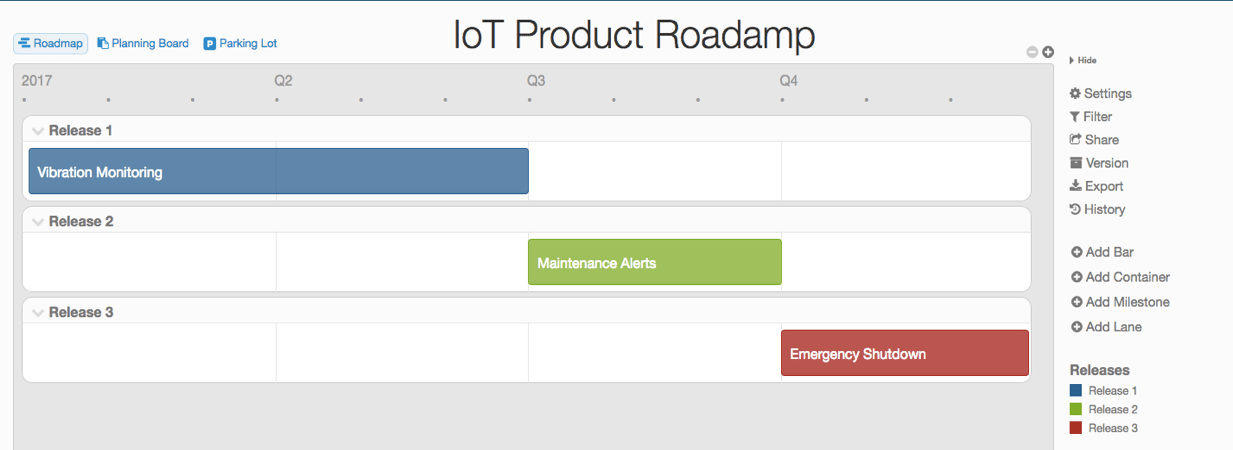
Example of a high‑level product roadmap
At first glance, this roadmap resembles one for a non‑IoT product. The challenge lies in translating each release’s effort and timeline into tangible outcomes that stakeholders can understand. Why does release #1 require six months, while releases #2 and #3 are shorter?
Enhancing Clarity with Story Mapping
To convey the full story, add a layer of detail that maps each high‑level feature to the underlying IoT stack.
Story mapping aligns with the IoT Technology Stack—hardware, embedded software, communications, cloud platform, and cloud applications—providing a visual narrative that is deeper than a backlog but not as granular as sprint planning.
In the smart pump scenario, the story map shows how each release’s features span the stack, clarifying dependencies and effort across teams.
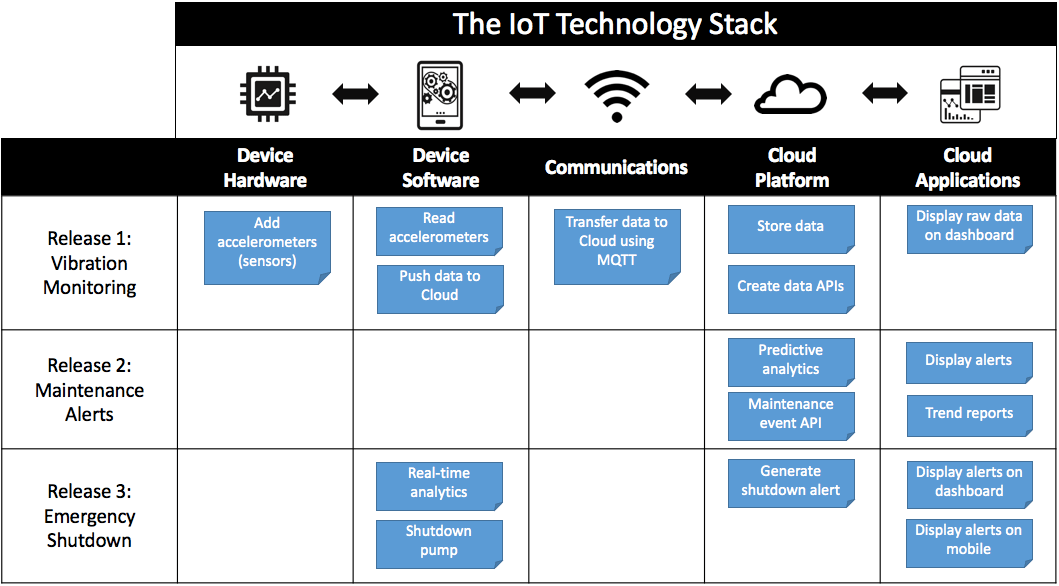
Example of story mapping a product roadmap
Notice that not every stack layer is touched in every release. Release #1, for example, focuses on hardware and foundational communications, setting the stage for the faster, feature‑heavy releases #2 and #3. This explains why release #1 takes longer—establishing the infrastructure first allows subsequent releases to ship more quickly.
Recommended reading: A Product Management Framework for the Internet of Things
Coordinating Engineering Teams with the Roadmap
The story map also serves as a coordination tool across engineering groups. By creating vertical slices, each team can focus on its slice while understanding how it fits into the overall vision.
As illustrated, well‑defined data formats and inter‑layer interfaces enable teams to work in parallel, accelerating delivery without compromising cohesion.
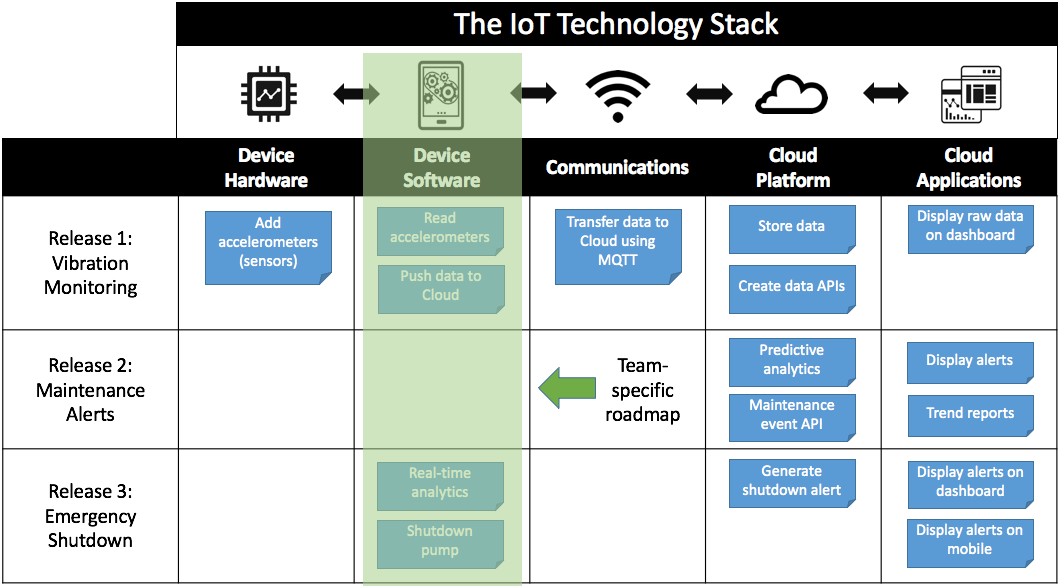
Example of a team‑specific product roadmap
The Bottom Line
Communicating a clear product vision across a company is one of the toughest tasks a Product Manager faces. A well‑structured IoT roadmap turns that challenge into a powerful alignment tool, fostering transparency, better collaboration, and ultimately happier teams and customers.
Enjoyed this guide? Sharing it with your product network would help more people navigate the complexities of IoT roadmapping. Thank you!
PS: This article was originally a guest post for the ProductPlan Blog.
Internet of Things Technology
- Building Sustainable IoT Products: A Practical Guide for Product Leaders
- Choosing the Right IoT Platform: A Practical Guide
- What Is an IoT Product Manager? A Practical Guide to the Role and Skills
- Turning IoT Data into Actionable Insights: A Proven Data Strategy Framework
- Securing Your IoT Product: A Practical Guide to Preventing Hacker Attacks
- Elevate Your Operations: Leveraging IoT Tank Monitoring for Safer, Smarter, and More Profitable Petroleum Management
- How to Build a Profitable IoT Business Model
- Revolutionizing IoT: How Mobile Location Tracking Drives Asset Visibility and Efficiency
- How to Secure Authentic Proposals for IoT Product Development
- 7 Steps to Build a Successful Automation Roadmap