



Turning IoT Data into Actionable Insights: A Proven Data Strategy Framework
In the IoT world, the real value lies in the insights you extract, not the raw data you collect. Too often companies launch devices that generate endless streams of numbers, only to end up overwhelmed and unable to act on them. This article explains why a well‑defined data strategy is essential, shares a hard‑learned lesson from a real project, and outlines how deep industry knowledge can make the difference between a successful product and a costly failure.

Defining Your Data Strategy
At its core, an IoT product is judged by the value it delivers to the customer. If it doesn’t solve a real problem, it fails—regardless of how much data it produces.
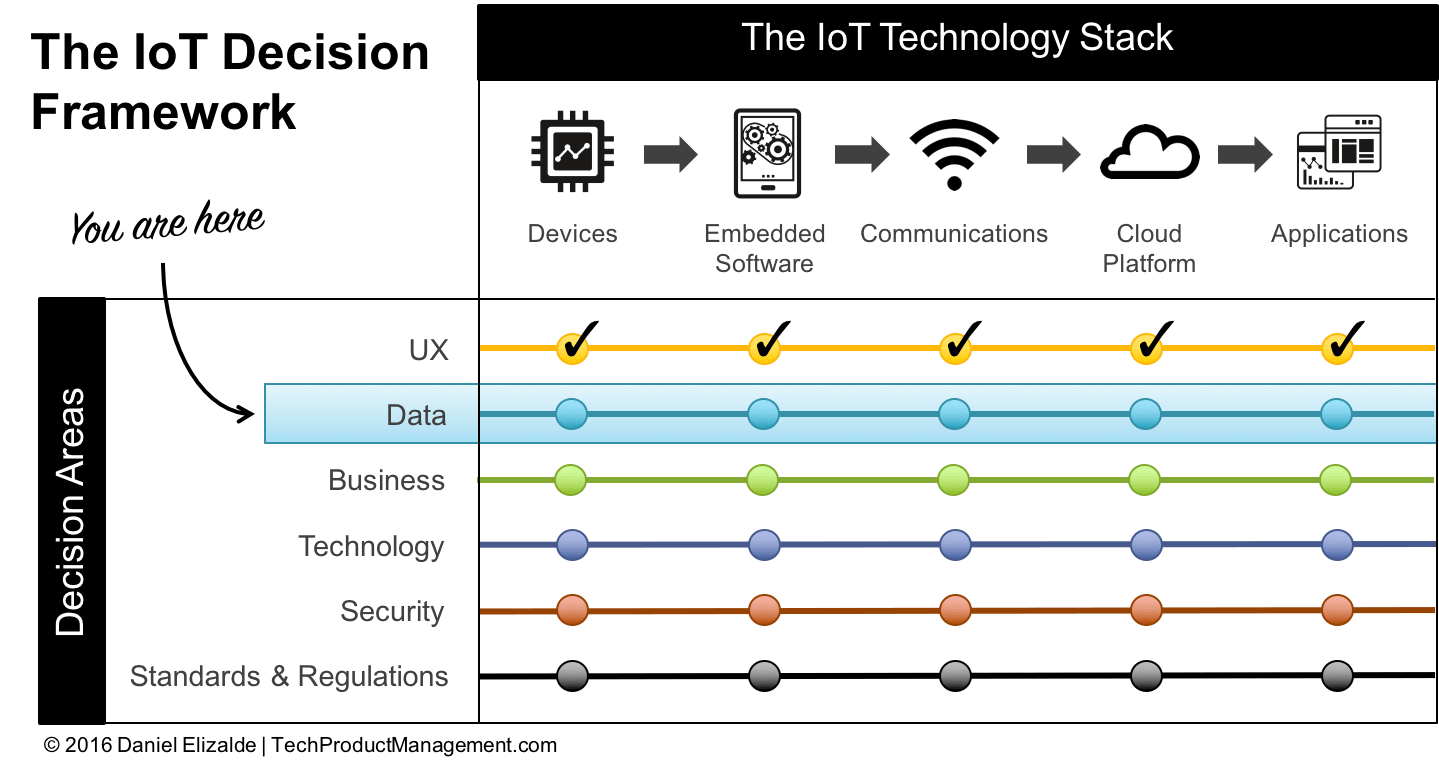
Many teams stumble on the first hurdle: they have no plan for turning data into actionable insight. A data strategy is more than just data capture; it starts with a clear business objective, then walks through the IoT technology stack to decide what data to collect, store, analyze, and share at each layer.
This systematic approach is a key part of the Data Decision Area in the IoT Decision Framework.
The Myth of “More Data Is Better”
Early in my career, I built a turnkey IoT solution for a semiconductor manufacturer. The client—let’s call him Kevin—needed to automate the characterization of new chips, a process that involves running countless input combinations and recording the outputs to ensure they match design models.
While the deployment unlocked unprecedented testing capabilities, a few months later Kevin called me in panic: “We’re drowning in data, and we don’t know what to do with it.” The system produced gigabytes of data every second. A few minutes of operation generated enough information that it would take weeks to sift through, yet the team had no analysts, no processing pipelines, and no way to translate the numbers into decisions.
This experience taught me a hard lesson: deploying sensors and actuators without a data strategy turns your IoT solution into a noise‑generator instead of a value‑creator.
Insights Over Raw Numbers
In hindsight, we should have asked: what decision does Kevin’s team actually need to make? Instead of focusing on visibility, we should have prioritized the extraction of actionable insights—patterns, thresholds, and anomalies that directly inform engineering and manufacturing.
When we returned for phase two, we conducted a full data‑strategy workshop with the entire organization. We discovered that they lacked data‑science talent, had no existing analytics platform, and were overwhelmed by the volume. By filtering out redundant streams, centralizing data in a private cloud, and adding a lightweight analytics layer, we reduced the data footprint and provided real‑time dashboards that the team could use immediately.
Know Your Customer’s Industry
Product managers often jump into unfamiliar markets, but industry knowledge is the secret sauce that turns a generic solution into a tailored success. A classic analogy: a shepherd is approached by a consultant who claims to know how many sheep there are. The shepherd’s skepticism stems from the consultant’s lack of context and the hidden cost of a wrong assessment.
Just as the shepherd’s intuition saved him, deep domain expertise lets product leaders ask the right questions and avoid over‑engineering. In Kevin’s case, our initial lack of semiconductor industry insight meant we designed a system that solved part of the problem but didn’t address the real bottleneck—data overload.
The Bottom Line
IoT products that simply collect data without a clear path to insight leave customers frustrated and the business stranded. Product managers must first understand the customer’s world, identify the most pressing challenges, and then build a data strategy that translates raw numbers into decisive actions.
Internet of Things Technology
- How IoT Data Management Drives Innovation: 4 Key Benefits
- Unlocking IoT Data: How Business Rules Management Drives Enterprise Value
- IoT Data Management: A Practical Guide to Successful Implementation
- Creating a Stakeholder‑Focused IoT Product Roadmap
- 4 Proven Strategies to Seamlessly Customize Your Industrial IoT Product
- Securing Your IoT Product: A Practical Guide to Preventing Hacker Attacks
- Is Your Manufacturing Facility Ready for IoT? A Practical Guide
- Turning IoT Data into Business Value: A Practical Guide
- Harnessing IoT Data for Manufacturing Excellence
- Powering Your IoT Projects to Success