



Mastering Data Acquisition for IoT Product Managers
Data acquisition is the backbone of any IoT solution, translating physical phenomena into actionable digital information. As a product manager, grasping its fundamentals equips you to steer engineering discussions and shape data‑centric product strategies.
While the mechanics of signal capture may seem esoteric to those without a hardware background, a clear understanding of the end‑to‑end workflow empowers you to make informed decisions and advocate for user‑centric features.
Our earlier discussion outlined the four core hardware pillars of an IoT device. Here we zoom in on the most critical component: the Data Acquisition Module.
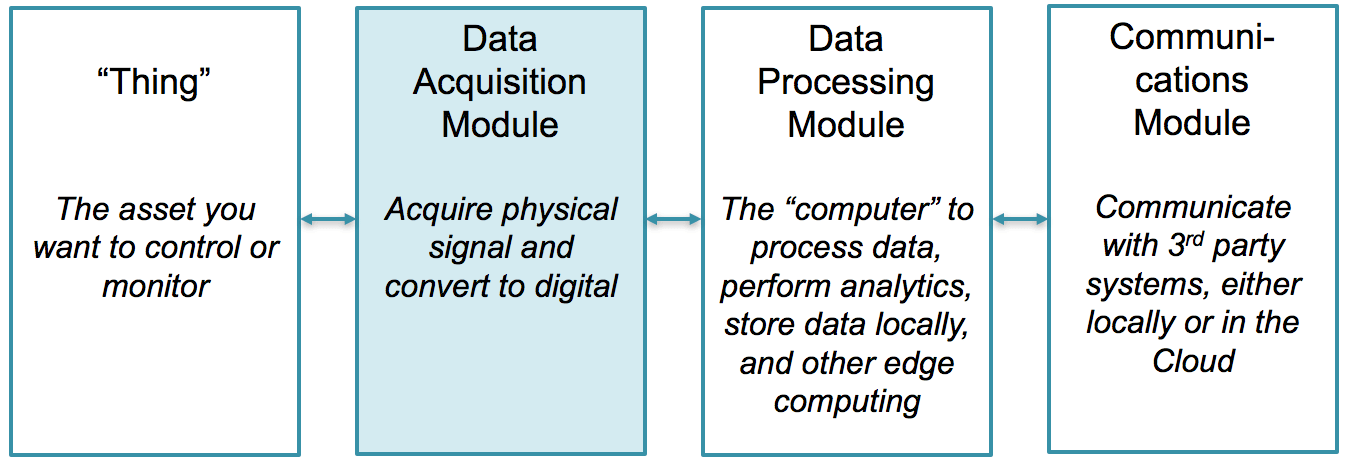
The module’s job is to capture real‑world signals and convert them into digital data that a processor can interpret.
Signals come in two broad categories: discrete and analog. This post focuses on analog signals, the most common in IoT sensing.
What Is an Analog Signal?
An analog signal varies continuously in amplitude or frequency, reflecting changes in the underlying physical phenomenon. For example, temperature fluctuations produce a continuous voltage waveform.
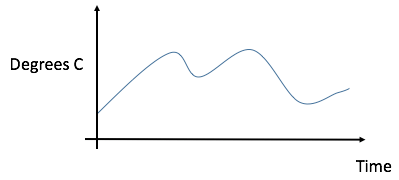
Understanding the nature of the signal you intend to capture is the first step in building an effective data acquisition chain.
From a product‑management lens, the acquisition process can be distilled into five key components:
- Define the target real‑world signal
- Choose the appropriate sensor
- Implement signal conditioning
- Select an analog‑to‑digital converter (ADC)
- Interpret the raw data
1. Define the Target Signal
Before selecting hardware, clarify exactly what you need to measure. Typical examples include:
- Temperature
- Sound
- Humidity
- Vibration
- Light
- Pressure
- Other environmental variables
Don’t jump straight to a sensor. First, determine the physical phenomenon, the specific parameter (e.g., CO₂ concentration vs. oxygen level), and the context in which the data will be used.
Signal Type and Granularity
Be explicit about the measurement target: a specific gas, a temperature range, or a vibration frequency band. Precise requirements guide sensor selection.
Temporal Dynamics
Assess how rapidly the signal changes. Ambient room temperature may vary slowly, whereas engine coolant temperature can fluctuate hundreds of degrees per second. Knowing the rate of change informs the required sampling rate.
Signal Range
Define the expected minimum and maximum values. A room‑temperature sensor may need a 0–40 °C range, whereas furnace monitoring might require thousands of degrees. Range specifications directly impact sensor choice.
2. Choose the Right Sensor
Each analog sensor translates a physical change into an electrical output—usually a voltage or current proportional to the measured quantity. Selecting a sensor that matches your defined parameters is critical.
3. Signal Conditioning
Sensor outputs often need adjustment before they can be fed to an ADC. Common conditioning techniques include:
- DC offset adjustment
- Amplification or attenuation
- Filtering to remove noise
Signal conditioning ensures the signal falls within the ADC’s input range and maintains integrity in noisy environments. Many vendors offer ready‑made conditioning modules; collaborate with engineering to choose the optimal solution.
4. Analog‑to‑Digital Conversion
Conversion is the process of sampling the conditioned analog signal to produce discrete digital values. Two primary parameters determine ADC performance:
- Sample Rate – how many samples per second the ADC takes.
- Resolution – the number of bits per sample, dictating measurement granularity.
According to the Nyquist theorem, a signal must be sampled at least twice its highest frequency to avoid aliasing. For accurate waveform reconstruction, engineers often sample at 10× the signal frequency. For instance, a 100 Hz signal requires a 1 kHz sampling rate.
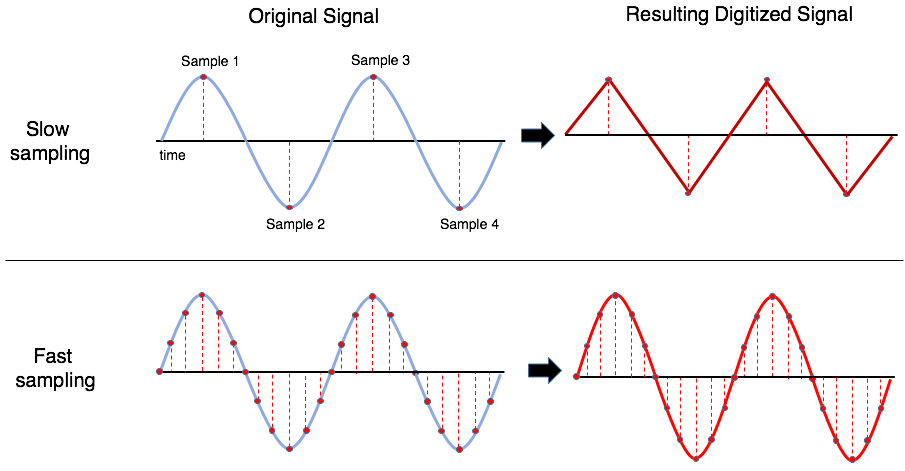
Resolution defines how finely the analog range is divided. An 8‑bit ADC offers 256 discrete levels, whereas a 24‑bit ADC yields 16.7 million levels. Higher resolution allows finer distinctions—critical for precision sensing.
Example: a thermocouple measuring 0–96 °C with a 4‑bit ADC yields a step size of 6 °C (96/16). Using an 8‑bit ADC reduces the step size to 0.375 °C (96/256), vastly improving measurement fidelity.
From a product perspective, sample rate and resolution directly influence data volume. A 24‑bit ADC sampling at 200 kHz generates 600 kB per second from a single sensor—data that must be processed, stored, and transmitted efficiently.
5. Data Interpretation
Raw ADC values must be converted into meaningful units using manufacturer‑provided formulas. This step, often called calibration or interpretation, transforms numbers into actionable insights.
Metadata enriches each data point—timestamps, sensor IDs, device locations, etc.—enabling robust analytics and traceability.
Bottom Line
Data acquisition is indispensable for IoT products, yet it need not be a technical black box. As a product manager, focus on the data strategy: quantity, transfer, and value creation. By understanding the basics of signal capture, conditioning, and digitization, you can guide engineering toward solutions that meet user needs while managing data flow and security effectively.
Internet of Things Technology
- Designing an IoT Data Product UI: 9 Essential Considerations
- How IoT Data Management Drives Innovation: 4 Key Benefits
- Four Proven Steps to Turn IoT Data into Actionable Insights
- 5 Proven Principles for Designing Reliable Wireless IoT Products
- IXrouter: Seamless Edge‑to‑Cloud Connectivity for Industrial IoT
- B2B Product Innovation: A Strategic Roadmap for Product Managers
- A Practical IoT Decision Framework for Product Managers
- Is Your Manufacturing Facility Ready for IoT? A Practical Guide
- Turning IoT Data into Business Value: A Practical Guide
- Top IoT Trends Driving Growth in 2019